Forte Campolongo: An Italian First World War Fortification


Site at a Glance
- Rating
- 4.6
- Popularity
- Low
- Country
- Italy
- Primary era
- Modern
- Eras represented
- Modern
- Civilizations
- Italian
- Site type
- Military
- Remains
- Fort
On this page11 sections
History
Forte Campolongo was an Italian defensive fortification in Italy, built between 1910 and 1914 on Cima di Campolongo to control the Val d’Astico during the years before the First World War. It formed part of the Agno–Assa barrier, a coordinated group of forts and batteries intended to block a valley or strategic route, in Sector III of Schio. The fort covered approximately five kilometres of the valley between Campagna and Lastebasse and supported the Monte Verena fort group from the flank and rear.
Construction and strategic role
Forte Campolongo faced the Austro-Hungarian Lusern armoured fort across the Val Torri, about six kilometres away in a straight line. Together with Forte Verena and Forte Corbin, it formed part of Italy’s direct response to the Austro-Hungarian defensive system. Site-levelling began in July 1910. Four short-barrelled 149 mm guns were brought to the site in April 1911 and placed temporarily, then transferred to two annex batteries after the earthworks were complete.
The front ditch was started on 1 October 1911, interrupted by winter, and resumed the following spring. The cistern and two annex batteries were finished by 1 May 1912. Work was nearly complete by February 1914, and Italy’s Alpini, the country’s mountain infantry, finished the remaining tasks, including the wire entanglements, by September that year. The fort’s construction was overseen by the Italian military engineering corps, which designed and built defensive works such as Campolongo.
Opening of hostilities and destruction
On 24 May 1915, Forte Campolongo opened fire on the Lusern fort. The high rate of fire caused a gun burst in one turret on 30 May. The turret mechanism was badly damaged, two crewmen were killed, and two others were wounded.
Austro-Hungarian forces began bombarding the Italian forts with 30.5 cm mortars on 6 June 1915. Campolongo was judged destroyed and abandoned by the Italian side on 12 June. Its three remaining serviceable guns were removed on 2 July for use in field positions. Before the Austro-Hungarian spring offensive of 1916, an aerial photograph appeared to show that the entrances had been cleared, although snow concealed clear external traces. The Austro-Hungarian forces apparently did not know that the fort had already been disarmed.
From 19 May 1916, Campolongo was shelled by a 42 cm M14 coastal howitzer and 30.5 cm Mortar Battery No. 5. The bombardment reduced the fort to ruins and ended on 22 May, after Austro-Hungarian troops reached the Monte Verena–Cima di Campolongo line. An artillery commission inspected the fort on 23 May in search of usable guns that could be turned against Italian positions, but found none. The tree-trunk decoys mentioned in connection with the inspection were not present either.
Later military assessment and conservation
After the capture, an Austro-Hungarian army report concluded that Campolongo and Monte Verena had no further fortification value. Their long-range batteries and concrete accommodation areas could no longer be used, while their exposed positions would attract enemy fire. Two damp rock passageways and the ammunition magazine were considered intact. Campolongo remained in Austro-Hungarian hands until the end of the First World War.
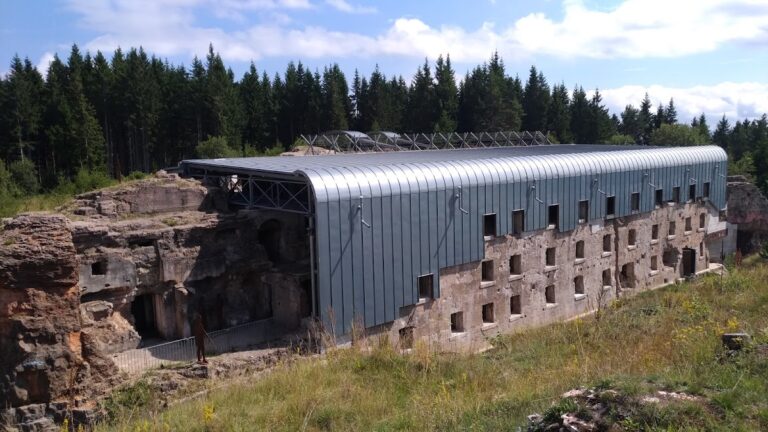
Extensive safety and repair work began in 2005. The fort was subsequently restored through the Ecomuseum of the Great War in the Vicentine Prealps project, preserving the damaged structure as evidence of the fighting on the plateau.
Remains
Mountain setting and defensive layout
Forte Campolongo occupies the 1,720-metre summit of Cima di Campolongo in the northern part of the Seven Communities Plateau, within the municipality of Rotzo in the Province of Vicenza. The position overlooks the Val d’Astico, while steep slopes descend toward the Val d’Assa. The left side of the battery deck borders the steep descent into the Val Torri, giving the fort a naturally protected flank.
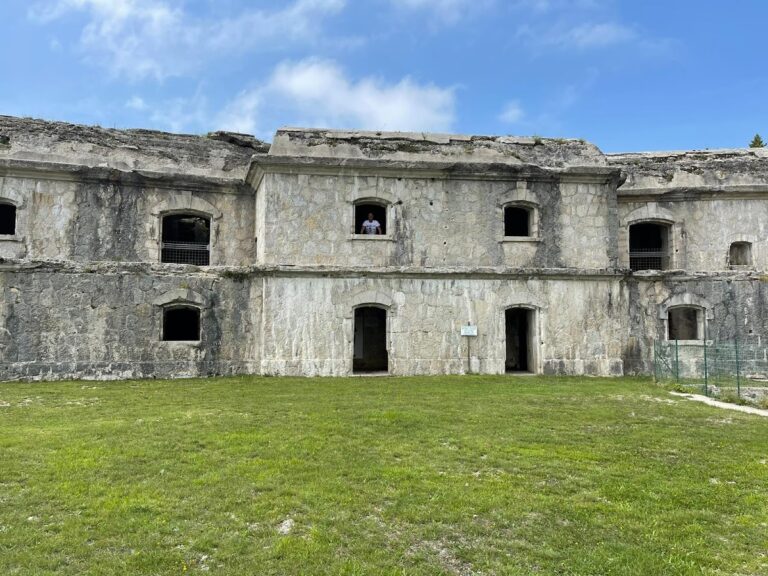
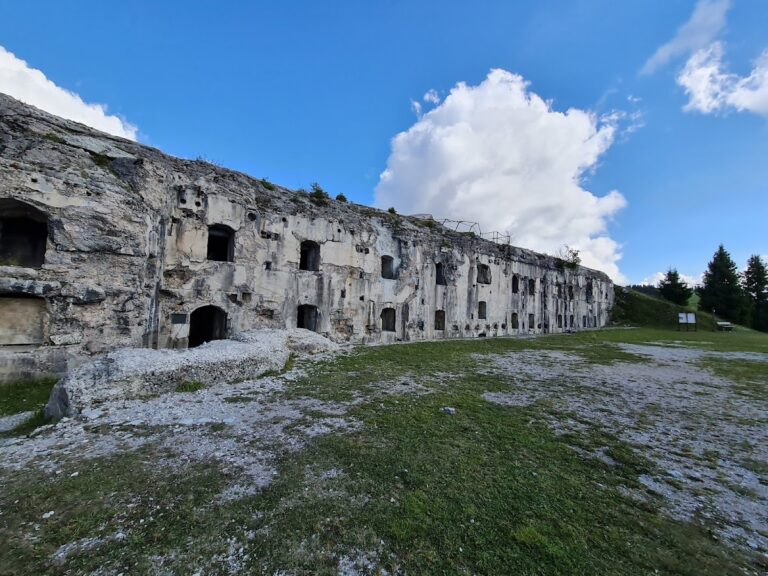
The fort was a straight, two-storey structure aligned from southwest to northeast, with its front directed toward Lusern. Its battery block measured 52 by 13 metres and held four armoured gun turrets and an armoured observation post. The turrets stood in a line, with ten metres between their centres. Above them, the roof was formed by 2.5 metres of unreinforced concrete laid in three layers.
Front ditch and entrance
A five-metre-deep ditch protected the front of the fort. Its outer wall was masonry, topped by a 2.20-metre-high obstacle grille, and the ditch floor was secured by a permanent wire entanglement. Entry passed through a poterne, a covered passage providing access through a fortification, and this entrance was protected by a guard casemate, a protected chamber used for military purposes.
Magazine and barracks
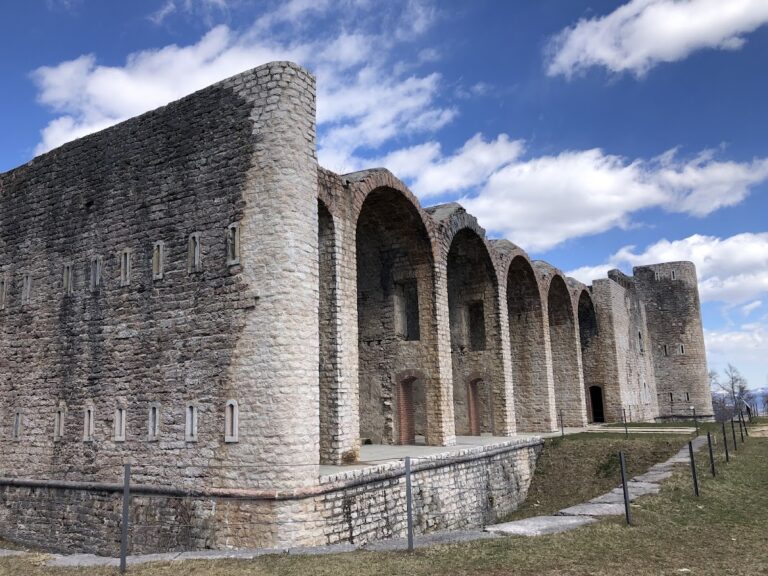
The ammunition magazine lay beneath a ten-metre-thick cover of rock and could be reached from the road passageway. Two ammunition lifts connected the magazine area to the gun positions. Below the fort, a 40-metre-high semicircular retaining wall stood in front of a rock escarpment. This created a small plateau for a barracks, which was connected by another passageway to the road passage and then to the lower storey of the fort. A road also reached the barracks plateau.
Close-defence line
Close defence was provided by an approximately 1.50-metre-high concrete infantry wall. It could be entered through a small open work yard on the right side of the battery block and through the passageway, and it incorporated a small machine-gun platform. An uncovered staircase in the gorge ditch formed the connection between the lower and upper storeys.
Turrets and armament
The original armoured turrets were made by Armstrong, Mitchell & Company at Pozzuoli. Each had an internal diameter of 4.61 metres and was transported in three sections before being assembled at the fort. The armour was 14 centimetres thick, and each turret weighed approximately 22.5 tonnes. The front armour was itself made from several sections.
The first main armament consisted of four Armstrong 149 mm L/35 A guns with steel barrels. Their barrels had a calibre length of L/36.6, or 5.46 metres, and weighed 3.7 tonnes apiece. A 42-kilogram explosive shell could reach 12,400 metres, while a 52-kilogram shrapnel shell, containing 1,057 lead balls measuring 15.2 millimetres in diameter, had a range of 12,000 metres. The defensive armament also included four 75 mm B guns without recoil systems and four machine guns for close defence.
In 1913, the original turrets were replaced by two-part armoured turrets made by Schneider-Creusot. Their shell sections were 15 centimetres thick and mounted on a two-centimetre inner skin. The meeting line between the two halves created a pronounced weak point. The replacement weapons were four Schneider 149 mm L/35 S guns, whose performance matched the earlier guns and whose rate of fire was approximately two rounds per minute.
Bombardment damage
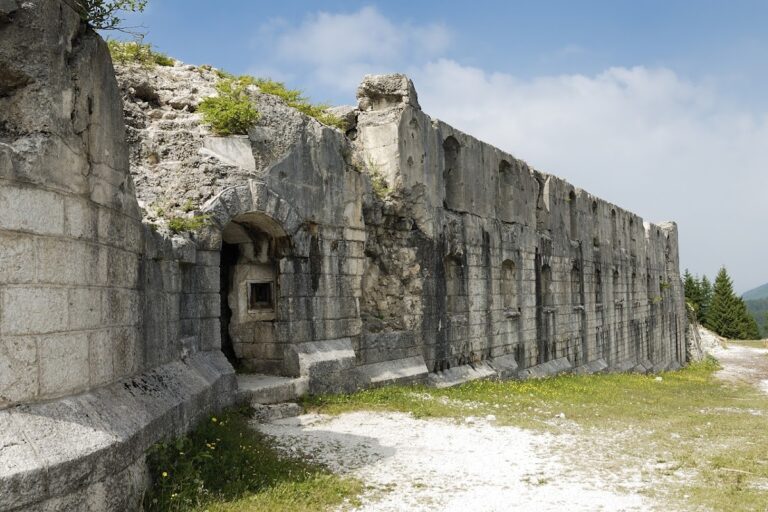
The 1915 and 1916 bombardments caused severe structural damage across the battery block. Concrete in front of the third and fourth turrets was destroyed, their front armour was shattered, the gun wells were exposed at the front and rear, and their traversing mechanisms were wrecked.
A shell passed beneath the front armour of the second turret and exploded inside it, throwing the turret backward onto the roof upside down. A direct hit penetrated the first turret and exploded within it, tearing open its cupola, an armoured rotating gun housing, and leaving the cupola bent forward over the turret shaft. Several direct hits also ripped open the roof of the battery passage. One probable 42 cm shell penetrated the roof behind the first turret and exploded on the passage floor, forcing the passage downward into the cistern. These deformed turrets, broken concrete surfaces, exposed gun wells, and damaged passages define the fort’s present ruined character.