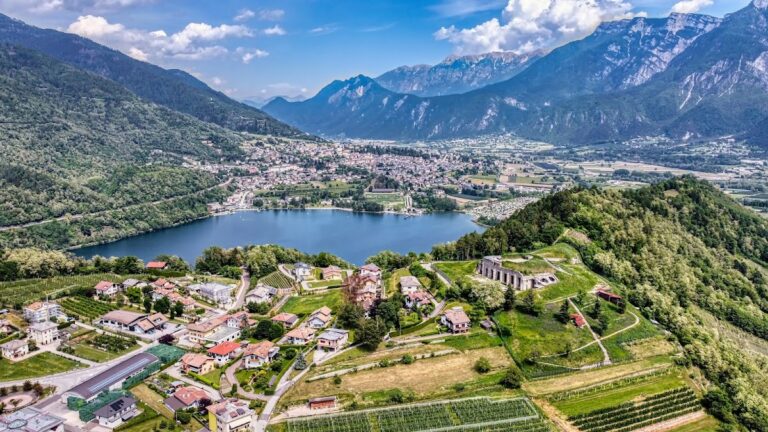
Forte Sebastiano: An Austro-Hungarian Fort in Italy


Site at a Glance
- Rating
- 4.3
- Popularity
- Low
- Country
- Italy
- Primary era
- Modern
- Eras represented
- Modern
- Civilizations
- Habsburg
- Site type
- Military
- Remains
- Fort
On this page14 sections
History
Forte Sebastiano is an Austro-Hungarian First World War fort in Italy, near Folgaria, built between 1910 and 1913 as part of the Folgaria–Lavarone defensive barrier. Originally called Werk Cherle and also known as Forte Cherle, it guarded the imperial border against a possible advance from the neighboring plateau of the Sette Comuni.
Construction and military role
Planning began in 1909 under First Lieutenant E. Luschinsky, while construction was later supervised by Captain Karl von Barta. The planned cost was 1,600,000 crowns, but the completed work cost 1,682,000 crowns. Forte Sebastiano became the third armed strongpoint of the Folgaria barrier.
The fort was renamed San Sebastiano because Werk Cherle could be confused with nearby Forte Verle. The new name referred to the hamlet of San Sebastiano, about 2 km to the northeast. The fort controlled the road between Passo Tonezza del Cimone and Folgaria. With Werk Sommo to its right, it covered the Valle Orsara; with Werk Gschwent to its left, it covered the Val d’Astico and the road from Arsiero to the plateau.
Captain Edmund Proksch was the fort’s first commander and remained in command during the First World War. Its standard establishment was five officers and 128 men, but the actual garrison consisted of three officers and 236 men. The number temporarily rose to about 400, including Landsturm personnel, members of the Austro-Hungarian territorial reserve force who sought shelter within the fort.
The emergency garrison included a detachment of the Imperial-Royal State Rifle Regiment Bozen No. II, the 2nd Company of Fortress Artillery Battalion No. 1 from Tenna under Lieutenant Colonel Ludwig Pengov, and the 1st to 4th Companies of Fortress Artillery Battalion No. 8 from Haidenschaft and Wippach under Colonel Alfred Langer.
Forte Sebastiano in the First World War
Between 24 May 1915 and 22 May 1916, the fort fired 21,647 10 cm shells at Italian positions. It fired another 5,105 shells between 15 and 18 May 1916 in support of the Austro-Hungarian offensive.
The fort stood outside the principal sector of the Italian infantry attacks, but it came under heavy artillery fire. Twenty-eight-centimeter howitzers at Monte Campomolon, together with two more guns in the courtyard of the unfinished Forte Campomolon, fired approximately 3,400 shells at it. A battery on Monte Toraro added about 10,000 rounds from 14.9 cm field artillery against the access road and the 20 cm front armor of the casemate howitzers. The armor was struck repeatedly but was not penetrated because armor-piercing ammunition was unavailable. Continuous repairs prevented serious damage to the concrete roof.
In June 1915, experience gained from the bombardment of Werke Verle and Lusern prompted the construction of a 120 m underground access gallery alongside the access road. It led from the traditor battery, a protected artillery position intended to fire along the side or rear of an attacking force, and was completed on 11 October 1915. Rock shelters were also excavated beneath the fort to protect against 30.5 cm shells, while another passage was cut through the bedrock to the counterscarp gallery, a defensive passage built into the outer wall of the surrounding ditch.
By 17 December 1915, replacement positions for the turret howitzers had been prepared outside the main fort. Changed circumstances after June 1916 made these positions unnecessary, and Forte Sebastiano remained operational until the end of the war.
Abandonment and later damage
After the Austro-Hungarian forces abandoned the fort, Italian troops occupied it in November 1918. Royal Decree No. 1882, issued on 12 August 1927, removed the fort from the military works and arranged its lease to the Municipality of Folgaria for 29 years from 1 January 1931, together with Forte Sommo Alto and Forte Dosso del Sommo. It became municipal property on 18 May 1935.
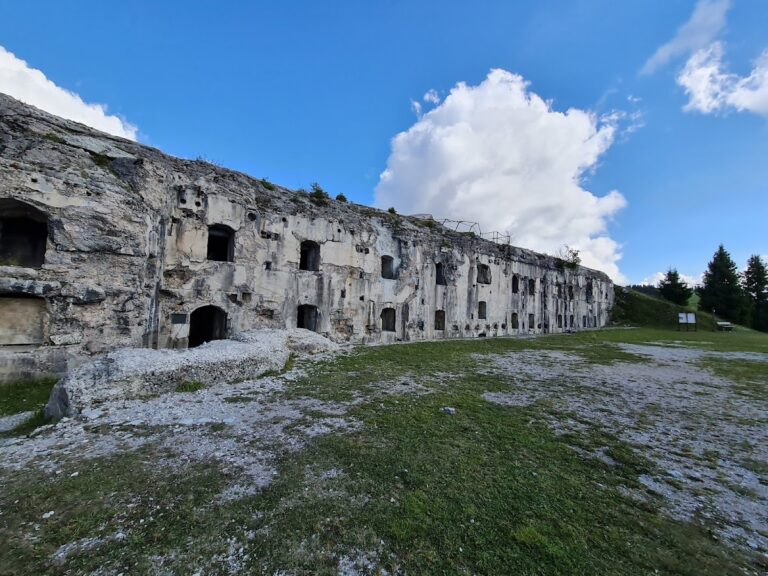
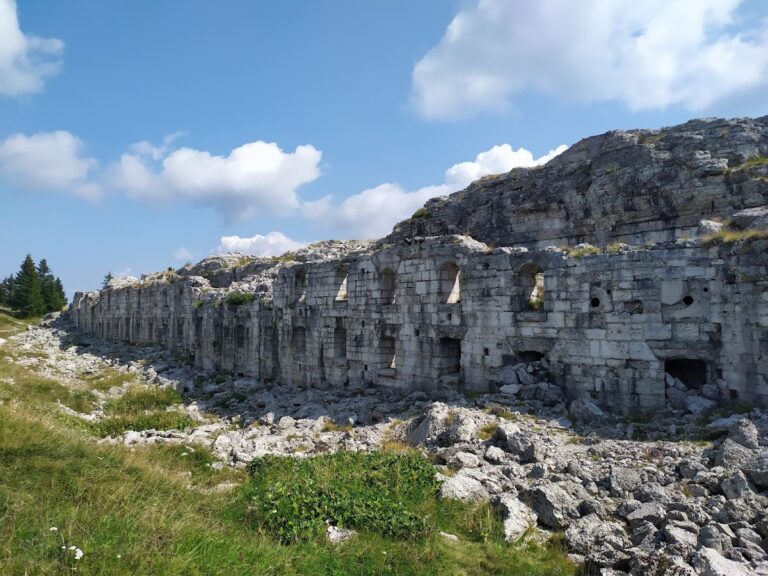
During the 1930s, the armored cupolas were dismantled and their steel was blasted out with explosives. This took place during the League of Nations steel embargo against Italy, imposed in response to Italy’s war in Abyssinia. The casemate block collapsed after the removal of its armor, while the battery block was reduced to a heap of rubble.
Extensive clearing began in 1990. Restoration during the late 1990s opened parts of the gallery system, although some sections may be flooded. The fort remains partly accessible in a heavily damaged condition and is owned by the Municipality of Folgaria.
Remains
Forte Sebastiano occupied a ridge southeast of Passo del Sommo, at 1,445 m above sea level and about 2 km from the former Italian border. Its triangular plan was set into the natural rock on the Folgaria plateau near Prima Posta. The battery block and casemate block were separated to limit the effects of bombardment and joined by a protected passage called a poterne. The centers of the armored gun cupolas were 24 m apart.
Main fortification blocks
Casemate block
The casemate block had a ground floor, an upper floor, and a combat or battery floor. It contained an armored observation cupola, two armored machine-gun positions, and the traditor battery. The two 10 cm M.12 casemate howitzers in this battery had 20 cm front armor. Their position was designed for fire along the side or rear of an attacking force. After the armored steel was removed and blasted out during the 1930s, the casemate block collapsed.
Battery block
The single-storey battery block held four armored gun cupolas and two armored machine-gun positions. Its armament consisted of four 10 cm M.9 howitzers in rotating turrets, two 10 cm M.12 casemate howitzers, two 60 mm M.10 guns, and 17 M.07/12 machine guns. Two 35 cm searchlights and six 21 cm searchlights supported the fort’s defensive operation. The battery block now survives as a demolished mass of rubble.
Ditch and underground defenses
Fortification ditch
A ditch surrounded the fort, measuring 6 m deep and 8 to 9 m wide. At the projecting angle on the right side of the front ditch stood a two-storey counterscarp gallery, a ditch-defense passage and firing position. It was connected to the battery block by a poterne, meaning a protected underground or covered passage between parts of a fortification.
Access galleries and shelters
The 120 m underground access poterne ran parallel to the access road from the traditor battery. Additional rock caverns beneath the complex provided protected shelter for the garrison. A later passage was bored through the bedrock to the counterscarp gallery. Parts of this gallery system remain accessible.
Associated military remains
Scala dell’Imperatore
Near the fort is the Scala dell’Imperatore, or Emperor’s Stairway, a long stone staircase that formerly led to a military hospital. The hospital survives only in ruins.
Military cemetery
A former military cemetery is also located near Forte Sebastiano, forming part of the military landscape associated with the fort and its wartime setting.