Fortress Campo Luserna: An Austro-Hungarian Frontier Fort in Italy


Site at a Glance
- Rating
- 4.3
- Popularity
- Low
- Country
- Italy
- Primary era
- Modern
- External website
- Open
- Eras represented
- Modern
- Civilizations
- Habsburg
- Site type
- Military
- Remains
- Fort
On this page14 sections
History
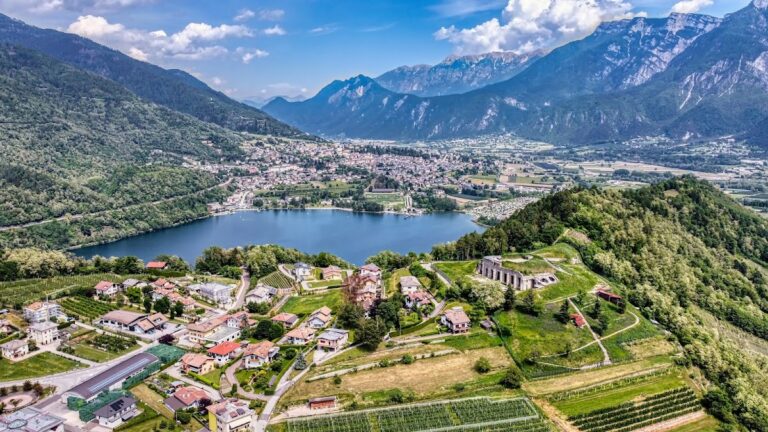
Fortress Campo Luserna was an Austro-Hungarian fortified work in Italy, built between 15 July 1908 and 30 October 1912 on the frontier with Italy. It formed part of the Lafraun, or Lavarone, defensive sector and the wider defensive group known as the Sperrgruppe on the Plateau of the Seven Communities. Positioned on the Costa-Alta ridge northeast of Luserna, it was the group’s most advanced work and covered the Val d’Astico, Valle Rio Torto, and Val Torra.
Construction and military role
The fortress was planned by Captain E. Lacom, also recorded as Lakom. Construction was estimated to cost 1,605,400 crowns, although the final cost reached 2,259,648 crowns. Its position at about 1,548 to 1,549 metres above sea level allowed it to control approaches across the valleys. The Val Torra separated Campo Luserna from the Italian Forte Campolongo, about 6 kilometres away.
In wartime, the principal work was assigned 3 officers and 247 non-commissioned officers and soldiers. The nearby Oberwiesen installation had 1 officer and 33 other personnel, while Viaz had 1 non-commissioned officer and 22 soldiers. A separate listing gives a total garrison of 312 men, including the commander, other officers, ordinary soldiers, mountain infantry, a medical officer, telephone operators, trench workers, servants, and orderlies.
The planned garrison included mountain infantry from the Imperial-Royal Landesschützen Regiment “Trient” No. I, fortress artillery from Trento and Chiesa di Lavarone, and locally organized Standschützen rifle formations from Merano and Kitzbühel. The Landesschützen were specialized Austro-Hungarian mountain infantry, while the Standschützen served in locally organized territorial units. When Italy entered the war, these assigned formations were on the Eastern Front, so Campo Luserna initially depended on emergency detachments from the Bozen Landesschützen Regiment No. II and Fortress Artillery Battalions Nos. 1 and 8.
The crisis of May 1915
First Lieutenant Emanuel Nebesar commanded Campo Luserna when war began. He had previously served in a fortress searchlight unit, and First Lieutenant Schaufler later succeeded him. Italy began heavily bombarding the fortress on 25 May 1915, no later than two days after declaring war. By 28 May, roughly 700 shells from 280-millimetre guns and 600 from 149-millimetre guns had been fired at the position. About 950 shells landed within the fortress grounds, around 320 struck the concrete roof, and four hit armoured components.
On 28 May, Nebesar decided that the fortress could not be held. He ordered parts of its guns and equipment disabled, raised a white flag, and evacuated the work with its garrison. Major Jelinek, the sector commander, had approved the evacuation without consulting higher commands. The neighbouring forts Verle and Gschwent immediately fired on the area around Campo Luserna to prevent Italian occupation. Italian infantry attacks from the trenches were repulsed, and the former garrison retook the fortress after about an hour under Schaufler’s command. Otto Jöchler, a Standschützen patrol leader, removed the white flag and later received the Silver Medal for Bravery.
Nebesar was arrested and faced four military proceedings. Three convictions were annulled on procedural grounds. A later acquittal, based on incapacity attributed to explosive gases, was overturned by the supreme military appellate court, but no further trial took place before the war ended.
Bombardment and wartime adaptation
Repairs linked to the evacuation order continued until 13 June 1915. Heavy Italian fire continued at reduced intensity until 30 June, after which the 280-millimetre howitzers stopped firing. Italian turrets at Monte Verena and Campolongo then maintained mainly harassing fire. From 28 July to 8 August, Campo Luserna took part in the bombardment of Forte Campolongo. During the same period, Austro-Hungarian 305-millimetre mortars also attacked Campolongo and eventually suppressed it.
From 31 July, workers placed gravel-filled gabions on the roof to form a protective layer against shell fragments. Between 4 and 27 August, a tunnel about 60 metres long was driven from the lower level of the casemate block toward the first hairpin bend of the fortress road. It initially helped provide fresh air and was later enlarged to contain accommodation, magazines, and a telephone room.
A second major bombardment began on 15 August and lasted until 31 August 1915. Around 3,000 heavy-calibre shells were fired at Campo Luserna, while approximately 2,000 replacement shells had to be brought forward for the fortress’s own artillery during those two weeks. The fort returned fire against Italian batteries on Monte Verena and Monte Angaro and helped repel the Italian attack on the Basson infantry position on 24 August.
The bombardment killed Lieutenant Sölder von Prankenstein, commander of the Traditor battery, on 24 August. An ensign, Felix Schwefel, died the same day when fragments entered the listening and observation post. Two other men were killed when a shell struck the protected exit from the battery block on 18 August, and another was wounded when the upper casemate level was penetrated on 23 August. Landsturm labour formations also suffered heavy losses while repairing roof craters with rapidly setting concrete. The Landsturm was the Austro-Hungarian territorial reserve, used chiefly for local military duties.
Reduction of the artillery and later repairs
Between 8 September and 16 October 1915, howitzers II, III, and IV were removed and placed in temporary positions about 200 metres southeast of Malga Cost’Alta, known as Battery Cost’Alta. Turret III was abandoned and its entrance sealed with concrete. Turret I and the Traditor guns remained operational through the winter. One 6-centimetre trench-defence gun was moved to a higher level, while the other went to a field position north of the fortress.
Repaired gun positions were rearmed from March to April 1916, and howitzers II and IV were reinstalled between 7 March and 13 April. Campo Luserna used harassing fire to conceal Austro-Hungarian troop movements and to draw fire from Italian batteries, revealing their positions. A third bombardment lasted from 9 April to 20 May 1916. About 860 shells from 280-millimetre guns and 100 from 305-millimetre guns fell in the immediate vicinity.
After the Austro-Hungarian spring offensive pushed the front southward, Italian howitzers could no longer reach the fortress, which entered a second major repair phase. The roofs of the casemate and battery blocks were strengthened with up to 3.5 metres of concrete. Turret II was repaired. Turrets I and IV were reinstalled without their howitzers because their rotation mechanisms could not be restored, and machine guns were placed in their firing openings. Turret III became a stairway and searchlight position after the original route from the battery block to the roof had been destroyed.
By November 1916, Campo Luserna was partly ready for defence, but its remaining howitzers were eventually transferred to field positions near the front. Only the two Traditor guns and the 6-centimetre gun in the upper trench-defence level remained at the fortress. The garrison suffered 23 deaths. Wartime damage included 50 hits on armoured components, 20 hits on turret cupolas, five hits on rotating observation posts, and 16 penetrations of the concrete roofs. The fortress saw no further fighting before the end of the war.
Demolition and conservation
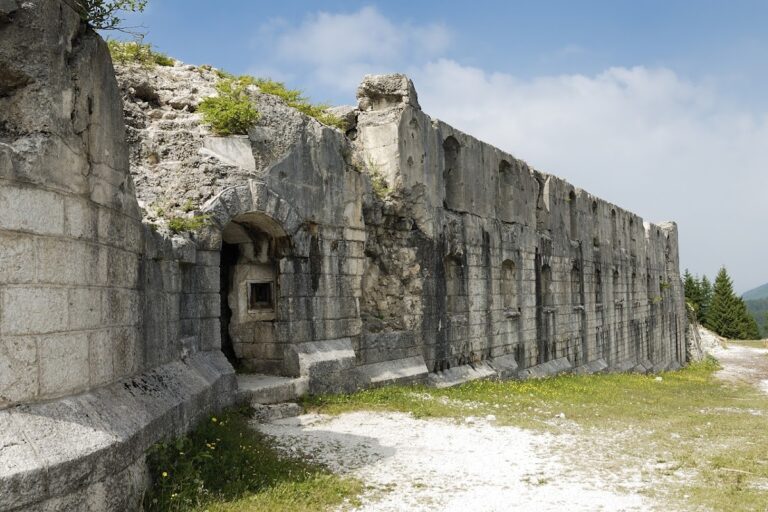
After the war, Campo Luserna passed into Italian state ownership and was removed from the list of military properties in 1927. In response to the steel embargo imposed on Italy by the League of Nations because of its war against Ethiopia, steel components were removed from the fortification. The municipality of Luserna acquired it on 3 June 1935, and demolition blasting began on 16 June. The upper level of the casemate block, the battery block, and the Viaz and Oberwiesen installations were completely demolished.
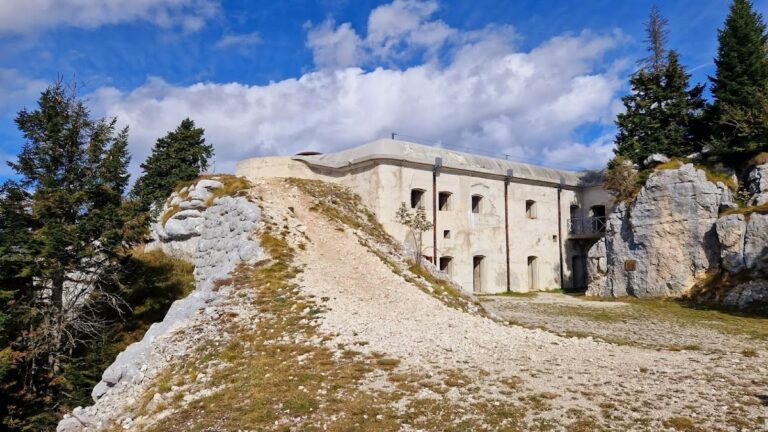
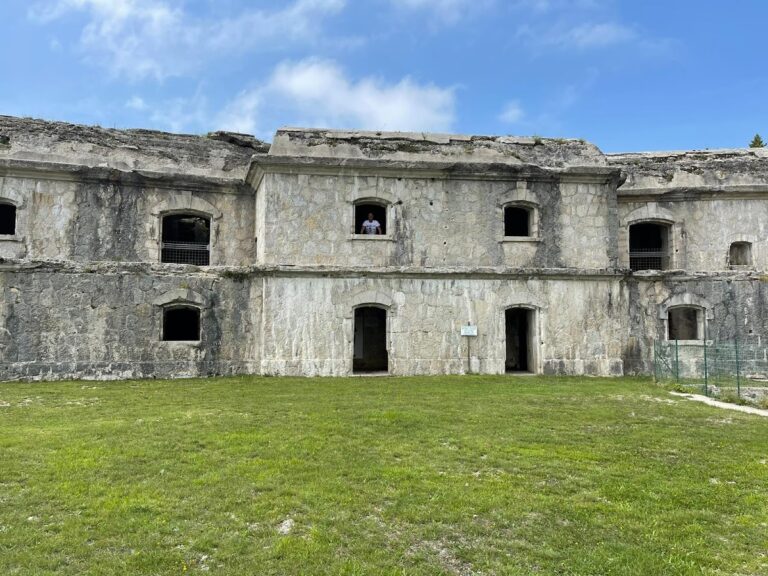
Clearance, recovery, and safety work at the fortress and its two outposts began again in 1990 through cooperation between the municipality of Luserna and the Employment Office of the Autonomous Province of Trento. A recovery and restoration campaign lasting almost 20 years involved the Autonomous Province of Trento, the Trentino–South Tyrol region, and the municipality. Conservation restoration in 2014 added a steel roof to protect the surviving structures from weather. The municipality owns the site, which is partly walkable and presented as an open-air museum. A peace monument was erected in the early 1990s, and in August 1993 the fortress hosted an Italian-Austrian peace meeting.
Remains
Main fortress
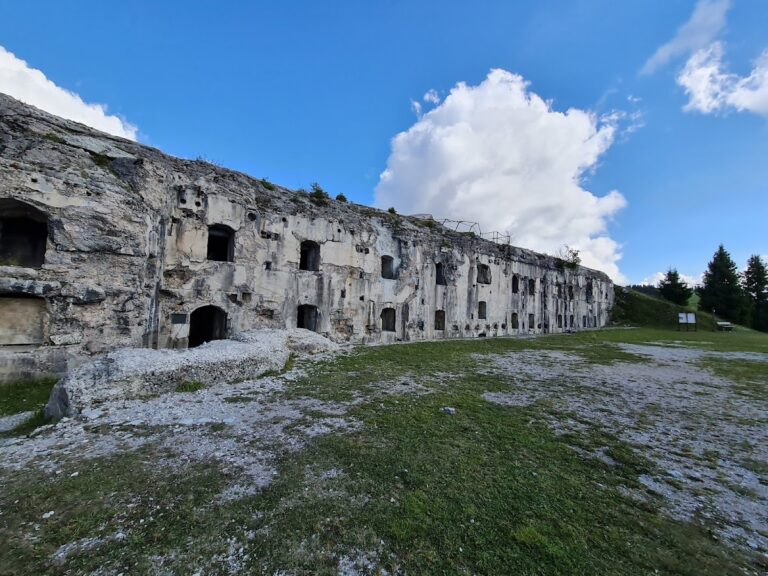
The principal work stood on the Cima Campo, or Monte Bisele, height and formed an angle of about 45 degrees. Its longer arm was the battery block, aligned exactly north to south with its front facing east. The complex occupied more than 200,000 cubic metres. Built mainly of concrete, with iron reinforcement in places, it incorporated armoured structures cut into the living rock and was less dispersed than later fortress designs.
Casemate and battery blocks
The casemate is a fortified enclosed chamber for guns or troops. At Campo Luserna, the casemate block had three levels. Its two upper levels joined the left shoulder of the battery block, which existed only at those levels. The upper level continued into the battery block, while the middle level contained the Traditor battery, a flank-defence battery designed to fire along the side or rear of an adjacent defensive sector. The lowest level was smaller and did not extend into the battery block.
The principal armament comprised four 10-centimetre M.9 howitzers in rotating armoured turrets. An armoured flank battery facing the neighbouring work at Verle held two 8-centimetre M5/9 guns with small firing openings. Two 6-centimetre M10 guns in the front-ditch caponier provided close defence. A caponier was a protected structure projecting into a fortress ditch so defenders could fire along the ditch.
Ditch and close-defence positions
A ditch surrounded the main work, reaching up to 10 metres in width and 8 metres in depth. The caponier at its front point defended both the front ditch and the ditch along the right flank. Close defence also used four armoured casemates, each containing two Schwarzlose machine guns, three armoured cupolas with two machine guns each, two rotating observation posts with one machine gun each, and three wall loopholes with one machine gun each. The fortress had 19 machine guns in total.
Four 21-centimetre searchlights illuminated the fortress, while Oberwiesen had a further 35-centimetre searchlight. Wartime fire damaged the armoured turrets, observation posts, concrete roofs, and internal passages. Shell craters were filled with rapidly setting concrete, and later repairs added up to 3.5 metres of protective concrete to the roofs. The converted remains of turret III replaced the former roof access from the battery block, serving as a stairway and searchlight position, while the abandoned turret entrance was sealed with concrete.
Independent outposts
Oberwiesen
Oberwiesen stood west of the main work at about 1,517 metres above sea level. It was a self-contained observation and infantry-defence installation controlling the Val d’Astico. Optical communication connected it with the observation post on Monte Rust and with the Belvedere-Gschwent and Sebastiano-Cherle forts.
The outpost included a fixed armoured structure cut into the rock, a rotating observation cupola with a machine gun, and rapid-fire weapons in two metal barracks. Its 35-centimetre searchlight supported the observation and defensive role. Demolition later destroyed the installation, along with the upper casemate level and battery block of the principal work.
Viaz
Viaz stood east of Campo Luserna at about 1,507 metres above sea level. It controlled the Malga Campo clearing and the Torra valley and formed the most advanced position toward the Italian lines. Built in concrete and excavated into the living rock, it contained a fixed armoured cupola with two machine guns.
A tunnel approximately 210 metres long connected Viaz directly with the fortified area near Oberwiesen. From the outpost, the Italian Forte Casa Ratti in the southern Val d’Astico, about 10 kilometres away, could be seen. Viaz was completely demolished during the twentieth-century blasting campaign.
Supporting structures
The officers’ barracks stood behind the fortress and accommodated the commander and seven officers, including two officers of the Trient Landesschützen Regiment and a medical officer. A separate tunnel, about 453 metres long, connected the barracks directly to the fortress. The wartime alterations also left the enlarged lower-level tunnel, which incorporated accommodation, magazines, and a telephone room after its original construction as an air passage.