Montgomery Castle: A Norman Border Fortress in Wales


Site at a Glance
- Rating
- 4.6
- Popularity
- Low
- Country
- United Kingdom
- Primary era
- Medieval
- External website
- Open
- Eras represented
- Medieval, Early Modern
- Civilizations
- English
- Site type
- Military
- Remains
- Castle
On this page15 sections
History
Montgomery Castle, also known as Castell Trefaldwyn, is a Norman border fortress in Wales, United Kingdom, built by the English crown in 1223 on Castle Hill above Montgomery. Its position in the Welsh Marches, the frontier zone between the English kingdom and the principality of Wales, made it a military and administrative centre during repeated conflicts before the area was largely pacified in the early fourteenth century.
Hen Domen and the Earlier Lordship
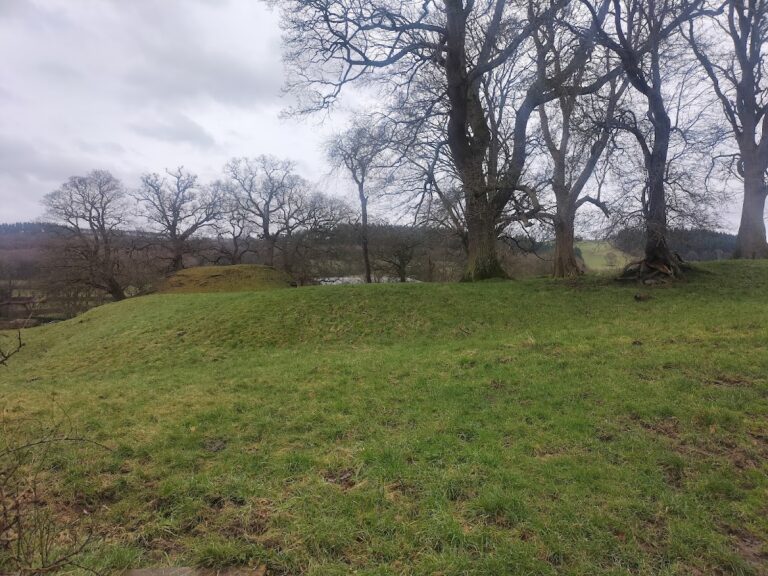
The castle replaced an earlier motte-and-bailey fortress called Hen Domen, built for Roger de Montgomery, Earl of Shrewsbury, between 1071 and 1074. A motte-and-bailey consisted of a raised earthwork mound carrying a fortified enclosure and an adjoining defended yard, or bailey. Hen Domen stood about 1,500 metres northwest of the present castle, where it controlled an important ford across the River Severn.
Prince Cadwgan ap Bleddyn and his brothers captured Hen Domen in 1093. After Roger’s son, Robert of Bellême, rebelled in 1102, Henry I granted the fortress to Baldwin de Boulers. His name gave rise to the Welsh designation Trefaldwyn, meaning “Baldwin’s Town.” The de Boulers family, later known as Bowdler, held Hen Domen as the centre of a small lordship in the Welsh Marches until about 1214 or 1215, when Prince Llywelyn ab Iorwerth captured and destroyed it.
After 1223, Hen Domen was rebuilt and strengthened as an outpost of the new royal castle. It was abandoned and fell into decay around 1300, after Edward I’s conquest of Wales. Excavations at Hen Domen and the later Montgomery Castle are represented by permanent exhibitions and scale models at The Old Bell Museum in Montgomery.
The Royal Castle and the Welsh Frontier
Following a successful campaign against Llywelyn ab Iorwerth, the royal justiciar Hubert de Burgh ordered a new castle in 1223 to secure the English-Welsh frontier. Construction began on a new site southeast of Hen Domen on the sixteenth birthday of Henry III, king of England from 1216 to 1272. The first defences were made provisionally from timber and were soon replaced with stone. The inner ward, including its gatehouse, was complete by 1228, when the castle came under Hubert de Burgh’s administration.
A Welsh attack led by Llywelyn ab Iorwerth failed in 1228. The middle and outer wards were then added, and the walls and gatehouse of the middle ward were complete by 1253. A fortified settlement grew beside the castle, and Montgomery received a Royal Charter in 1227. It is regarded as the oldest borough in Wales.
Hubert de Burgh probably shaped the castle’s design. He had defended Chinon and Dover during sieges and was involved in building or rebuilding Skenfrith, Grosmont, and White Castle. After his fall from power in 1232, Montgomery returned to royal administration.
Wars of the Thirteenth Century
Montgomery was repeatedly drawn into the Anglo-Welsh War of 1231 to 1234. A Welsh force was ambushed and defeated near the castle in May 1231, but a retaliatory attack burned the town in June without taking the fortress. In September 1233, another Welsh assault damaged the well tower. The tower was later repaired and given a new roof.
During the war of Dafydd ap Llywelyn, the successor of Llywelyn ab Iorwerth, Welsh forces burned the town again in early 1244. In February 1245, however, the town’s inhabitants defeated a Welsh force within sight of the castle walls. War resumed under Llywelyn ap Gruffudd, the grandson of Llywelyn ab Iorwerth and the last Welsh ruler widely recognized as Prince of Wales. His forces burned Montgomery in March 1257, while the castle resisted attack. Parts of its garrison were ambushed and killed during sorties into Wales in January and May of that year.
During the Second Barons’ War, a conflict between supporters of the English monarchy and rebellious barons, a force led by Roger Mortimer of Wigmore took refuge at Montgomery in summer 1264. In September 1267, the castle hosted Llywelyn ap Gruffudd’s homage to Henry III and celebrations connected with the Treaty of Montgomery. The negotiations took place at Shrewsbury, and the treaty recognized Llywelyn’s position as Prince of Wales.
The construction of Dolforwyn Castle led to further strengthening at Montgomery. A kitchen and brewhouse were added in the inner ward during this period. In December 1282, the castle served as a mustering point for the English army advancing towards Builth Wells during Edward I’s conquest of Wales. Edward I, who reigned from 1272 to 1307, completed the English conquest of Wales. The campaign ended with Llywelyn ap Gruffudd’s defeat and death at the Battle of Orewin Bridge.
In early 1295, part of the English army of the Earl of Warwick assembled before Montgomery and defeated Welsh rebels at the Battle of Maes Madog. After the Welsh revolt of 1294 to 1295 was suppressed, the castle lost much of its military importance. It was neglected and used mainly as a prison. The Mortimer family acquired it in the fourteenth century.
Later Occupation and Destruction
During the rebellion led by Owain Glyndŵr, a major Welsh revolt against English rule in the early fifteenth century, his forces captured, plundered, and burned Montgomery in 1402. The castle resisted the attack, although the town remained largely ruined until the early seventeenth century.
After Wales was incorporated more closely into the English state under Henry VIII, Rowland Lee oversaw new residential buildings in the inner and middle wards. Lee was Bishop of Coventry and Lichfield and served as president of the Council of the Marches from 1534 to 1543. The Council was a government body responsible for justice and administration in the border counties.
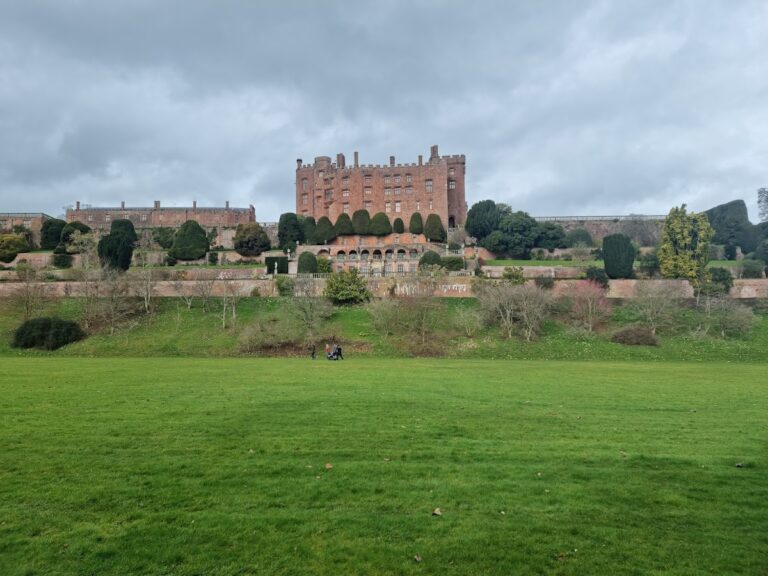
From 1622, Sir Edward Herbert commissioned John and Samuel Scampion to build an elaborate three-winged mansion of brick and timber framing in the middle ward. The castle became a Royalist stronghold during the First English Civil War, a conflict between supporters of the Stuart monarchy and Parliamentarian forces. A Royalist garrison occupied it in 1643 for Charles I under the elderly Lord Herbert of Cherbury.
Parliamentarian forces commanded by Sir Thomas Myddelton and Thomas Mytton captured the castle in September 1644. The Battle of Montgomery followed on 17 and 18 September. On 18 September, Royalist forces under John Byron attempted to recover the fortress but were defeated by Parliamentarian forces under Myddelton, Mytton, and John Meldrum. It was the largest battle of the war in Wales and a major Parliamentarian victory.
Sir John Pryce, the new Parliamentarian governor and a former Royalist, changed sides again in May 1645. During the Second English Civil War, Parliament ordered the castle’s complete demolition in 1649 to prevent its military reuse and reduce the need for garrisons. The Herbert mansion was destroyed as well, despite opposition from the second Lord Herbert, who had inherited the title in 1648. The ruins were later used as a stone quarry, and much of the remaining masonry collapsed in 1800. Montgomery Castle is now a Grade I listed building and a Scheduled Monument.
Remains
Hilltop Fortress and Wards
Setting and Defensive Layout
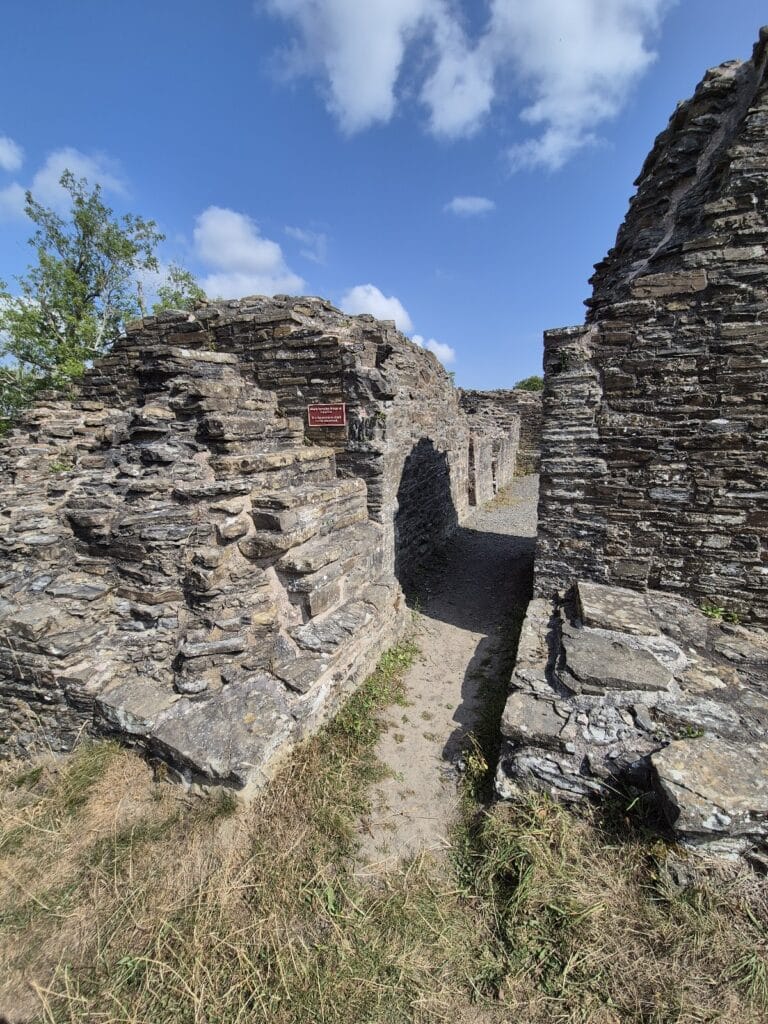
The surviving ruins stand west of Montgomery on Castle Hill, a basalt outcrop with steeply falling sides on three sides. The stone fortress was arranged in an inner ward, a middle ward, and a smaller outer ward. Much of the structure survives only as foundations or low wall remains because of the demolition ordered after 1649. A ditch cut into the rock separated the inner ward from the middle and outer wards.
Inner Ward
The inner ward, also called the donjon, was enclosed by a high curtain wall. A curtain wall is a perimeter defensive wall, while a donjon is the principal fortified stronghold. The strongly defended gatehouse contained two D-shaped defensive towers. Residential apartments were built against the inside of the curtain wall, and the ward also contained the later-thirteenth-century kitchen and brewhouse. The inner ward survives in a substantially ruined condition, with foundations and low sections of wall marking its former buildings and defences.
Well Tower
The well tower formed part of the castle’s water-defence arrangements. Welsh forces damaged it during the attack of September 1233, after which it was repaired and re-roofed. Its surviving remains belong to the wider defensive complex of the inner ward.
Middle and Outer Wards
The middle ward was protected by its own walls and gatehouse by 1253, while a smaller outer ward extended the defensive arrangement. The middle ward later contained the three-sided mansion commissioned by Sir Edward Herbert from 1622. Built of brick and timber framing, the residence was destroyed during the post-Civil-War demolition, leaving the ward within the ruined fortress.
Predecessor Fortress
Hen Domen
Hen Domen, northwest of Montgomery Castle, was an earthwork motte-and-bailey rather than a stone fortress. Its raised mound, defended enclosure, and position near the River Severn ford formed the earlier military centre of the lordship. Archaeological excavations at the site, together with the remains of the later castle, are interpreted through exhibitions and scale models at The Old Bell Museum.
Legend and Interpretation
The Bards’ Tradition
A later legend claims that Edward I had 500 Welsh bards burned at the stake after they refused to praise him at a banquet following his conquest of Wales. The story was retold in János Arany’s 1857 ballad The Bards of Wales. It remains a legend rather than an established event associated with the castle.