Fortifications of Rouen: Defensive Enclosures, Castles, and Naval Arsenal


Site at a Glance
- Rating
- 4.3
- Popularity
- Low
- Country
- France
- Primary era
- Medieval
- External website
- Open
- Eras represented
- Classical, Medieval
- Civilizations
- French, Norman, Roman
- Site type
- Military
- Remains
- Wall
On this page13 sections
History
The Fortifications of Rouen in France are the surviving traces of defensive lines built to protect the city from the late Roman period through the Middle Ages. A Roman enclosure was hurriedly constructed by the end of the third century after repeated Frankish raids destroyed the undefended city, while later Norman and Capetian works reshaped Rouen’s defenses.
Roman and Norman Defenses
During the Pax Romana, the long period of relative stability under Roman imperial rule, Rouen belonged to the many Gallic towns for which no fortifications are established. The situation changed in the second half of the third century, when Frankish raids repeatedly struck the city. These attacks led to the construction of a Roman defensive enclosure by the close of the century.
By the twelfth century, Rouen had a Norman defensive enclosure. The medieval city was later enclosed and strengthened under Capetian rule during the thirteenth and fourteenth centuries. The names of Basse-Vieille-Tour and Haute-Vieille-Tour squares preserve the memory of a former Norman ducal tower.
Ducal and Capetian Strongholds
Richard I of Normandy established a ducal palace at the southeastern corner of the medieval city. A fire damaged it in 1200, and Philip Augustus, Philip II of France, subsequently ordered its remaining structures demolished.
After the conquest of the Duchy of Normandy in 1204, Philip Augustus built Bouvreuil Castle on Bouvreuil Hill between 1204 and 1210. Henry IV dismantled the castle in 1591, leaving the surviving keep, now known as the Joan of Arc Tower. Joan of Arc was imprisoned and tried at Rouen Castle in December 1430.
English Rule and the River Front
Henry V of England began constructing the Vieux Palais in 1419, following the English conquest of Rouen. The stronghold occupied the southwestern corner of the city and represented English control while overseeing the area used by river traffic. Its former position is preserved in the name Rue du Vieux-Palais.
Rouen’s defensive history also included the Clos des Galées, a medieval shipyard and arsenal established by Philip the Fair, Philip IV of France, in 1293. The facility received, maintained, built, and armed royal vessels. As English forces approached in 1418, the people of Rouen burned its equipment. Rebuilding began only in 1451, and the arsenal declined after Francis I founded the port of Le Havre. Its last vessel was built in 1532.
Memories and Surviving Traces
Around 934, a battle between the Normans of William Longsword and forces led by Riulf, Count of the Cotentin, took place in a meadow outside Rouen. The area became known as the Pré de la Bataille, a name that remained in use for centuries and survives in Rue du Pré-de-la-Bataille. A medieval entrance mentioned in 1731 under the same name was a false gate rather than one of the city’s principal gates.
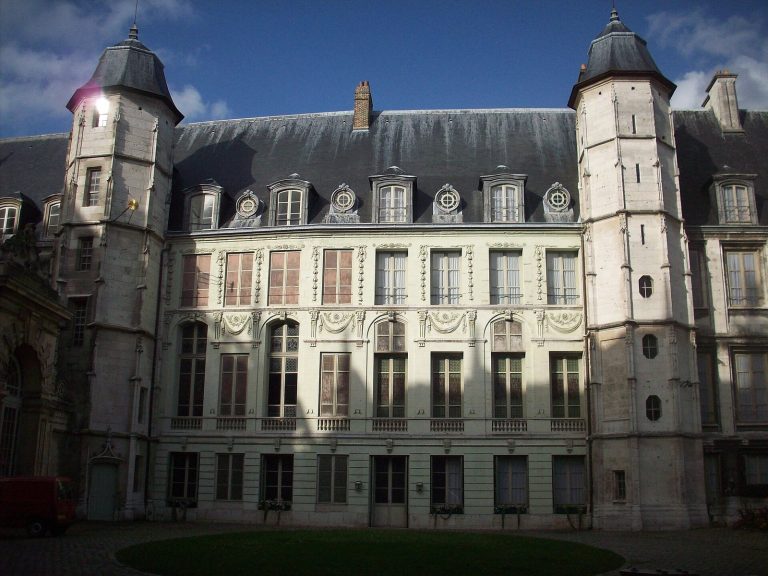
Of the gates once distributed along Rouen’s walls, the Guillaume-Lion Gate is the surviving example. It was moved from its original position during the postwar Reconstruction. Modern work at the Barbey-d’Aurevilly College, formerly the Hôtel d’Arras, revealed a 40-metre stretch of wall 1.5 metres below ground level. On 19 February 2026, another section of the city wall collapsed beside Boulevard de Verdun.
Remains
Roman Enclosure
The Roman defenses formed a rectangle, or castrum, a planned fortified enclosure arranged on a geometric layout. Builders incorporated materials reused from demolished Gallo-Roman buildings on the outskirts of the city. The enclosure bordered the Seine to the south and stood against the hills to the north. Two watercourses running perpendicular to the river, together with surrounding marshland, provided natural protection on the eastern and western sides.
Medieval Castles and Gate
Joan of Arc Tower
Bouvreuil Castle stood on Bouvreuil Hill. The Joan of Arc Tower is its surviving keep and the only remaining part of that castle.
Guillaume-Lion Gate
The Guillaume-Lion Gate is the only preserved gate of Rouen’s former fortifications. Its present position results from its relocation during the postwar Reconstruction, rather than from its original placement in the city’s defensive line.
Clos des Galées
The Clos des Galées occupied a protected naval complex enclosed by walls and a ditch. Its installations included a basin called the estang, dry docks, stores, and workshops for carpentry, sewing, and weapons manufacture. Timber came from the Roumare and Rouvray forests, iron from the Pays d’Ouche, and locally spun hemp supplied the material for ropes and sails.
Porte d’Arras Defenses
Casemate
The Porte d’Arras casemate is a late-fifteenth-century fortified chamber built into the rampart at the bottom of the ditch. A casemate provided protected positions from which weapons could fire against attackers and helped keep enemy artillery away from the walls. The structure defended the ditch between the Cauchoise Gate and Bouvreuil Castle.
The interior measures 12 metres by 3 metres and has a vaulted height of 4 metres. Access descends a staircase of 37 steps and continues through a 25-metre underground passage. The associated wall section extends for 40 metres and lies 1.5 metres below ground level, in the area now occupied by Boulevard de la Marne.