Starý Zámek: A Gothic Castle Ruin in Czechia


Site at a Glance
- Rating
- 4.7
- Popularity
- Medium
- Country
- Czechia
- Primary era
- Medieval
- External website
- Open
- Eras represented
- Medieval, Early Modern
- Civilizations
- Holy Roman Empire, Kingdom of Bohemia
- Site type
- Military
- Remains
- Castle
On this page8 sections
History
Starý Zámek, also known as Borotín Castle, is a Gothic castle ruin in Czechia near Borotín, first mentioned in 1356 in connection with Vitěk of Borotín. Vitěk may also have founded the castle. He belonged to the Landštejn branch of the powerful South Bohemian Vitkovci family, and the stronghold remained with his descendants for almost a century.
The Landštejn Lords and the Hussite Wars
Vitěk’s descendants Jan and Heřman supported the Hussite movement. The Hussite Wars were fifteenth-century conflicts in Bohemia arising from religious reform and struggles over political authority. On 16 October 1423, Heřman of Landštejn and Borotín was elected as a Calixtine representative to the twelve-member provincial government at the Diet of St. Havel in Prague. The Calixtines were the more moderate faction within the Hussite movement.
During the wars, Mikuláš of Landštejn and Borotín lived at Borotín. He became a supporter and hetman, or military commander, of the Taborites in 1426. The Taborites formed the radical military wing of the Hussite movement. After Mikuláš changed sides in 1434, a Taborite army attacked the castle on 21 May. Borotín survived the initial assault, and the army soon withdrew toward Prague and central Bohemia. On 30 May, the Battle of Lipany brought the effective end of the Taborite field armies. Mikuláš of Borotín fought in the coalition cavalry alongside other former Taborites.
Sale, Destruction, and Confiscation
By 1446, Mikuláš had sold Borotín Castle to Jan Malovec of Pacov, a fellow participant in the fighting at Lipany. The castle then disappears from the written record until 1613, when Pavel, a descendant of Jan Malovec, sold it to Kryštof Vojkovský of Milhostice.
Vojkovský’s sons joined the Bohemian Estates Revolt, an uprising of Bohemian estates against Habsburg rule that began in 1618. In retaliation, the castle and its farmyard were plundered and burned. After the rebels were defeated at the Battle of White Mountain in 1620, their properties were widely confiscated. On 16 March 1623, the castle, farmyard, the town of Borotín, and surrounding villages were sold to Polyxena Lobkowicz of Pernstein as the “old castle called Borotín.”
A further description from 1623 states that only the castle’s name remained. Its roofless walls had been demolished, and the entire inner courtyard had burned. Polyxena incorporated Borotín into the Jistebnice estate, a landed domain administered from Jistebnice. The Lobkowicz family retained the estate for approximately two centuries.
Later Ownership and Preservation
In 1829, Ferdinand Lobkowicz sold the Jistebnice estate to the Prague industrialist Jan Nádherný. Nádherný received the noble title “of Borotín” nine years later. The family’s last owner of the estate was Freiherr Konstantin Nádherný of Borotín in the mid-twentieth century. Freiherr is a German baronial title. He emigrated after 1948, and his descendants live in Austria and Canada.
From the seventeenth through the twentieth centuries, local inhabitants quarried material from the ruined castle for building work, including construction of the Baroque farmyard beside it. Starý Zámek and the adjoining farmyard have been protected as a cultural monument since 1963. Restoration during the early 1980s gave the ruins their present appearance.
Remains
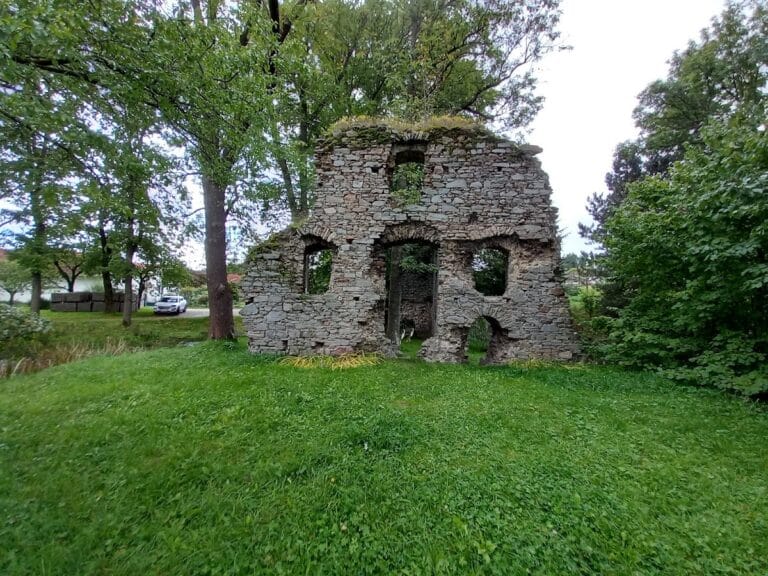
The ruins stand about one kilometre southeast of Borotín on a gentle hill beside Starozámocký Pond, which served as a natural defensive feature. At approximately 500 metres above sea level, the Gothic castle occupies a site organized around a polygonal inner core, defensive enclosures, entrances, and later residential additions. The adjoining Baroque farmyard occupies the outer part of the complex.
The Castle Core and Defences
The castle core had a polygonal plan with a massive bergfried, the principal defensive tower of a medieval castle, projecting from its upper section. A zwinger, or outer defensive enclosure between the main fortifications and an exterior wall or approach, surrounded the core. Entry from the outer area passed through a tower gate that no longer survives.
A smaller round tower protected the entrance into the inner core. The palace on the southern side survives only in fragments. During the Late Gothic period, a new moat was dug around the entire core, while new eastern gates with a series of loopholes were constructed. Loopholes are narrow openings that allowed weapons to be used from behind defensive walls.
Later Residential Buildings
New residential buildings were added in the central area during the Late Gothic period. In the early sixteenth century, another palace was built beyond the new gate. Traces of a former wooden chamber survive there, together with part of the bergfried. These are among the best-preserved elements of the castle.
The Baroque Farmyard
The Baroque farmyard adjoins the castle remains and occupies the outer part of the complex. Its southern wing contains vaulted stables. The western part of the former castle was heavily damaged by the extraction of stone used by local inhabitants and in the farmyard’s construction.
The moat around the core was damaged when a road was built during restoration work. Archaeological traces also survive among the ruins, adding material evidence to the visible walls, towers, gates, and surviving parts of the castle’s residential buildings.