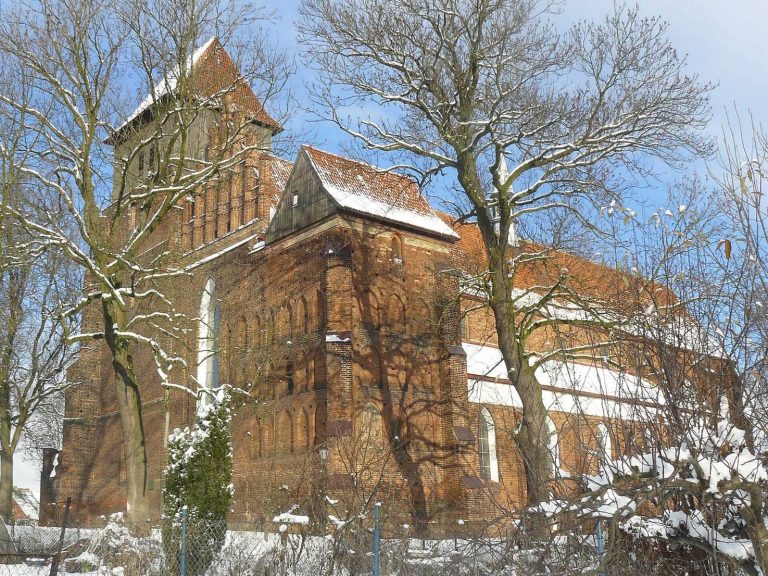
11 Sigismund Augustus Boulevard in Elbląg: Former Malthouse of the Teutonic Castle


Site at a Glance
- Rating
- 4.7
- Popularity
- Medium
- Country
- Poland
- Primary era
- Medieval
- External website
- Open
- Eras represented
- Medieval, Early Modern
- Civilizations
- Crusader, Teutonic Order
- Site type
- Military
- Remains
- Castle
On this page16 sections
History
Foundation and the Teutonic stronghold
11 Sigismund Augustus Boulevard in Elbląg, Poland, is a surviving fourteenth-century brewery building associated with the Gothic castle of the Teutonic Order. The medieval stronghold was founded in 1237, according to a chronicle by Nikolaus von Jeroschin, while construction of its new brick-and-stone form began in 1239 or 1240. Its completion is dated either to 1242 or to 1260.
Medieval foundation traditions relate that building materials were prepared at Marienwerder and carried to a meadow near the mouth of the Elbląg River. An initial earth-and-timber fortress was said to have been destroyed by pagan opponents and rebuilt after the fighting. The traditionally identified meadow was later called Herrenpfeil. Archaeological investigation has left the location of that first fortress uncertain, and the relationship between the castle settlement and the earlier trading emporium of Truso remains unconfirmed.
A Dominican monastery may have been established beside the fortress in 1238. During the thirteenth century, the castle and its surrounding settlement served as a base for the Teutonic Order’s campaigns against the pagan communities of Warmia. The Teutonic Order was a German religious-military institution that created and administered a territorial state in the eastern Baltic during the Middle Ages.
Political and religious center
Between 1251 and 1309, Elbląg Castle was the most important Teutonic stronghold in Prussia. It housed the Prussian land master, a senior regional administrator of the order, and hosted the provincial chapter, the assembly responsible for important administrative and religious matters. In this period, Elbląg functioned as the de facto political capital of the Teutonic state.
The order intended Elbląg to become the residence of its grand master. A very large Church of Saint Andrew was planned in connection with the castle, with Romanesque columns and relics of the True Cross, the Christian relic traditionally identified with the cross of Jesus’s crucifixion. Hermann von Salza received the relics from the Roman Emperor in 1232. In 1241, Pope Gregory IX granted a ten-day plenary indulgence, a formal remission of religious punishment associated with sin, to crusaders who visited the relics at the Elbląg castle.
The civil settlement outside the castle was intended to receive Lübeck law in 1240, although the Teutonic Order formally confirmed the arrangement six years later. By the end of the thirteenth century, Elbląg had commercial contacts with France and England, adding an international trading role to its political and military importance.
After the grand master’s departure
In 1309, Grand Master Siegfried von Feuchtwangen transferred the grand master’s seat to Malbork. This ended Elbląg Castle’s position as the political center of the order’s state, but the fortress remained one of its most important military sites. It became the seat of the grand hospitalier, a senior official responsible for the order’s hospitals, who also served as commander of Elbląg. One of the three mints in the Teutonic state operated at the castle.
The size and provisioning of the garrison changed over time. In 1386, it included 152 Teutonic brothers and their servants. Stores prepared for a possible siege included fish, oil, beef, mutton, pork, sausage, salt, beer, and more than 5,500 cheeses. In 1440, the cellars held 430 barrels of beer, four barrels of mead, 1,600 barrels of lard, 428 sides of beef, pork, and tongues, butter, pickled meat, and large quantities of salt.
By the middle of the fifteenth century, the garrison had declined to about forty brothers and their servants. The castle was nevertheless equipped with 59 guns, 12.5 barrels of gunpowder, two barrels of saltpeter, 36,000 arrows, 21 iron helmets, 17 suits of armor, and seven pairs of gloves. The following year, 41 brothers were present, including four priests and five men in the castle hospital.
Capture, demolition, and later uses
During the Great War between Poland, Lithuania, and the Teutonic Order, Elbląg’s inhabitants seized the castle. The city council assumed full authority, and the city paid homage to Władysław Jagiełło, the king of Poland who also ruled Lithuania as Jogaila, on 22 July 1410. The Teutonic garrison returned in September after the Polish-Lithuanian forces withdrew.
In 1454, an uprising by the Prussian Confederation began the Thirteen Years’ War, a conflict that brought the confederation and Poland into war with the Teutonic Order. Elbląg Castle was attacked on 6 February and captured after six days. Its garrison was permitted to withdraw to Malbork, and the Old Town Council then ordered the castle’s demolition. The complex remained largely ruined for about a century. Defensive walls, towers, and several buildings were dismantled entirely only in the late eighteenth century.
Some buildings in the outer bailey passed to the Bridgettines, a religious community, during the fifteenth century and remained in their possession until 1520. In 1535, they became the seat of Elbląg Gymnasium. The surviving complex later formed part of the Archaeological and Historical Museum in Elbląg, which has occupied ancillary buildings of the former castle since 1954.
Archaeological recovery
Archaeological work at the former castle site took place in 1914 and again in 1919. The excavations brought to light architectural details from the medieval complex, including an elaborately decorated portal with the wise and foolish virgins, a Christian parable contrasting five prepared virgins with five who were unprepared for the bridegroom’s arrival. The portal was probably used as a model for a similar entrance at the church of Malbork Castle.
Remains
The northern outer bailey
The former malthouse at 11 Sigismund Augustus Boulevard is identified with the brewery of Elbląg Castle’s northern outer bailey. An outer bailey was an enclosed subsidiary area distinct from the main or high castle. The brewery is a fourteenth-century brick structure, and its surviving cellars form part of the physical remains of that area.
Former brewery and malthouse
The building represents the castle’s brewing facilities within the outer bailey. Its medieval fabric survives together with the cellars, linking the present structure to the service and production zone of the Teutonic stronghold. The remains belong to the fourteenth-century phase of the castle complex.
Defensive remains
Near the brewery are a fragment of Gothic defensive wall and a fragment of a tower. These elements preserve parts of the outer bailey’s fortified boundary and stand alongside the cellars and brewery remains as surviving components of the northern castle area.
Later building over the western wing
Building of 1521
A building erected in 1521 stands over the cellars of the castle’s western wing. Its restrained Renaissance forms reflect a period after the medieval stronghold had been captured and ordered to be demolished. The structure was rebuilt in 1599 and later served successively as a Bridgettine convent, Elbląg Gymnasium, and museum.
Relics and recovered architectural elements
High-castle relics
A column standing in front of the 1521 building is a surviving relic of the high castle. Other preserved or recovered elements include a castle capital, the ornamented upper part of a column or pillar, together with fragments of wall and tower.
Decorated portal
The excavated portal carries the motif of the wise and foolish virgins. Its original position within the castle is not precisely established, but its decoration probably provided an architectural model for a comparable portal in the church at Malbork Castle.
Early settlement remains
Excavation in the former castle area also uncovered foundations of some early burghers’ houses and production establishments. These remains belong to the settlement’s early development and place domestic and productive activity alongside the fortress’s religious, administrative, and military buildings.