Quinta dos Ribafrias: A Renaissance Manor Estate near Sintra


Site at a Glance
- Rating
- 4.5
- Popularity
- Medium
- Country
- Portugal
- Primary era
- Early Modern
- External website
- Open
- Eras represented
- Early Modern, Modern
- Civilizations
- Portuguese
- Site type
- Domestic
- Remains
- Manor House
On this page6 sections
History
Quinta dos Ribafrias is a historic estate near Sintra, Portugal, centered on a small Renaissance palace with elements of the Manueline style, commissioned between 1536 and 1541. It developed from land granted by the Portuguese crown and later became part of the Cultural Landscape of Sintra.
Royal Grant and Sixteenth-Century Construction
In 1515, King Manuel I donated the land to Gaspar Gonçalves. At the time, it was known as the Herdade das Laranjeiras, or Orange Tree Estate. Gonçalves held a ceremonial office in the Portuguese Royal Household that required him to open the door for visitors entering the king’s room. He commissioned the palace between 1536 and 1541, during the reign of John III, who succeeded Manuel I as king of Portugal in 1521.
After the palace was completed, John III appointed Gonçalves Lord of Ribafria and granted him an official coat of arms. The estate therefore combined a royal grant, a noble title, and a residence whose design reflected the Renaissance and the Manueline style, a Portuguese form that joined late Gothic architecture with maritime, natural, and emblematic decoration.
Damage, Restoration, and Institutional Use
The estate was damaged by the earthquake of 1755. In 1902, it was sold to the Count of Cartaxo, and his grandson undertook restoration work during the 1960s.
From 1987 to 2002, Quinta da Ribafria housed the Friedrich Naumann Foundation, a German liberal political foundation active internationally in civic and political education. During this period, the gardens were improved and office space was added within the garden under the supervision of the Portuguese architects Francisco Caldeira Cabral and Gonçalo Ribeiro Telles.
Sintra Municipality acquired the estate in 2003. After a period of neglect, the Cultursintra Foundation took it over for sculpture displays and summer open-air performances, while the municipality remained identified as its owner. Quinta da Ribafria forms part of the Cultural Landscape of Sintra, inscribed on the UNESCO World Heritage List in 1995 under cultural criteria (ii), (iv), and (v). The estate was designated a Portuguese National Monument as a Monument of Public Interest on 18 August 1943.
Remains
The Palace
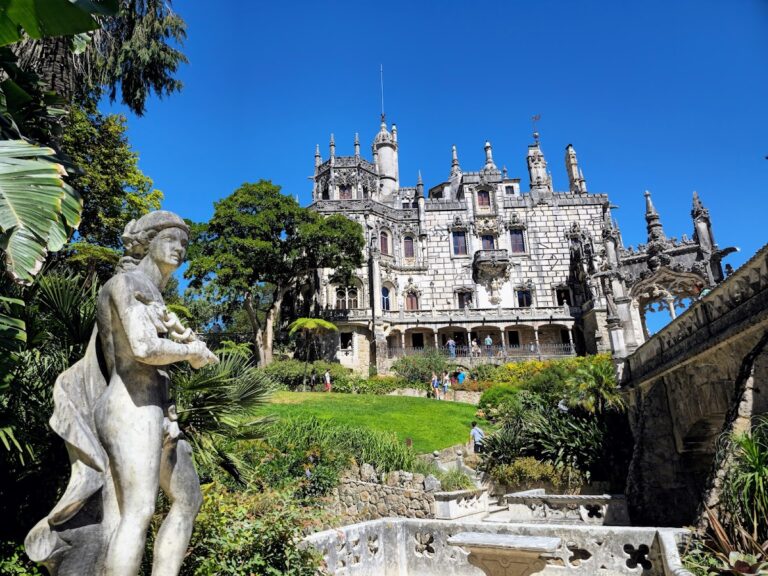
The main building is a small Renaissance palace that incorporates Manueline elements and is regarded as an example of a Portuguese manor house of its period. Its façade is symmetrical, with two principal parts and Mudéjar battlements. Mudéjar architecture combines Islamic artistic traditions with Christian building practices in the Iberian Peninsula.
A tower inspired by medieval Portuguese buildings was added to the palace in the seventeenth century. Its upper edge is finished with a cornice and merlon battlements, the raised sections between openings along a defensive parapet. On the western side, Gonçalves’s coat of arms is carved in stone.
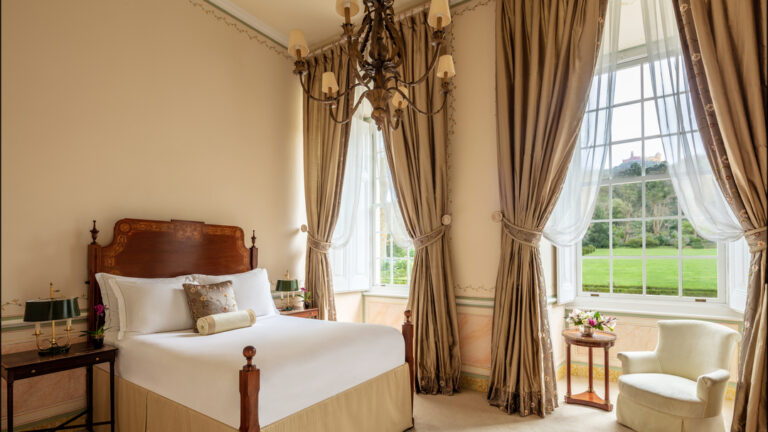
Inside, wooden coffered ceilings carry painted hunting scenes, floral designs, and marine motifs. The house also contains chapels, including a small chapel set separately in the wooded garden.
Gardens and Estate Setting
The estate retains many orange trees, preserving a direct connection with its earlier name, the Orange Tree Estate. Its gardens were improved during the Friedrich Naumann Foundation’s occupation, when office space was also introduced into the garden. These later additions form part of the surviving estate alongside the palace, chapels, and historic plantings.
Nearby sites