Forte Corbin: An Italian First World War Fortress


Site at a Glance
- Rating
- 4.7
- Popularity
- Medium
- Country
- Italy
- Primary era
- Modern
- External website
- Open
- Eras represented
- Modern
- Civilizations
- Italian
- Site type
- Military
- Remains
- Fort
On this page11 sections
History
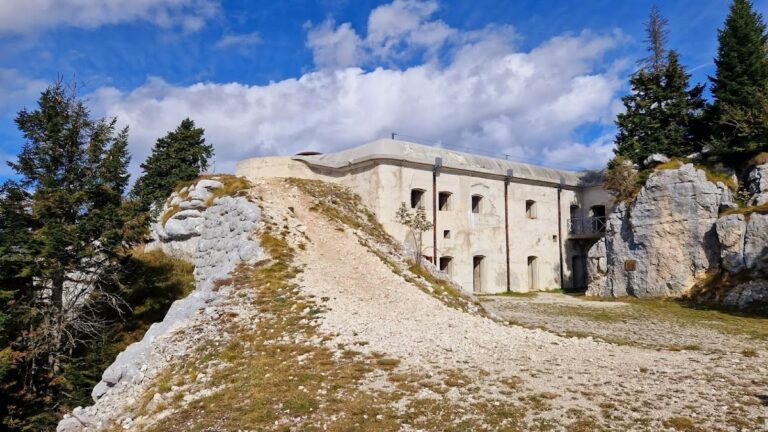
Forte Corbin, also called Forte di Punta Corbin, is an Italian fortress built by the Kingdom of Italy on the southwestern edge of the Asiago–Seven Communities Plateau. Construction began in 1906 and was completed in 1911, during the period when Italy was strengthening its Alpine border defences before the First World War. The fort stands at 1,077 metres above sea level on a rocky spur overlooking the Val d’Astico, and formed the eastern part of a defensive barrier against a possible Austro-Hungarian attack. Its western counterpart was Forte Casa Ratti, near Arsiero on the opposite bank of the Astico stream.
Construction and military purpose
The difficult mountain terrain made construction a major logistical undertaking. A military road connected Treschè Conca with Punta Corbin, while the steel parts of the gun cupolas were brought by rail to Campiello station and then carried by cart to the building site. There, the components were assembled and welded. The recently opened Rocchette–Asiago railway supported this transport operation. Workers employed by the contractors, together with their families, lived for several years in a village built near the fortress.
Forte Corbin was assigned to defend the southwestern sector of the First World War front on the Seven Communities Plateau. Its garrison was mainly associated with the 9th Fortress Artillery Regiment, a military formation responsible for operating permanent artillery forts and their defensive systems. The fort was intended to control approaches through the Val d’Astico and to support the wider fortified border zone between Italy and the Austro-Hungarian Empire, the multinational state that opposed Italy on the Alpine front.
First World War operations
During the first two months of the war, Forte Corbin fired on Austro-Hungarian positions around Luserna, but the results were limited. Its six 149-millimetre guns were then dismantled because they were considered more useful nearer to the front. Wooden trunks replaced the guns in their positions as a deception intended to mislead Austrian observers. The camouflage succeeded, and Austrian artillery continued to bombard the fortress for almost a year.
On 15 May 1916, about fifty long-range shells struck the fort. They were fired by the Austrian 380-millimetre siege howitzer known as “Barbara,” positioned near Forte Campo Luserna. The attack formed part of the Strafexpedition, or “punitive expedition,” the major Austro-Hungarian offensive of 1916 against Italian positions in the Trentino and Alpine border region.
On 30 May 1916, during the offensive, Forte Corbin came under heavy shellfire. Retreating Italian forces blew up parts of the structure, after which advance units of the 28th Division under Colonel Kliemann occupied it. On the same day, Carlo Stuparich, a writer and Italian irredentist, was killed at an advanced defensive position on the road to the fort while it was held by a platoon of Grenadiers. Italian irredentism was a nationalist movement that sought to bring Italian-speaking or historically Italian-claimed territories outside the Kingdom of Italy under Italian rule.
Two Italian Grenadier companies attempted to recapture the fortress in the first days of June. They initially succeeded, but a strong counterattack restored Austro-Hungarian control several hours later. Italian forces regained permanent possession on 25 June 1916, after the imperial troops withdrew from the Monte Cengio area and established themselves along the Val d’Assa defensive line. Forte Corbin retained its strategic function until 1918, although its position far behind the front left it largely inactive for most of the war after these initial operations.
Postwar abandonment and conservation
After the war, the fortress served as a depot and barracks for military units undergoing training until the end of the 1920s. It was later abandoned and heavily damaged by material salvagers. Iron and steel were removed from the structure, and explosives were sometimes used to extract metal from the masonry. In 1942, the military land and the ruins passed from state military property to private owners.
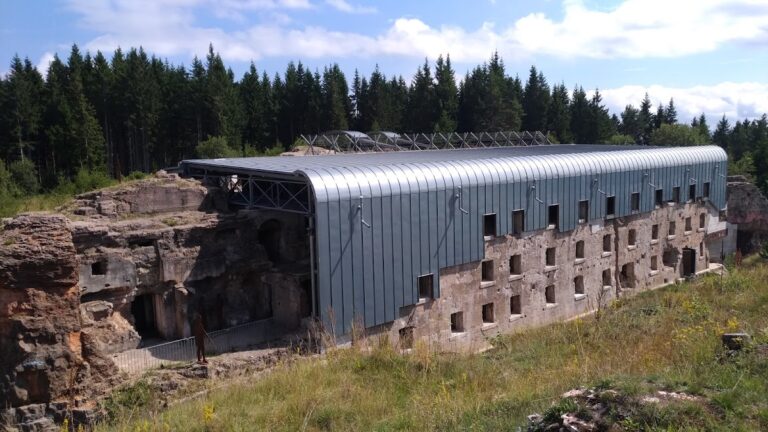
From the early 1980s, the owners undertook extensive clearing, safety work, and conservation restoration. These interventions made the surviving structure visitable. Forte Corbin remains privately owned and contains a small museum dedicated to military history.
Remains
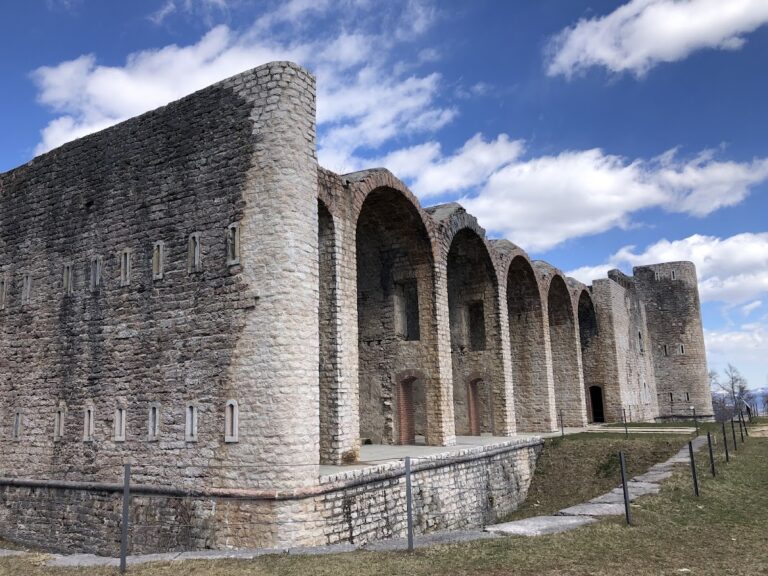
Forte Corbin occupies the rocky Punta Corbin spur above the Val d’Astico, at the southwestern corner of the Asiago–Seven Communities Plateau. Its planned complex combined artillery batteries, command facilities, a powder magazine, trenches, observation positions, warehouses, and accommodation. The landward side was protected by a high anti-personnel ditch strengthened with substantial masonry, while the main internal route and underground galleries connected the eastern entrance area with the western part of the fortress.
Outer defences
Ditch and close-defence positions
The exposed landward side is bordered by a high defensive ditch. On its outer eastern side were positions for light artillery intended for close defence. A protected machine-gun position occupies the central part of the ditch, with loopholes for firing through the masonry. Along the inner edge of the northeastern side, facing the access road, a long covered trench formed a second defensive line. It contains numerous firing positions and continues as an open trench protecting the northwestern side of the fortress.
Observation post and guardhouse
At the western extremity of the rocky spur stands a small valley observation post. Its loopholes provided a 180-degree field of view over the Val d’Astico below. On the eastern side, a massive guardhouse protected the entrance and the military cableway. A steep path descended from the fortress towards Pedescala at the bottom of the valley, crossing a difference in elevation of several hundred metres. The cableway that once linked the entrance with the valley no longer survives.
Internal galleries and artillery positions
Accommodation and service areas
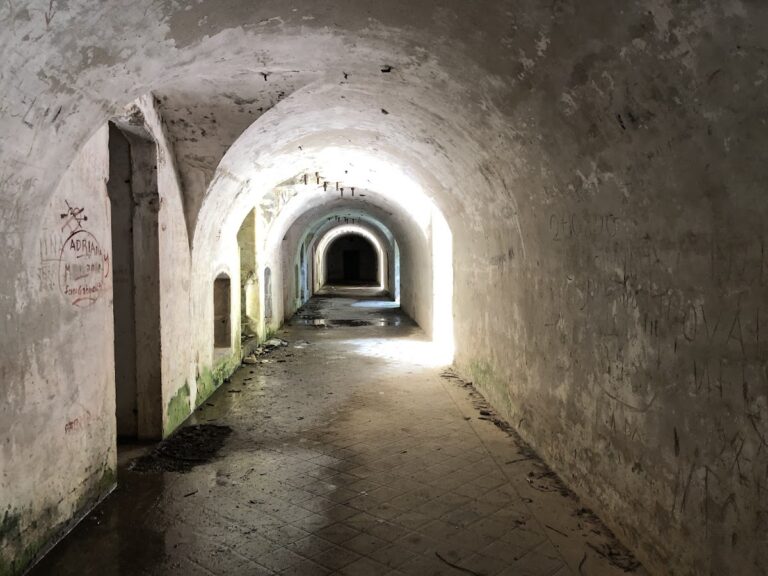
An internal route and underground galleries lead towards the western section of the fortress. This area contained accommodation for 134 artillerymen, service rooms, the powder magazine, and the machinery used to rotate the armoured gun cupolas. The galleries formed the protected circulation system linking these functions within the fort.
Armoured gun cupolas
The principal armament consisted of six 149-millimetre steel guns mounted in rotating steel cupolas approximately 160 millimetres thick. Their full rotation and range of 7 to 11 kilometres allowed them to cover positions along the Val d’Astico, including Monte Cimone, Tonezza del Cimone, Spitz di Tonezza, Monte Campomolon, Cima di Campolongo, and Luserna. Smaller artillery pieces included 87-millimetre bronze guns on rigid mounts, while several machine guns installed in casemates provided close-range defence.