Fort Royal in Sainte-Marguerite Island: A French Fortress and State Prison


Site at a Glance
- Rating
- 4.3
- Popularity
- Medium
- Country
- France
- Primary era
- Early Modern
- Eras represented
- Classical, Early Modern, Modern
- Civilizations
- French, Roman, Spanish
- Site type
- Military
- Remains
- Fort
On this page20 sections
History
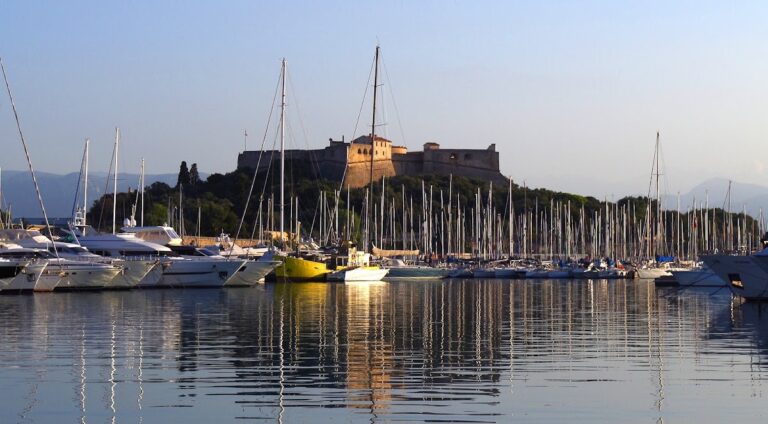
Fort Royal in Sainte-Marguerite Island is a French fortress and former state prison on Sainte-Marguerite Island in Cannes Bay, France. Its first fortification was probably built between 1624 and 1627 during the early modern period, and the site later became a military stronghold, a royal prison, and a museum containing archaeological material from the island.
Ancient island and Lérins Abbey
Sainte-Marguerite, the largest of the Lérins Islands, was occupied at least from the fifth century BC. Excavations in the 1970s and 1980s exposed foundations belonging to buildings of that period. In antiquity the island was known as Lero, probably after the local deity Leron. Pliny the Elder, quoting the Greek geographer Strabo, referred to a sanctuary of the deity on the island. The neighbouring island of Saint-Honorat was then called Lerina.
The ancient settlement of Vergoanum, mentioned by Pliny, is thought to have disappeared during the first century. Roman occupation began on the island during that century, and later Roman construction left cisterns and other remains beneath the fortress. Around 410, Honorat of Arles, a late antique Christian bishop and monastic founder, arrived on Lerina and began establishing an abbey. Lérins Abbey retained ownership of Sainte-Marguerite into the early modern period.
Creation of the royal fortress
Around 1560, the reforming congregation of Sainte-Justine of Padua and Monte Cassino proposed transferring the island to the French king. The proposal was linked to the abolition of the commendatory system, in which an often non-resident ecclesiastical patron received an abbey’s revenues and nominal administration. Building a fort on the island was one reason for the proposed transfer. Guillaume du Vair, president of the Parliament of Provence, made a similar suggestion around 1600.
In 1612, Louis XIII restored the commendatory arrangement in favour of Claude of Lorraine, the younger brother of Charles of Lorraine and the king’s lieutenant general in Provence. The monks gave Claude the island in the hope that he would fortify it. Claude transferred it to his elder brother, the Duke of Guise, in 1618. The duke then ceded most of his rights to Jean de Bellon for 4,500 livres while retaining a perpetual right of repurchase.
Bellon built a manor over the ruins of a Late Roman establishment. A first fortification probably followed between 1624 and 1627, possibly under Jean de Bonnefons, the king’s engineer in Provence. Jacques de Maretz surveyed the works in 1632 during an inspection with Henri de Séguiran commissioned by Cardinal Richelieu, Louis XIII’s chief minister. A further inspection by Charles-Bernard Duplessis-Besançon in 1634 produced repair proposals, but France’s declaration of war on Spain in 1635 interrupted the planned work.
Spanish occupation and French reconquest
On 13 September 1635, during the war between France and Spain, a Spanish fleet reached the Lérins Islands. It comprised 22 galleys, four brigantines, and nine galleons, carrying 3,000 soldiers and six guns under three commanders, including Álvaro II de Bazán, Marquis of Santa Cruz. Fort Royal surrendered, as did the tower on Saint-Honorat.
The Spanish established a fortified camp across the islands. They built Fort Aragon at the southwestern tip, Fort Monterey in the eastern third of Sainte-Marguerite, and a smaller fort with a tenaille, a defensive work with angled sides, at the island’s eastern tip. Most of these works were unrevetted earthworks. The principal French fort was rebuilt according to a plan signed by the Spanish engineer Honofre Antonio Gisolfo.
France recovered Sainte-Marguerite after a 45-day siege during the Battle of the Lérins Islands. Short of drinking water, the Spanish garrison capitulated on 12 May 1637, and the garrison of Saint-Honorat surrendered the following day. On 14 May, Bishop Henri de Sourdis celebrated a thanksgiving Mass with a Te Deum, a Christian hymn of thanksgiving. France abandoned the Spanish fortifications except for the principal fort.
French military development
In 1639, Richelieu appointed Charles de Pechpeyrou-Comminges de Guitaut as military governor. Guitaut was a naval lieutenant who had taken part in the siege and a Knight of Malta. He held the office until 1649, when he resigned in favour of his nephew, Guillaume de Guitaut.
Around 1650, François Blondel and Pierre de Bonnefons proposed strengthening the outer works. Two demi-lunes, detached crescent-shaped outworks, and the landward entrance known as the Royal Gate were built in the middle of the seventeenth century. The fort’s masonry was complete by 1647, when the landward entrance was protected by a demi-lune and the western Marine Gate had been completed.
Louis XIV’s leading military engineer, Vauban, inspected the fort in 1682, 1692, and 1700. His recommendations included protecting the Marine Gate with a demi-bastion, completing the walls and ditches of the demi-lunes, improving the covered way, creating a glacis, converting the well into a cistern, moving the powder magazine, and improving the artillery. Work based on his proposals began in June 1693 under Antoine Niquet, who directed royal fortification works in Provence. When Vauban returned in 1700, he observed that several improvements had repeatedly been proposed without being carried out. By then, the well had been converted into a cistern.
Royal prison and religious persecution
In 1685, Fort Royal was designated for use as a state prison. A prison wing was built between May 1689 and October 1691 under the engineer Jean-Louis de Cayron. Bénigne Dauvergne de Saint-Mars, appointed governor in 1687, brought with him the prisoner later known as the Man in the Iron Mask, an unidentified state prisoner whose confinement became one of the fort’s best-known historical associations.
After Louis XIV revoked the Edict of Nantes, which had granted limited legal protection to French Protestants, Fort Royal became one of four royal prisons on the Mediterranean coast used for people accused of religious crimes. Huguenots, the French Protestants targeted by the policy, included ministers who continued to preach clandestinely. Three companies of invalid soldiers guarded the prison. Because these soldiers were allowed to marry, a civilian population gradually formed around the fort.
A former cell has housed a Huguenot memorial since 1950. It commemorates six Protestant ministers imprisoned for life after returning secretly to France to preach to Protestant communities. Louis XIV spared their lives, although execution had been intended, in the hope that they would convert.
Paul Cardel, a minister from Rouen, returned to France in 1688. Arrested in Paris on 2 March 1689, he was transferred to Sainte-Marguerite on 18 April and died there, reportedly insane, on 23 May 1694. Pierre de Salve, Sieur de Bruneton, was arrested in Paris on 10 January 1690 and transferred to the island five days later. A sermon by him, titled “To Me, Christ Is Gain, to Live and to Die,” survives.
Gabriel Mathurin, known as Lestang and originally from Uzès, was arrested in Paris on 18 April 1690 at the age of 50. He remained at Sainte-Marguerite until his release in 1715 and died in Ireland in 1718. Mathieu de Malzac, born at Uzès in 1657, was arrested in 1692 and spent 33 years in captivity. A recommendation from Louis XIV’s minister Pontchartrain gave him the exceptional privilege of a two-hour walk. He died in prison on 15 February 1725.
Élisée Giraud of Bergerac was transferred to Sainte-Marguerite on 16 August 1693 after travelling through England and the Netherlands to Paris and spending two years in Vincennes. Jean Gardien Givry, born at Vervins in 1647, returned to France in 1691 and held clandestine assemblies. Arrested on 3 May 1692, he spent two years in Vincennes before being transferred with Giraud to Sainte-Marguerite, where he died.
Eighteenth- and nineteenth-century confinement
During the War of the Austrian Succession, wealthy inhabitants of Cannes sought refuge in the fort. Austro-Sardinian forces and English ships attacked it for booty, and the garrison surrendered on 20 December 1746 to Austro-Sardinian troops commanded by General Broun. The Chevalier de Belle-Isle retook the island on 26 May 1747.
A memorandum of 1751 described the fort as being in poor condition and useful chiefly for holding prisoners, since it protected neither a settlement nor a port. Projects proposed in 1764, 1774, 1782, and 1792 were only partly implemented. Repairs to parapets, openings for guns, and interior and exterior wall coverings took place in 1775. The prison continued to hold Protestant ministers and other prisoners.
The Marquis de Jouffroy d’Abbans was confined there from 1772 to 1773. He reportedly conceived his steam-powered Pyroscaphe after watching galleys manoeuvre offshore. The state prison was abolished during the early years of the Republic, after which the fort became a military prison.
Under the Empire, the prison held Antoine Omer Talon in 1804, the Duchess of Escars for about two months around 1807, and the Bishop of Ghent, Maurice de Broglie, for ten months in 1812. In 1816, about 100 Mamelukes of Napoleon’s Imperial Guard were sent to the island for protection from massacre by the population of Marseille.
The château was restored between 1833 and 1837 to accommodate 160 convicts. After French forces captured Emir Abd el-Kader’s smala in 1843, nearly 800 captives, including women and children, were relegated to the island. Around 600 Austrian soldiers were interned there in 1859 after the Battle of Montebello.
Marshal François Achille Bazaine was imprisoned in the fort and escaped on 10 August 1874, reportedly by descending the ramparts on a rope. Fort Royal lost its prison function at the beginning of the twentieth century. The army departed before the fort was classified as a historic monument on 27 July 1927.
Archaeology and museum use
Archaeological excavations on Sainte-Marguerite began in 1973. The main building of the fort was used to present finds from underwater and terrestrial excavations, and the Museum of the Sea opened there in 1978. Cannes purchased the fort in 1996. The museum was renamed the Museum of the Iron Mask and the Royal Fort in 2020.
The fort was included in the Heritage in Peril programme in 2024 as part of efforts to restore it. Its present use combines the preservation of the fortress with the interpretation of the island’s ancient, military, and prison history.
Remains
Fortress layout and defensive works
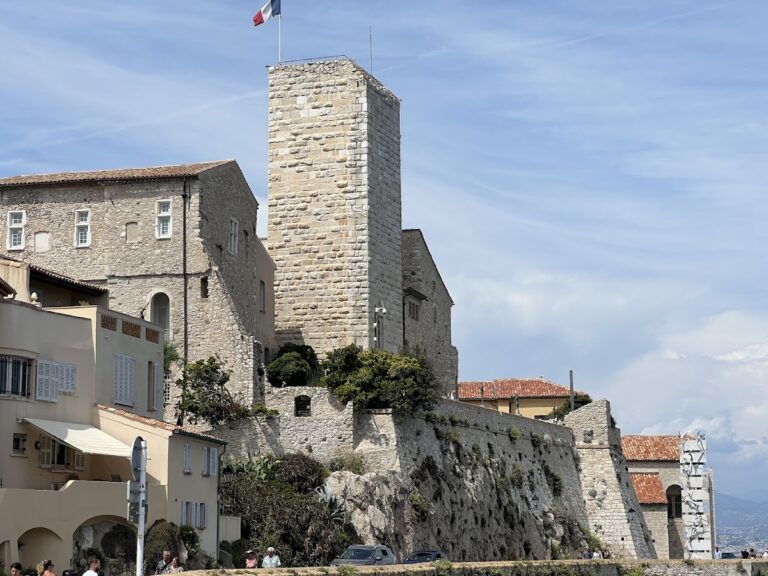
Fort Royal occupies a broad rocky platform above the sea, facing Cannes Bay and Cape Croix. The first fort had an irregular trapezoidal plan. A 1632 survey shows a bastioned enceinte, a defensive perimeter with projecting works, together with a château, a vaulted chapel, and stables built above ancient Roman cisterns.
Spanish enceinte
The Spanish reconstruction retained the outline of the earlier fort in dotted form and created a pentagonal enceinte. The landward front had three bastions, projecting fortifications designed to permit fire along the faces of neighbouring walls. The southern enclosure included two curtain walls, the connecting sections between projecting works, as well as a ditch and a protected covered way. Each side extending from the landward front ended toward the sea in a demi-bastion. The seaward side, forming the base of the pentagon, measured about 110 metres and underwent little alteration. A planned northwestern demi-bastion was never built.
Gates and outer works
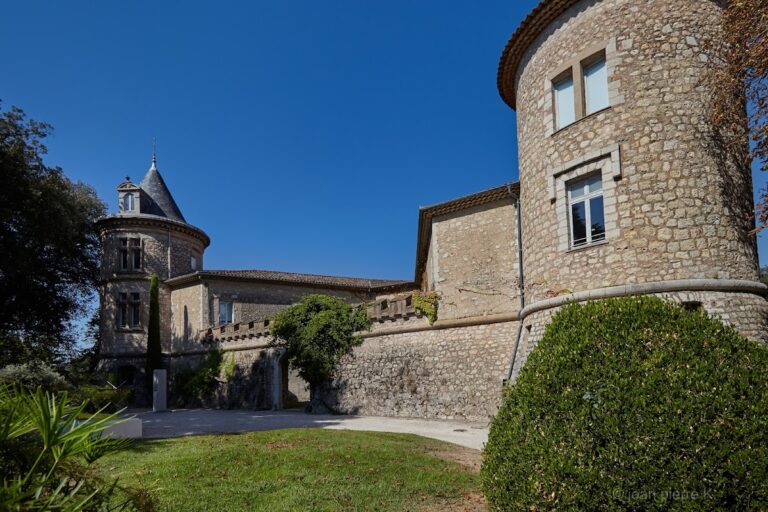
By 1647, the fort’s masonry was complete. The landward entrance was protected by a demi-lune, and the western entrance, the Marine Gate, had been completed. The former manor of Jean de Bellon became the governor’s residence. The Royal Gate was later concealed by a demi-lune and approached by bridges supported on masonry piers. The Marine Gate was reached by a triangular outwork based on a proposal by François Blondel.
The road to the Marine Gate was constructed in 1839. Before then, the gate could be reached only from an anchorage, followed by a ramp and staircase. In 1843, after proposals made in 1838 and 1841, the passage toward the Royal Gate was converted into a shelter and the gate became a postern, or secondary entrance.
Artillery positions
A battery of four heavy guns was planned for the Richelieu Bastion in 1841 and installed about twenty years later. The Convention Battery was built at the eastern tip of the island in 1861 and also served as a prison. In 1862, the château tower was converted into a semaphore station.
Barracks, chapel, and prison
Barracks and parade ground
Two groups of parallel buildings arranged at right angles formed the barracks and a parade ground. The 1679 plan shows the arrangement that subsequently remained unchanged, with the church and powder magazine on the southern side. In 1720, Paul-François de Lozière d’Astier added another barracks wing, making the group resemble the existing four wings.
From the 1750s, the barracks around the parade ground were called Saint-Honorat, Saint-Hilaire, Saint-Césaire, Saint-Urbain, and Saint-Macaire. Those near the church were known as Saint-Vincent and Saint-Maximin. A well, probably dug by the Spanish, stood near the eastern curtain wall.
Prison wing
The prison wing was built perpendicular to the governor’s residence along the seaward front between 1689 and 1691. It was constructed for state prisoners, and the former cell used for the Huguenot memorial belongs to this prison area. The restored château and prison buildings now form part of the museum complex.
Roman remains and archaeological museum
Ancient water and bathing installations
Roman remains survive within the fort, including an ancient system of cisterns and elements of a laconium, a dry-heated Roman bathing chamber comparable to a sauna. Jean de Bellon’s manor was built over a Late Roman establishment, while the Spanish-era stables occupied the area above the Roman cisterns.
Museum collections
The main building houses material recovered from underwater and terrestrial excavations on the island. The museum presents the results of excavations that began in 1973, connecting the fort’s later military history with the earlier occupation of Sainte-Marguerite.
The Unknown Cannon
A bronze French classical cannon known as the Unknown Cannon was discovered in 1995 in the sea north of Sainte-Marguerite at a depth of 41 metres by Pierre Gabrielle and Henri Mielloux. Cast in Strasbourg in 1715 by Antoine de Bercan, commissioner of the foundries, it is a 24-pounder measuring 3.68 metres long and weighing 2,800 kilograms.
The cannon bears the motto “Ultima ratio regum,” meaning “The final argument of kings,” together with the arms of Louis XIV and his son Louis-Auguste de Bourbon, Duke of Maine and Grand Master of the Artillery. Fleurs-de-lis, dolphins, and antique trophies decorate the piece in the ornate classical style introduced into French artillery from 1666.
Designed for siege warfare, the cannon could fire a 12-kilogram iron ball about four kilometres. Its effective use was mainly direct fire, with an approximate range of 500 metres.
Nearby sites