Linz Palace: A Habsburg Residence and Museum in Austria


Site at a Glance
- Rating
- 4.6
- Popularity
- Medium
- Country
- Austria
- Primary era
- Early Modern
- External website
- Open
- Eras represented
- Medieval, Early Modern, Modern
- Civilizations
- Duchy of Bavaria, Habsburg, Holy Roman Empire
- Site type
- Domestic
- Remains
- Palace
On this page19 sections
History
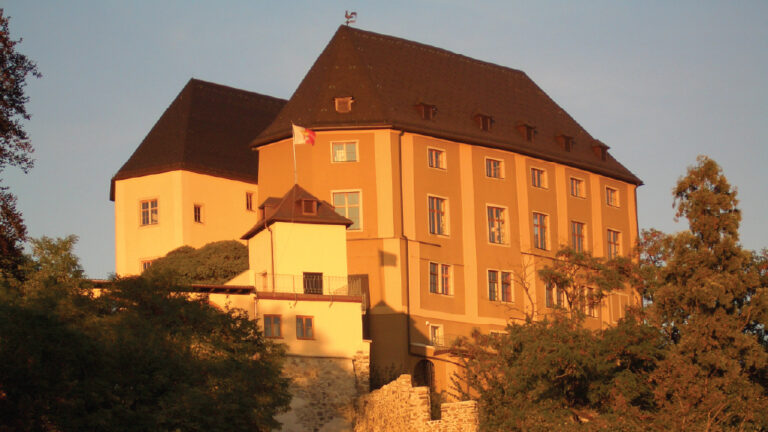
Linz Palace is a historic palace in Austria, standing above Linz’s old town beside the Danube on the site of the former Roman fort of Lentia. The site is first mentioned on June 20, 799, and its medieval castle was converted into a palace in 1477 under Emperor Frederick III.
Medieval Lords and the Babenberg Acquisition
Until about 1150, the Lords of Linz held the site as feudal lords of the High Bishopric of Passau, an ecclesiastical principality whose bishops exercised territorial and feudal authority, while the Dukes of Bavaria held sovereignty in the region. Around the middle of the twelfth century, Passau expanded Ebelsberg Castle as its base near Linz. The Haunsperg family probably then succeeded the Lords of Linz as holders of the Linz fief.
In 1205 or 1206, Babenberg Duke Leopold VI of Austria and Styria acquired the emerging city of Linz and its castle from Gottschalk II von Haunsperg. The Babenbergs ruled Austria before the Habsburgs and connected the site with the developing ducal administration.
Habsburg Residence
Emperor Frederick III converted the castle into a palace in 1477, and it served as his residence from 1489 to 1493. His son and successor, Maximilian I, also stayed frequently in Linz and at the palace.
Frederick’s grandson, the future Emperor Ferdinand I, expanded and richly furnished the palace for his wife, Anne of Bohemia and Hungary, after their wedding in Linz. Their children Elisabeth, born in 1526, and Ferdinand II, born in 1529, were born at the palace. Their daughter Catherine lived there with her household from October 1567 until her death in 1572, following her separation from her husband, the Polish King Sigismund II Augustus.
Rudolf II’s Rebuilding and the Seventeenth Century
In 1600, Emperor Rudolf II ordered the palace demolished and rebuilt to plans by Anton de Moys of Antwerp, a Dutch master builder in Habsburg service who had been court architect in Vienna from 1581. The work included a new principal gate leading toward the city, completed in 1604.
During Bavarian rule from 1620 to 1628, Count Adam von Herberstorff lived at the palace as governor. He strengthened the surrounding fortifications in preparation for a possible peasant siege, and rebellious peasants besieged the castle in 1626.
Emperor Ferdinand III and his court stayed at Linz Palace from 1644 to 1646 during the plague in Vienna. Emperor Leopold I resided there during the Second Siege of Vienna in 1683, when Ottoman forces attacked the Habsburg capital.
Fire, Penitentiary, and Military Use
In 1783, the provincial governor and his offices moved from the palace to the Linz Landhaus. During the Napoleonic Wars, the palace was used as a military hospital. A city fire began there in 1800 and destroyed the south wing together with part of the transverse wing.
After the fire, authorities decided to move the penitentiary from the abandoned Baumgartenberg Abbey into the damaged palace. A modern provincial penitentiary began operating there in 1811, and prisoners produced cloth, drill, and other textiles. The closure of the Linz wool factory, with the associated loss of wool-combing and spinning work, may have contributed to the prison’s transfer in 1851 to Garsten Abbey, another institution suppressed under Joseph II.
From 1851 to 1945, the palace served as military barracks. Between 1953 and 1963, it was extended and restored for use as the Castle Museum of the Upper Austrian Provincial Museums. The museum opened partly in the north wing in 1963 and throughout the complex in 1966.
Museum Expansion
The museum initially presented historical and ethnographic collections. It later added permanent displays of historical weapons, musical instruments, coins, and material relating to technical history, natural science, art, and cultural history.
In 2006, an architectural competition was held to rebuild the destroyed south wing. The winning proposal came from HoG architektur of Graz, represented by Martin Emmerer, Clemens Luser, and Hansjörg Luser. The new wing expanded the museum and was completed in July 2009. Since then, the rebuilt south wing and the redesigned ground floor of the north wing have also provided space for art exhibitions.
Excavations during the south-wing project investigated a room filled with sand and fine rubble after the fire of August 18, 1800, while an escape tunnel remained open. The excavated space was opened during the November 3–4, 2011 symposium “Giving Space to the Buried: A Remembrance Update” and now contains a permanent exhibition on the fate of Jews, Sinti, and Roma.
The castle park west of the fortification wall and above the palace is commonly called Schlossberg. It forms part of the Römerberg ridge, which extends westward toward Freinberg. A proposal to build Linz’s new music theater into the mountainside beside the palace on the Danube side was rejected in an Upper Austrian referendum initiated by the Freedom Party of Austria on November 26, 2000.
Remains
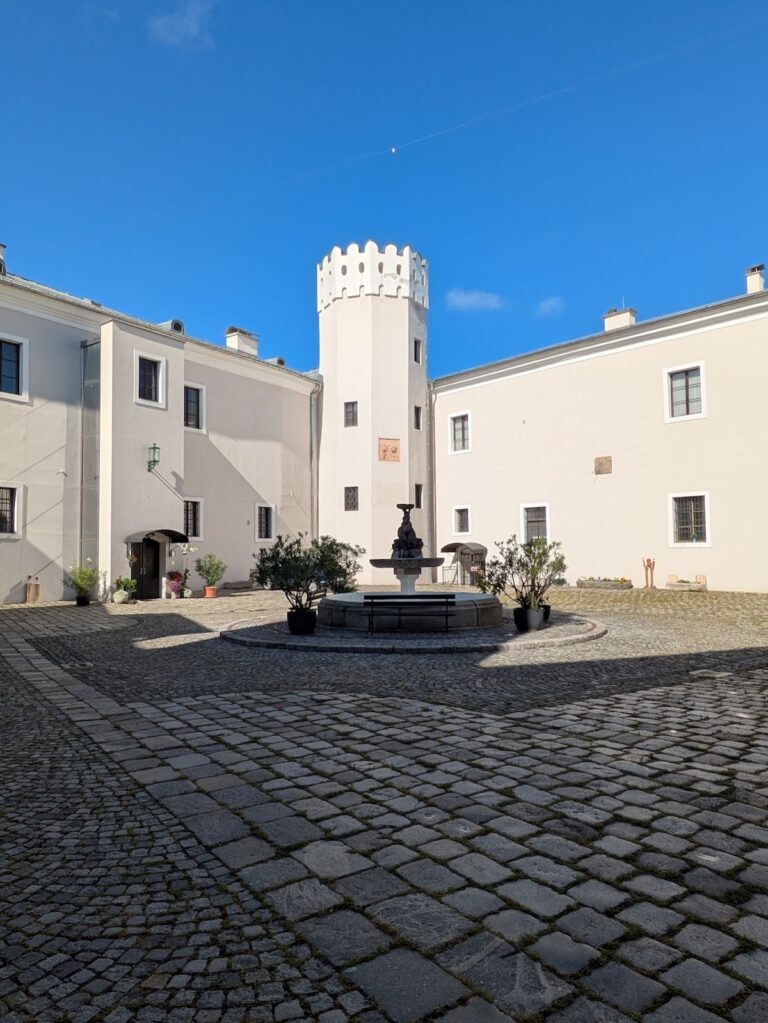
Linz Palace occupies a hill beside the Danube, with the old town below it and the Schlossberg plateau rising on its eastern side. The complex combines a massive defensive enclosure with a four-storey palace block arranged around two inner courtyards. Its surviving fabric reflects medieval fortification, the Habsburg rebuilding of the late fifteenth and early seventeenth centuries, the 1800 fire, and the later museum reconstruction.
Fortifications and Entrances
Outer Defences
Facing the rising plateau, the defensive system consists of projecting ramparts, a deep moat, and curtain walls, meaning connecting defensive walls between fortified points. Towers flank the walls and reinforce the approach to the palace.
Friedrich Gate
A rounded fortification, or rondel, protects the first gate. From there, an angled approach leads to the pointed-arched Friedrich Gate. Its coat-of-arms stone bears the date 1481 and the inscription A.E.I.O.U., a Habsburg dynastic motto whose full meaning has been interpreted in more than one way. The original stone is preserved in the museum’s north wing.
Rudolf Gate
The Rudolf Gate was built in 1604 as part of Rudolf II’s rebuilding campaign. It leads from the palace down toward Linz’s old town.
Palace Block and South Wing
Main Palace
The principal palace is a powerful four-storey block organized around two inner courtyards. Its form belongs to the transformation of the medieval castle into a Habsburg palace and to the rebuilding ordered by Rudolf II in 1600.
Rebuilt South Wing
The destroyed south wing occupied the southeastern side of the plan along the complex’s rectangular longitudinal side, slightly cut into the steep hillside. Its replacement is a steel-and-glass structure designed as a contemporary reconstruction and museum extension. Beneath it, a hall rises to 9 metres and contains the remains of a round tower 9.5 metres in diameter. The tower dates from the beginning of the sixteenth century, before Rudolf II’s rebuilding.
Archaeological and Historical Collections
Prehistoric and Medieval Objects
The museum’s archaeological displays include a Neolithic female statuette from the settlement at Ölkam, dating to around 4800 BC; a gold neck ring from the Hallstatt-period settlement of Uttendorf, from around 550 BC; and a La Tène-period beaked jug from Mining-Sunzing, dating to around 450 BC. The Hallstatt and La Tène periods were successive Iron Age cultural periods in central Europe.
The Fuchsenhof treasure contains material dating to the first century BC. It was buried around 1275–1278 and discovered in 1997. Medieval and early-modern works include the crusader sword of Kalhoch, also known as Chadeloh, von Falkenstein, from the fourth quarter of the twelfth century; the Eggelsberg Altar from the former pilgrimage church at Eggelsberg, dated 1481; the Adoration of the Magi by the Master of Mondsee, from around 1490–1493; and the Johannesschüssel by the Master of the Kefermarkt Altarpiece, from around 1500.
Objects from Early Modern Austria
Other displays include a tiled stove from Würting Castle, dating to around 1560; swords of the Linz city magistrates dated 1598 and 1659; a portal from Hartheim Castle dating to after 1598; a Marchtrenk cradle dated 1702; and a baroque apothecary from Weinberg Castle dating to around 1700. The museum also houses Franz Nikolaus Pernlohner’s map of the Traun River from its source to its mouth at the Danube. Made around 1688, it has a scale of 1:4,400 and measures 2,264 centimetres long by 38 centimetres high.
Nineteenth- and Twentieth-Century Exhibits
Later displays include a fortepiano built in Paris in 1803 by Sébastien Érard Frères for the German composer and pianist Ludwig van Beethoven. A fortepiano is an early form of piano used before the modern piano became standard. The art collections include Johann Baptist Reiter’s oil painting The Emancipated, a portrait of Louise Aston from around 1847, and Hans Makart’s The Japanese Woman, painted in oil on mahogany around 1873–1875. The Prambachkirchen meteorite is dated November 5, 1932.
Specialized Museum Collections
The Kastner art collection began with lawyer Walther Kastner’s donation in 1975, made on the condition that the works be displayed together. It grew from 323 works to more than 1,400 objects and is presented in three rooms. Other collections cover art from the twelfth to the eighteenth centuries, Upper Austrian coins and medals, musical instruments, natural history, regional industrial, economic, technical, and scientific history, folklore, and everyday culture.
The traditional-crib collection includes a crib from Garsten Abbey with almost life-sized figures dating to around 1730 and a mechanical crib from the workshop of Johann Georg Schwanthaler. Reverse-glass paintings from Sandl belong to the folklore collection, while the weapons collection contains historical cutting and thrusting weapons as well as firearms. Approximately 70 traditional cribs form part of the museum’s wider holdings.