Runkelstein Castle: A Medieval Hilltop Castle in Italy


Site at a Glance
- Rating
- 4.5
- Popularity
- Medium
- Country
- Italy
- Primary era
- Medieval
- External website
- Open
- Eras represented
- Medieval, Early Modern, Modern
- Civilizations
- Holy Roman Empire
- Site type
- Military
- Remains
- Castle
On this page16 sections
History
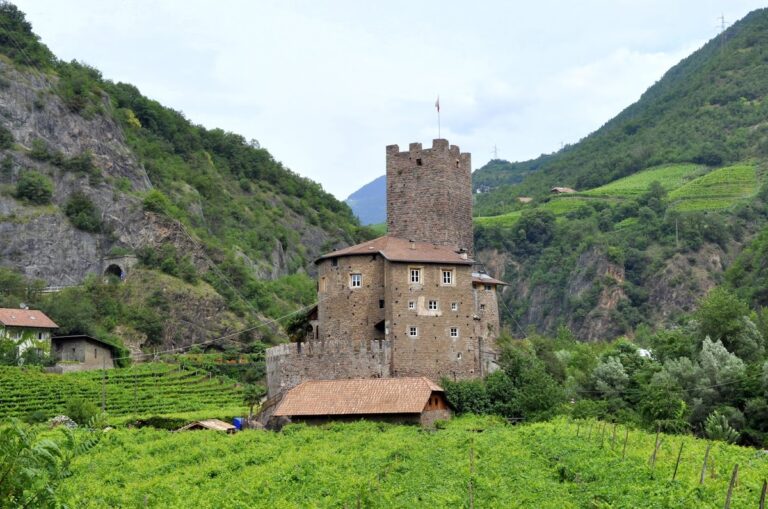
Runkelstein Castle is a medieval hilltop castle in Italy, near Bolzano in South Tyrol, whose documented history begins in 1237. Built in stone after permission was granted by the bishop of Trent, it later became a fortified residence celebrated for its extensive secular frescoes, which depict courtly and everyday life alongside religious and heroic themes. The complex has retained much of its medieval character despite damage, rebuilding, and later alterations.
Foundation and Medieval Ownership
Fortifications may have occupied the rocky site in Antiquity, but the first recorded castle was built in 1237 by the brothers Friedrich and Beral von Wangen. They received permission from Alderich von Campo, bishop of Trent, and the fortress was entered under the name Runchenstayn, the origin of the later name Runkelstein.
Count Meinhard II of Tyrol severely damaged the castle during a siege in 1274. It subsequently fell into disrepair before Meinhard granted it to Gottschalk Knoger, a protégé who had risen from service to become district judge of Egna. After Knoger’s daughter Agnes died, an arbitration judgment in 1341 transferred the castle to her daughter Weirad.
Runkelstein was restored during the fourteenth century, partly because its position enabled control of routes across the Alps between Germany and Italy. Franz and Niklaus Vintler of Bolzano acquired the castle in 1385 and began rebuilding and decorating it in 1388. A castle chapel was consecrated in 1390, while the residential buildings received the paintings that would later give Runkelstein its reputation as a “picture castle.”
Vintler and Tyrolean Rule
From 1419, the Bolzano nobleman Georg Metzner, a cousin of Hans Vintler, held a share in the castle. His descendants remained connected with its ownership for about a century. Runkelstein later passed to Sigismund the Rich and served as the residence of the prince-bishop of Trent from 1463 to 1465 under a grant from the counts of Tyrol. Prince-bishops of Trent were bishops who also exercised secular authority over the historical principality of Trent.
In 1500, the counts of Tyrol entrusted Runkelstein to Georg von Frundsberg. The castle suffered a major accident in 1520, when its powder magazine exploded. The keeper was killed, and the blast damaged the tower, the enclosing defensive wall, and part of the palace. Reconstruction was completed in 1531, with the defensive walls repaired first.
Liechtenstein Ownership and Decline
The castle passed to the von Liechtenstein family in 1538. From 1574, the Liechtenstein-Castelcorno branch lived there permanently and made architectural alterations. A Liechtenstein coat of arms remains on the main building. In 1672, a fire destroyed the East Palace, which was not rebuilt.
In 1759, the last Liechtenstein-Castelcorno holder rejected the fief, a property held under a feudal relationship, and Runkelstein returned to the control of the prince-bishops of Trent. By the eighteenth century, the castle had become a country residence for the bishops.
Restoration and Public Custody
King Ludwig I of Bavaria stayed at Runkelstein in 1833 and became the first person to sign its guest book, which is still preserved. In 1868, part of the Summer House collapsed into the ravine during a rockfall associated with construction of the new road to Sarntal.
Archduke Johann Salvator purchased Runkelstein in 1880 and gave it to Emperor Franz Joseph I, emperor of Austria and king of Hungary from 1848 to 1916. Restoration took place from 1884 to 1888 under Friedrich von Schmidt, the Austrian architect known for directing the reconstruction of Vienna’s St. Stephen’s Cathedral, with the participation of Sebastian Altmann, Johann Bittner, Otto Schmid, and Rudolf Breuer. The work sought to restore the castle as accurately as possible in a medieval style, using historically characteristic materials. The keep was rebuilt during this campaign, and the southern service building was added in the nineteenth century.
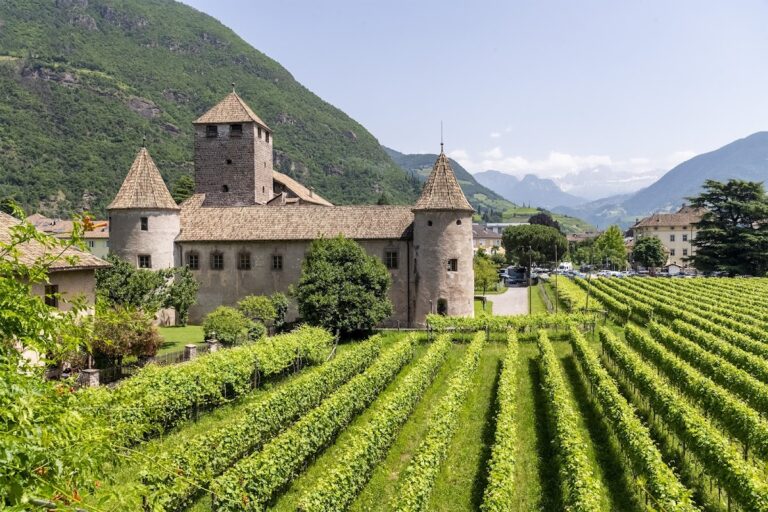
Emperor Franz Joseph donated Runkelstein to the municipality of Bolzano in 1893. The municipality remains its owner and administers the castle, together with Maretsch Castle, through the Bozen Castles Foundation. A further restoration campaign began in the mid-1990s and ended in January 2000. Runkelstein is regarded as one of the best-preserved medieval castle complexes of its type, with its medieval character largely intact. Its fame rests especially on the largest surviving medieval cycle of secular frescoes, painted between 1388 and 1410.
Remains
Runkelstein stands on a high outcrop of volcanic porphyry above the Talvera River, at the entrance to the Sarntal valley. Almost sheer slopes protect the rock on three sides. The castle follows the slightly elongated outline of the summit from north to south and includes a main castle with an extensive outer bailey. Buildings surround a small inner courtyard, while the sole entrance lies to the south, where a drawbridge formerly stood.
Residential Palaces
West Palace
The four-storey West Palace occupies the western side of the courtyard. It combines residential use with a defensive external wall and contains a bath room known as the Badestube. Its very well-preserved frescoes belong to the period of Vintler ownership. Other paintings show courtly life, knightly games, hunting, a lance tournament painted before 1402, a ball game, and communicating couples in the room of the lovers.
Frescoes in the West Palace were found beneath later paint and plaster in 1995. The bath room contains red painted wall hangings, painted arcades, elegantly dressed men and women, and animal representations. Upper rooms contain hunting scenes and tournaments. These paintings were produced before 1402 or around 1400.
Summer House
The Summer House occupies the northern side of the complex. Built from 1390, it connects eastward through the former kitchen wing with buildings along the eastern wall. Its decoration includes scenes of King Arthur’s knights, the story of Tristan and Isolde, and the rare cycle of the knight Garel of the Flowering Valley. The Tristan and Isolde paintings were made around 1410 by Hans Stocinger, a late-medieval painter associated with the Summer House frescoes.
East Palace and Chapel
The East Palace stands on the eastern side of the courtyard and has an attached castle chapel. Originally two storeys high, the chapel preserves paintings from several Christian traditions. The earliest include a Crucifixion group in the Romanesque apse, the semicircular sanctuary end, and a depiction of Cain and Abel’s sacrifice on the triumphal arch.
Other chapel paintings show episodes from the lives of Saint Christopher of Lycia and Saint Catherine of Alexandria, together with surviving parts of the legend of Saint Anthony Abbas. The paintings place sacred scenes within a complex otherwise especially known for its non-religious, or secular, decoration.
Fortifications and Service Areas
Southern Entrance
The southeastern part of Runkelstein was chiefly fortified because it contained the entrance and offered the most practical direction for an assault. The gate area was accompanied by defensive works and service buildings, including a forge, stores, and rooms for the garrison. The former drawbridge belonged to this southern approach.
Keep and Courtyard
The keep in the southeastern corner was rebuilt between 1884 and 1888. Part of the courtyard paving survives from the thirteenth century, as do paving stones and boundary walls along the steep approach. These surviving elements retain parts of the castle’s early circulation and defensive arrangement, while very little of the original interior furnishing remains.
Secular Fresco Cycle
Scenes of Courtly Life
The frescoes created between 1388 and 1410 form an unusually extensive visual record of late-medieval secular culture. Courtly life appears beside tournaments, dancing, hunting, crossbow shooting, knightly training, fishing, ball games, animals, lovers, and figures in elaborate clothing. Rather than concentrating only on sacred subjects, the paintings present activities and social ideals associated with aristocratic life.
Heroic Figures on the Summer House
The exterior of the Summer House carries nine triads, groups of three related figures, painted shortly after 1393. They include figures from Classical antiquity such as Hector, Alexander the Great, and Julius Caesar; biblical figures including Joshua, King David, and Judas Maccabeus; and medieval or legendary figures such as King Arthur, Charlemagne, Godfrey of Bouillon, Dietrich of Bern, Siegfried, and Dietleib of Styria. Giants and dwarfs also appear among the painted figures.
These subjects draw on medieval romance, heroic traditions, biblical history, and the memory of the early medieval Frankish emperor Charlemagne and the First Crusade leader Godfrey of Bouillon. Together with the scenes inside the palaces, they make the frescoes a valuable record of late-medieval clothing. The costumes preserve evidence of fourteenth-century fashion and of regional influences from different parts of Europe.
Nearby sites