Nehaj Fortress: A Sixteenth-Century Habsburg Fortress in Croatia


Site at a Glance
- Rating
- 4.6
- Popularity
- Medium
- Country
- Croatia
- Primary era
- Early Modern
- External website
- Open
- Eras represented
- Early Modern
- Civilizations
- Habsburg
- Site type
- Military
- Remains
- Fort
On this page17 sections
History
Nehaj Fortress is a sixteenth-century stone fortress in Senj, Croatia, built on the summit of Nehaj Hill as part of the Habsburg defence system against Ottoman expansion. Completed in 1558, it strengthened the city’s position on a contested frontier and became closely associated with the Uskoks, Christian refugee fighters who defended the Habsburg border while also raiding Ottoman and Venetian interests.
Earlier occupation of Nehaj Hill
Fortifications probably occupied the hill, also known as Trbušnjak, from antiquity. A watchtower may have warned the inhabitants of Senj when enemy ships approached from the Adriatic Sea. During the early Middle Ages, a Christian church stood on the site, although little is known about its history.
Archaeological work carried out during the fortress restoration in 1965 revealed the remains of the Church of St George, dating from the eleventh or twelfth century. The church was burned during a Turkish attack in 1520. Its surviving materials were later dismantled and reused when the fortress was built.
Construction under Habsburg rule
Ivan Lenkovic, captain of Senj from 1539 and a leader of the Senj Uskoks, promoted a new fortress after reporting the poor condition of the region’s defences to Emperor Ferdinand I. Habsburg funding was secured in 1551, and construction began in the mid-sixteenth century. The fortress was completed in 1558.
Lenkovic and Herbard VIII Auersperg received permission to demolish the remains of churches and houses outside Senj’s walls and reuse their building materials. Nehaj therefore formed part of a wider Habsburg effort to halt Ottoman expansion westward and reinforce the defence of Senj. Its position was intended to prevent an enemy besieging the city from establishing a secure camp, forcing attackers to undertake two separate sieges. Klis, farther south, was the principal fortress in this defensive system.
The Uskok frontier
After the Ottoman capture of Klis in 1537, Senj and Nehaj became major Uskok bases near the new Habsburg-Ottoman frontier. The Uskoks were Christian refugees displaced by Ottoman expansion who settled in Habsburg borderlands and served in frontier defence. From Senj, they guarded the border and launched raids into Ottoman territory, while also attacking Venetian shipping and interests. Ottoman forces did not capture the surrounding region.
The Habsburg-Venetian War of 1615 to 1617, a conflict between the Habsburg and Venetian powers that included disputes over Uskok attacks, ended with a treaty requiring the Uskoks to be expelled from Senj. Nehaj gradually lost its importance as a major fortress. It was not substantially reconstructed during the eighteenth and nineteenth centuries, and this limited alteration helped preserve much of its original form.
Excavation and present interpretation
The restoration begun in 1965 also brought important archaeological discoveries. Among them was the Senj Tablet, a Glagolitic inscription dating to around 1100. Glagolitic was a medieval Slavic writing system used in Croatian religious and literary texts, and the tablet is regarded as one of the oldest written documents in the Croatian language.
Nehaj is now state-owned and functions as a museum under the care of the Senj City Museum. Its exhibitions address the Uskoks, the history of Senj, the city’s former churches, weaponry, and local noble families. An annual festival of medieval culture, including historical reenactment and demonstrations of armed combat, continues the fortress’s association with the Uskoks.
Remains
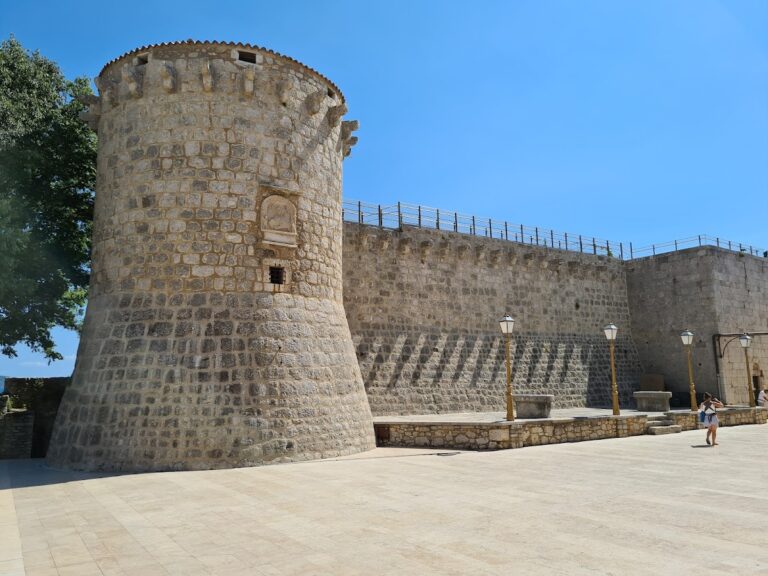
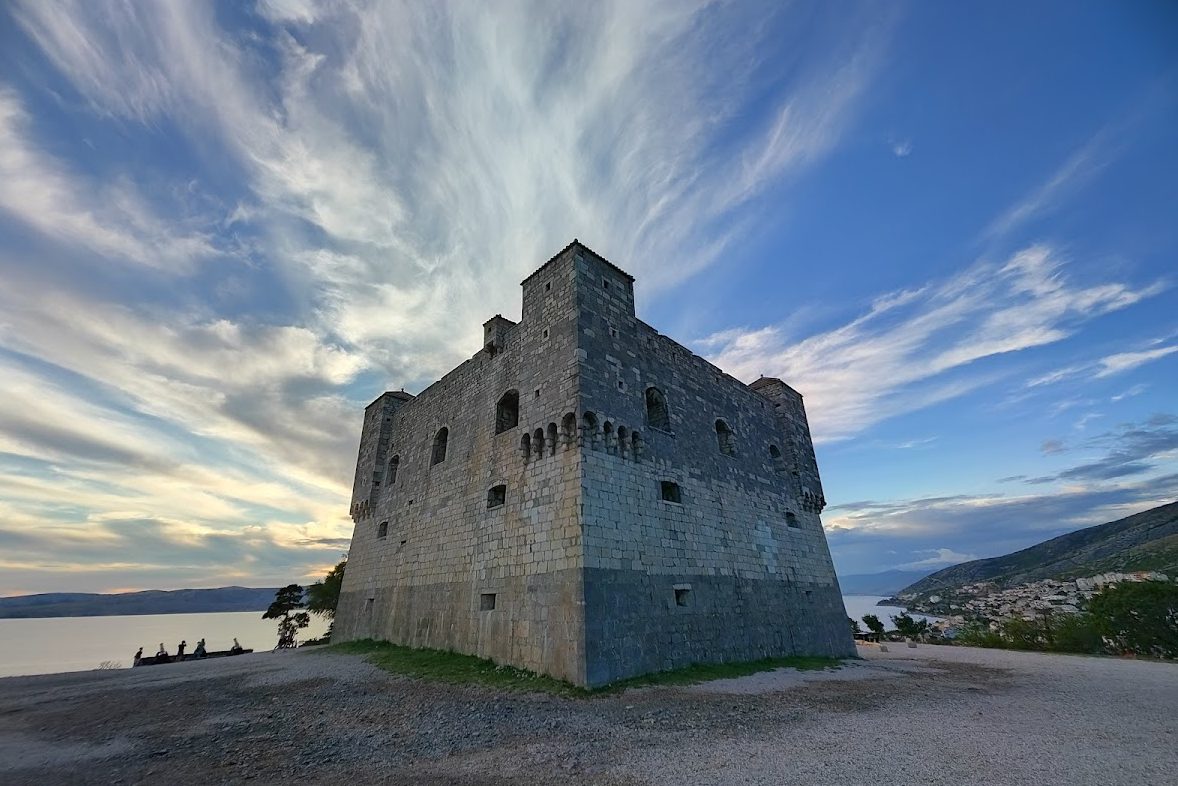
Nehaj Fortress stands on a hill beside the Adriatic Sea, approximately 62 metres above sea level. The building has an almost square or cubic plan, with sides measuring about 23 to 23.5 metres and an overall height of 18 metres. Its three defensive levels are enclosed by massive stone walls that taper upward, from roughly 3 to 3.30 metres thick at the base to about 2 to 2.5 metres at the top.
Walls and defensive towers
Stone walls
The walls are constructed from stone blocks, including material salvaged from demolished churches and houses outside Senj. More than 100 small loopholes pierce the masonry. These narrow openings allowed defenders to fire small arms, while 11 larger artillery openings accommodated cannon. The fortress was planned for a garrison of about 100 soldiers, although records kept by Lenkovic state that 300 men defended it.
Projecting towers
Five defensive towers project slightly from the walls. Four occupy the corners, while the fifth rises above the principal entrance. The corner structures are projecting half-towers that enabled defenders to direct flanking fire along the outer walls. Their brattices, which are projecting defensive structures, allowed defenders to fire downward, drop stones, or pour boiling liquid on attackers approaching the fortress.
Entrance and courtyard
Elevated entrance
The only entrance is a small doorway in the north wall, set approximately two metres above ground level. Access originally depended on a removable external staircase and a narrow wooden bridge leading to the doorway, features that strengthened control over the approach to the fortress.
Water cistern
Within the fortress is a small, narrow courtyard. Its central feature, which resembles a well, is a cistern, a constructed reservoir for collecting and storing water. A deep cavity was cut into the bedrock to collect rainwater or receive fresh water brought from outside sources.
Interior levels and collections
The ground floor contained the cistern, kitchen, defenders’ quarters, and an armoury. The first floor housed the commander and other officers. The second defensive level held 11 guns aimed in different directions, integrating the interior arrangement with the fortress’s role in controlling approaches to Senj.
Three stone-carved coats of arms survive on the walls. They represent Ivan Lenkovic, Archduke Ferdinand I of Austria, and the local nobleman Herbard VIII Auersperg. The Frankopans, a powerful local noble family that had controlled Senj until the fifteenth century, also belong to the city’s earlier political history.
Church remains and preserved objects
Church of St George
The excavated remains of the Church of St George are associated with the fortress site. Dating from the eleventh or twelfth century, the church was burned in 1520 and its remains were later dismantled during fortress construction.
Senj Tablet
The Senj Tablet was recovered during the same archaeological work. This Glagolitic tablet, dated to around 1100, is an early Croatian-language document and provides evidence of the cultural history connected with the hill before the sixteenth-century fortress was built.
Museum collections
The substantially preserved fortress was restored beginning in 1965 and now contains historical and arms collections. They include medieval weapons, twentieth-century firearms, several artillery pieces, and clothing and domestic objects associated with the Uskoks.
Nearby sites