Archaeological Park of Locri Epizefiri: Ancient Greek City in Italy


Site at a Glance
- Rating
- 4.3
- Popularity
- Low
- Country
- Italy
- Primary era
- Classical
- External website
- Open
- Eras represented
- Iron Age, Classical
- Civilizations
- Ancient Greek, Roman
- Site type
- City
On this page21 sections
History
The Archaeological Park of Locri Epizefiri in Italy preserves the remains of an ancient Greek city founded in the early seventh century BC on the Ionian coast of southern Calabria. Locri was part of Magna Graecia, the ancient Greek-speaking zone of southern Italy and Sicily, and became an important political, religious, and cultural centre in the region.
Foundation and early society
Locri’s foundation date is disputed. Ancient traditions connected it with the First Messenian War, while other calculations placed its establishment between the late eighth century and approximately 679 or 673 BC. The city is generally dated to the early seventh century BC. The first settlement stood near Cape Zefirio, now Cape Bruzzano, in a place associated with the Delphic oracle. After several years, the settlers moved about 12 to 20 kilometres north to the Epopis area, near the modern territories of Locri and Portigliola. They retained the name Epizefiri, meaning “around Zephyrion.”
Traditions differed over the settlers’ origins. They were variously described as Locrians from the Gulf of Crisa, Opuntian Locrians from eastern Locris, Ozolian Locrians from the Gulf of Corinth, or a mixed group that included Spartans and fugitive slaves. Aristotle and Polybius associated the foundation with servants who escaped with their masters’ wives during the Messenian wars, although other traditions altered or rejected that account.
The Greek settlement was established on or near an earlier indigenous community. The local Sicel population was displaced when the Locrians moved to the Epopis area. Earlier occupation of the territory is shown by pre-Greek rock-cut burials at Canale, Janchina, and Patariti, dating to approximately the ninth century BC.
Locri was governed by a conservative aristocracy described in different traditions as the “Hundred Houses” or the “Assembly of a Thousand.” Its population was divided into three tribes and thirty-six phratries, or kin-based social groups. Locrian society was also noted for recognizing maternal descent in inheritance and family continuity, as well as for the important social and religious roles attributed to women.
Law, expansion, and regional power
The lawgiver Zaleucus, traditionally dated to around 660 BC, was associated with Locri’s written legal code, one of the earliest in Europe. The code assigned specific penalties to offences in an effort to limit judicial discretion, private vengeance, and continuing family feuds. Zaleucus was also regarded as an arbitrator between competing social groups.
Locri reached its greatest territorial and cultural expansion during the sixth and fifth centuries BC. Between approximately 650 and 600 BC, it established or controlled Medma, later known as Rosarno, and Hipponion, later Vibo Valentia. It also occupied Metauros, later Gioia Tauro, in response to the expansion of Kroton. Further territorial gains extended Locri’s influence across Calabria and made it a leading city-state in the region.
Locri and Rhegion allied against Kroton and defeated it at the Battle of the Sagra, generally dated to approximately 560 to 550 BC. The victory halted Kroton’s southward expansion and established Locri as a major regional power. Later tradition attributed the outcome to Zeus and the Dioscuri, the divine twins Castor and Polydeuces, whose cult subsequently became important at Locri and Rhegion.
The city maintained close relations with Syracuse, first with the Deinomenid rulers and later with Dionysius I and Dionysius II. When Anaxilas, the tyrant of Rhegion, threatened Locri in 477 BC, the city sought assistance from Hieron I of Syracuse. Locri later supported Syracuse during the Athenian expedition to Sicily in 415 to 413 BC.
The alliance was strengthened when Dionysius I married Doris, a Locrian aristocrat. After Dionysius defeated the Italiote League in 389 BC, Locri received the territories of Kaulonia and Scolacium. The Halex River then marked its southern boundary with Rhegion.
Prosperity and political upheaval
The fourth century BC brought artistic, economic, and intellectual prosperity. Locri was associated with the poet Nossis, the philosophers Echecrates, Timaeus, and Acrion, and a flourishing Pythagorean school. This philosophical and religious tradition, associated with Pythagoras, emphasized mathematics, disciplined communal life, and the harmony of the cosmos. The physician Philistion was also linked with the city, and Plato was said to have visited Locri to study philosophy.
Between approximately 357 and 347 BC, Dionysius II of Syracuse was expelled from his city and established himself as tyrant of Locri. His policies against the local aristocracy and the depletion of the city treasury provoked an uprising. His family was killed, Dionysius was expelled, and democratic government was restored.
During the war between Rome and Pyrrhus of Epirus, Locri first allied with Pyrrhus in 280 BC, partly because of its earlier relationship with Tarentum, and later returned to the Roman side. Pyrrhus subsequently devastated the city and plundered the sanctuary of Persephone. Locri changed allegiance more than once during the conflict and minted coins for both sides.
Locri sided with Hannibal during the Second Punic War, the long conflict between Rome and Carthage, and Carthaginian forces occupied the city in 216 to 215 BC. In 205 BC, Scipio Africanus recovered Locri after Roman troops entered the lower quarter with the help of Locrian conspirators. Control then passed to Quintus Pleminius and Roman military commanders.
Pleminius and his troops committed violence and theft against the Locrian population and plundered the sanctuary of Persephone. After Locrians appealed to the Roman Senate, Pleminius was arrested, the soldiers’ loot was returned, and the sanctuary treasury was restored with additional public funds. Locri retained its laws and customs as a Roman ally, although the political upheavals of the third century BC caused economic decline and the abandonment of substantial urban areas.
Roman rule and abandonment
Locri remained allied to Rome and was required to provide ships in 191 and 171 BC. In 156 BC, its economic crisis prevented it from fulfilling another naval obligation, and Polybius helped secure an exemption from sanctions. During the Roman imperial period, Locri became a smaller administrative centre, while agricultural settlements and villas assumed greater economic and residential importance.
The city remained important in southern Italy into the fifth century AD, although its size had been reduced. It was gradually abandoned during the seventh and eighth centuries AD, partly because of Arab raids, and its inhabitants moved inland toward Gerace. The tradition that refugees founded Gerace under the leadership of a sparrowhawk is legendary. A settlement had already existed there since the Neolithic period.
Rediscovery and archaeological investigation
From the medieval period onward, ancient Locri was quarried for building stone. Blocks were reused in nearby construction, including at Gerace Cathedral. Interest in the site increased from the sixteenth century, and eighteenth-century visitors recorded surviving columns and Roman brick walls. Nineteenth-century construction intensified destruction and stone removal, but François Lenormant helped bring the damage to an end in 1879.
Archaeological investigation included a late nineteenth-century Italian-German campaign directed by Eugen von Petersen and Paolo Orsi, followed by Orsi’s work from 1908 to 1915. Paolo Enrico Arias investigated the site from 1940, and later campaigns were led by Gaspare Oliverio, Alfonso De Franciscis, Giorgio Gullini, Marcella Barra Bagnasco, and Diego Elia. Excavations revealed temples, cemeteries, urban quarters, workshops, fortifications, the theatre, the sanctuary of Persephone, and the sanctuary of the nymphs.
Excavation at Centocamere began around 1950 and exposed residential quarters, pottery workshops, part of the city wall, and a U-shaped stoa, a covered colonnaded building surrounding or bordering a courtyard. The work provided evidence for domestic life and stopped after 1956 before resuming with the University of Turin from 1969. The sanctuary of Persephone at Mannella was rediscovered and excavated by Paolo Orsi in 1910, while the theatre was identified and investigated from 1940 onward. Later campaigns examined Parapezza, southern Marasa, the city walls, the theatre, and a late antique complex containing a palatium and baths. Research around Casino Macri has continued under the University of Turin.
Remains
The Archaeological Park covers more than 230 hectares in the area of ancient Locri, approximately 3 kilometres southwest of the modern town. It lies between the Portigliola and Gerace rivers, the Ionian Sea, and the hills of Castellace, Abbadessa, and Mannella. The ancient city is divided into an upper public and sacred zone and lower residential and craft areas. A regular urban plan centred on a broad main street, the dromo, was supplemented by smaller parallel streets that generally descended from the hills towards the plain and coast. Major roads were about 14 metres wide, while smaller streets measured approximately 4.5 metres.
Fortifications and urban quarters
City walls
A roughly rectangular fortification system enclosed the city for about 7 to 7.5 kilometres along the coast and incorporated the elevated areas of Castellace, Abbadessa, and Mannella. It included stretches of wall and circular-based towers. Construction began around the sixth century BC, while much of the visible wall at Parapezza and Marasa dates to the third century BC.
Centocamere
Centocamere was one of the principal urban quarters. It contained houses, workshops, the sanctuary of Aphrodite, and the U-shaped stoa. The quarter was abandoned towards the end of the third century BC and was later partly replaced by a Roman necropolis.
House of the Lions
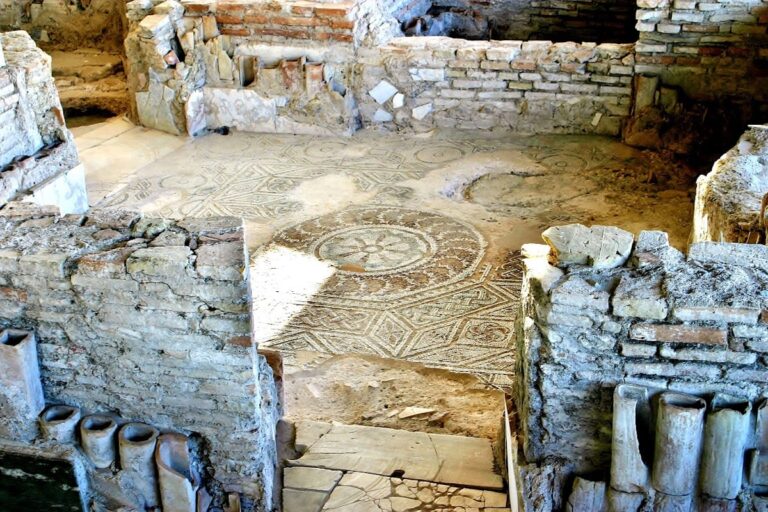
The House of the Lions dates to the early third century BC and is the largest excavated dwelling at Locri, covering about 400 square metres. Its features include reliefs of lions, a large portal of coloured marble, an andron for formal male dining, a private bathroom with a terracotta bathtub, and latrines.
Theatre and sacred architecture
Theatre
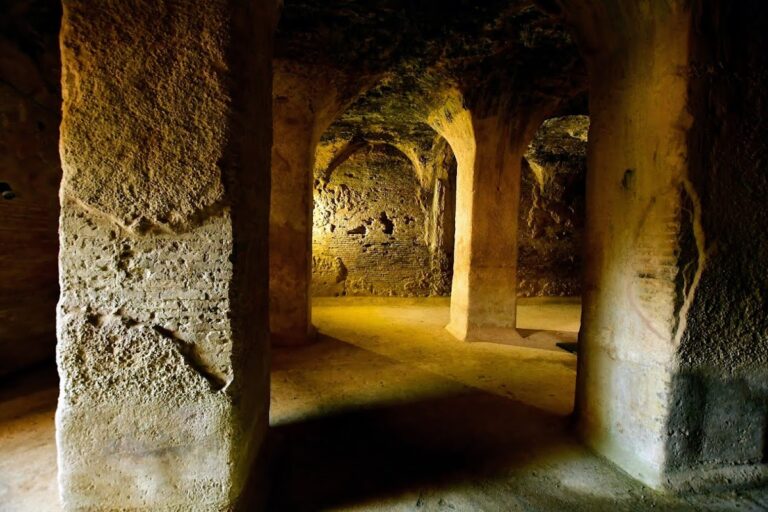
The theatre in the Pirettina area was built in the fourth century BC by cutting its seating into a natural hollow in soft sandstone at the foot of Casa Marafioti hill, below the Cusemi plateau. Its seating area could accommodate about 4,500 spectators. Rock-cut steps were combined with sandstone slabs, and six stairways divided the cavea, or seating area, into seven wedges. A horizontal passage called a diazoma separated the seating levels. The upper zone has largely deteriorated.
The theatre was rebuilt or substantially altered in Roman times, including during the first century BC. The lowest rows were removed and a high semicircular limestone wall was added, probably to protect spectators during gladiatorial or animal combats. The building may also have served for political assemblies during the Greek period.
Sanctuary of Aphrodite
The sanctuary of Aphrodite in the southern Marasa area stood near the southeastern gate. It consisted of a small temple, a central courtyard, and a U-shaped stoa. Built in two phases between the late seventh and mid-sixth centuries BC, it remained in use until the mid-fourth century BC. Six rooms, each approximately 7 by 5 metres, stood on either side of a courtyard measuring about 55 by 66 metres. The rooms were later subdivided into eleven.
More than 350 bothroi, or ritual pits used for offerings or sacrificial remains, were found in the stoa. They contained remains of meals, animal bones, terracotta figures, and dedications associated with sacred banquets. A black-glaze vessel bearing the name of Cybele indicates that this eastern goddess was present at Locri before or alongside her association with Aphrodite. Immediately outside the southern walls stood a late Archaic sacellum, or small shrine, dating to approximately 500 to 480 BC and associated with Aphrodite. Nearby, women’s religious groups held private celebrations of Adonis at the House of the Lions in a manner influenced by Athenian practice.
Ionic Temple of Marasa
The Ionic Temple of Marasa occupied the site of an earlier temple. The first building had a wooden frame and was constructed in the seventh century BC. It was remodelled several times before being demolished and buried in a large pit around the end of the sixth century BC. During the first half of the fifth century BC, a larger limestone temple in the Ionic style replaced it.
The later temple was built around 470 BC by Syracusan architects and craftsmen on the initiative of Hieron I of Syracuse. It kept the earlier location but had a different orientation. Measuring approximately 45.5 by 19.8 metres, it had a cella, the principal enclosed chamber, without central supports, a pronaos or front vestibule with two columns between the projecting wall ends, and an opistodomos, or rear chamber, that did not open into the cella. Stairways within the walls gave access to the roof.
Seventeen Ionic columns stood along each long side and six formed the façade. The columns were approximately 12 metres high and carried volute capitals. The architrave had three bands, while dentils replaced a conventional frieze. Three large upright limestone slabs in the centre of the cella covered a bothros important to the cult. The temple was destroyed in the nineteenth century, and only one column fragment remains visible above ground.
Sanctuaries at Mannella and elsewhere
The sanctuary of Persephone, also called Kore, stood outside the city walls on a narrow terrace between the Mannella and Abbadessa hills. Retaining walls probably marked the sacred enclosure and created a narrow approach. The complex included a building around a square pit interpreted as a treasury, while the sanctuary’s finds include figured terracottas, vase fragments, small terracotta altars, mirrors, dedicatory inscriptions, and numerous pinakes.
The sanctuary was used from the seventh to the second century BC. Its votive material relates to Persephone, the Greek goddess of the underworld and a figure associated with fertility and seasonal renewal, as well as to rites concerning fertility, marriage, the underworld, wisdom, and knowledge. The pinakes are rectangular or nearly square terracotta plaques, generally made during the first half of the fifth century BC. They have polychrome relief decoration, measure up to about 30 centimetres across, and contain holes for hanging. Many depict the abduction of Kore, who becomes Persephone, queen of the underworld and wife of Hades.
A sanctuary of Athena was probably established on Mannella hill within the city walls during the sixth century BC. A sanctuary of Zeus was associated with the Casa Marafioti area. Inscriptions found halfway up Mannella hill suggest that the agora, or public marketplace and civic space, may have been near the foot of the hill. The sanctuary of Demeter Thesmophoros stood immediately outside the northeast corner of the walls, facing a gate, and covered about 3,000 square metres. It was associated with agriculture, marriage, female fertility, and rites of passage.
At Grotta Caruso, a cave with a spring, the nymphs were worshipped from the sixth century BC. Other sacred areas outside the walls included a sanctuary of Demeter at Paparezza and further sanctuaries whose votive offerings indicate their religious importance.
Necropolises and archaeological finds
Lucifero and Parapezza cemeteries
The Lucifero necropolis contained approximately 1,700 tombs dating from the seventh to the second century BC. Other cemeteries included Monaci, Russo, Faraone, and Parapezza, while Roman cemeteries were established at locations including Saletta. At Lucifero, burial types included pit graves, graves covered by pitched tiles, and graves with semi-barrel vaults.
Burial goods included imported Greek and Magna Graecian vessels, bronze mirrors, fibulae, jewellery, cosmetic containers, lekythoi for perfumed oils, and small terracotta altars decorated with underworld imagery. Some children’s graves contained articulated terracotta dolls, balls, miniature lamps, and other small objects.
Parapezza, southwest of Lucifero, contained more than 200 graves and was intensively used during the Archaic and Hellenistic periods. Finds included vessels from Corinth, eastern Greece, Attica, and Laconia, hydriai for drawing and carrying water, vessels for cremated remains, and large containers for infant burials. A small limestone pediment with Doric decoration from a naiskos, or small shrine, dates to the fourth or third century BC and was found at Faraone.
The Parapezza burials also produced evidence for fourth-century BC Adonis gardens. These were made in broken and inverted transport amphorae in which fennel and lettuce were grown and watered with warm water. Food remains from the necropolises include cereals, pulses, hunted animals, fish, dairy products, fruit, wine, oil, olives, sauces, and honey.
Roman transformation and collections
Petrara complex
During the early Imperial period, Locri underwent a major urban and cultural transformation around the mid-first century AD. Roads and monuments were improved, especially in the Petrara area, and the urban plan was reorganized over earlier Greek streets and buildings that had served as houses and workshops.
Building A/B at Petrara was a multifunctional complex that may have served dynastic-cult, commercial, civic, and administrative purposes. Its arrangement has been compared with the Building of Eumachia at Pompeii and the Augusteum at Herculaneum, although its precise function remains uncertain.
Temple archive and sculptural remains
Near Marasa, a cylindrical stone chest contained thirty-seven inscribed bronze tablets. Dating to the late fourth or early third century BC, they are associated with the administration of the sanctuary or temple of Zeus. Two marble acroteria, sculptural elements placed at the apex or corners of a temple roof, may represent the Dioscuri on horseback. They are preserved in the National Museum of Magna Graecia in Reggio Calabria. Other finds from Locri include possible silen-head antefixes, decorative features that masked the ends of roof tiles and may have decorated the theatre.
The Ludovisi Throne, discovered in Rome, has been associated by many scholars with the Marasa sanctuary, although the attribution remains interpretive. A fragment of a terracotta pinax from Mannella, dated to approximately 470 to 460 BC and now in the National Museum of Magna Graecia in Reggio Calabria, contains a female figure comparable to one represented on the throne. The site museum and antiquarium contain material directly associated with Locri, including votive plaques from the Persephone sanctuary, funerary objects from the necropolises, architectural blocks, inscriptions, and other excavated finds.