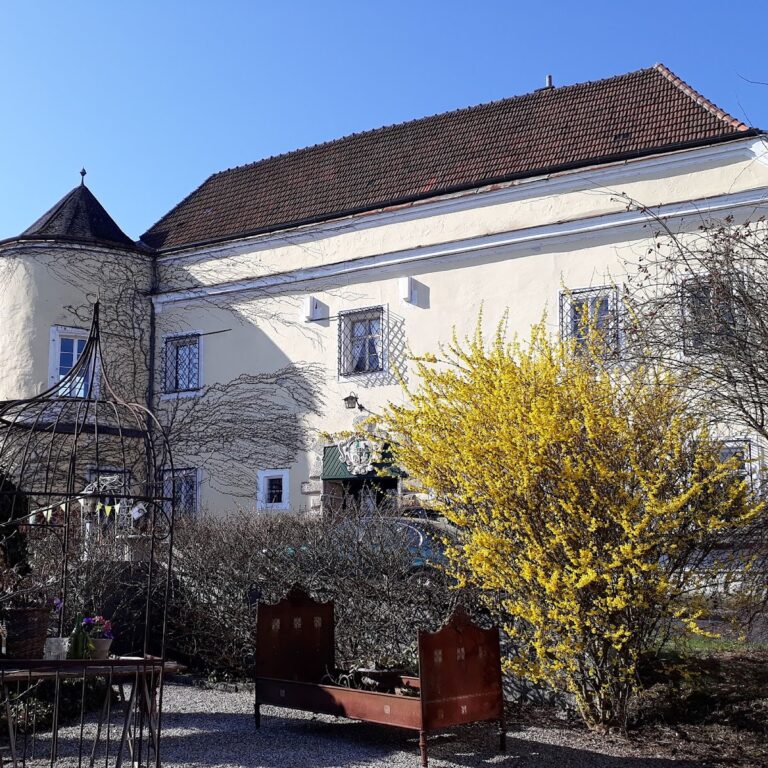
Schloss Engelseck: A Renaissance Castle Complex in Steyr, Austria
Site at a Glance
- Rating
- 4.8
- Popularity
- Very Low
- Country
- Austria
- Primary era
- Early Modern
- Eras represented
- Early Modern
- Civilizations
- Habsburg, Holy Roman Empire
- Site type
- Military
- Remains
- Castle
On this page6 sections
History
Schloss Engelseck, also known as Engelsegg, is a castle complex in Steyr, Austria, built around 1500 in a period associated with Renaissance architecture, although its exact construction date is unknown. The site served as a seat as early as the thirteenth century and later became associated with the wealthy cloth merchant Hans Fuchsberger, who is presumed to have built the complex and served as mayor of Steyr in 1525 and 1526.
From Teufelseck to Engelseck
Until 1642, the estate was called Teufelseck. The earlier name, Teufelsegg, came from the partly underground Teufelsbach. Josef Achtmarkt von Achtmarktstein, mayor of Steyr from 1642 to 1645, acquired the castle in 1641 and remodeled it in the Renaissance style, a European period that revived classical architectural forms and ornament. In 1642, he petitioned Emperor Ferdinand III, who ruled as Holy Roman Emperor from 1637 to 1657, to change the name to Engelseck. Achtmarkt von Achtmarktstein died in 1647.
Successive owners
Mattheus Riß owned the castle in 1667, and the Riß family of Risenfels retained it until 1726. Johann Josef von Risenfels was married to Helena Theresia Händl von Ramingdorf. Franziska von Rummel later owned the estate and sold it to Jakob Voith in 1783. The Höger family followed, then Josef Mayr in 1835, and later Josef Werndl, who also owned Schloss Rosenegg. Through Werndl’s daughter Anna, the property passed to the Counts of Lamberg.
The City of Steyr has owned Schloss Engelseck since 1918. The Austrian Federal Monuments Office lists the property under the name “Schloss Engelsegg” and includes it among protected immovable monuments.
Remains
Castle complex
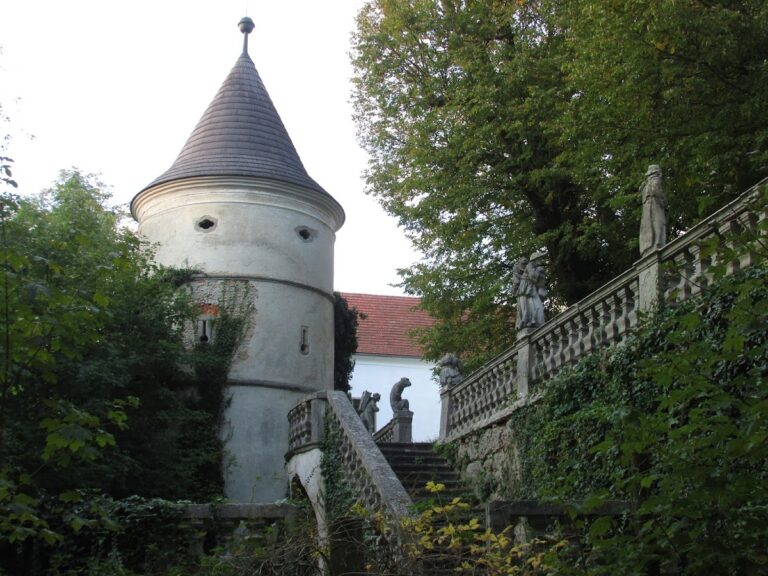
Schloss Engelseck is a simple two-storey Renaissance building arranged in three wings around a courtyard open toward the front. The short side wings have half-hipped roofs, which slope on their front sides, while a tall tower rises within the central wing. A crenellated enclosing wall, fitted with two round towers, surrounds the complex.
The central tower has a platform around its upper part rather than a roof and is finished with a false crenellated parapet, a decorative battlement-like top. This arrangement replaced an earlier onion dome. The exterior carries a round-arch frieze and imitation ashlar masonry, a decorative finish that reproduces the appearance of carefully dressed stone laid in regular courses. A statue of Saint John of Nepomuk stands on one of the walls. The fourteenth-century Bohemian priest and martyr became a prominent Catholic saint, particularly associated with bridges, waterways, and protection of the confessional.
Courtyard, towers, and grounds
A coat of arms dated 1766 is set on the south side of the courtyard, while the date 1617 appears on the west side. The round tower facing Redtenbachergasse has an attached rondel, a circular or semicircular projecting feature traditionally associated with fortifications or lookout structures, offering a view over the city of Steyr. A tree-filled park extends beside and behind the castle.
The complex also appears in a 1674 engraving by Vischer, where it is identified as “Engelsegg.”
Nearby sites