Palazzo Gabrielli-Mignanelli: A Late-Renaissance Palace in Rome


Site at a Glance
- Rating
- 4.5
- Popularity
- Very Low
- Country
- Italy
- Primary era
- Early Modern
- Eras represented
- Early Modern, Modern
- Civilizations
- Italian, Papal States
- Site type
- Domestic
- Remains
- Elite Residence
On this page7 sections
History
Palazzo Gabrielli-Mignanelli is a late-Renaissance palace in Rome, Italy, built around 1575 for Count Girolamo Gabrielli of Gubbio. Its construction is attributed to Alessandro Moschetti. The palace rose on the slopes of the Pincian Hill, on land once occupied by the Gardens of Lucullus, laid out in the first century BC by Lucius Licinius Lucullus, a Roman general and statesman known for his wealth and cultural patronage. In the sixteenth century, this area was still considered periurban, and the palace became its first monumental building.
From the Gabrielli to the Mignanelli
Ownership changed after the marriage of Maria Gabrielli and Giovanni Mignanelli in 1615. Giovanni was related to Cardinal Fabio Mignanelli, and the palace passed to the Mignanelli family of Siena. Their name also became attached to the piazza in front of the building.
During the mid-seventeenth century, Margherita Mignanelli brought the palace to Domenico Vaini as her dowry. The Vaini inheritance later passed to the Lante della Rovere family through the marriage of Angela Vaini and Ludovico Lante in 1705.
Institutional and modern uses
From the late eighteenth century, the palace was rented to several institutions. The Banca Romana occupied it from 1834 to 1865, while the ground floor accommodated the Circolo dei Francesi from 1848. This association was frequented by French residents of Rome. After Italian unification, the Directorate of the State Archives of Rome also used the building. In 1814, before these later institutional phases, the adolescent Massimo d’Azeglio stayed there with his father, Cesare Taparelli d’Azeglio, who had been sent to Rome in connection with the return of Pope Pius VII.
In 1887, Pope Leo XIII acquired Palazzo Gabrielli-Mignanelli for the Urbaniana University, a pontifical institution connected with Catholic missionary and theological education. He commissioned Andrea Busiri Vici to complete and renew the facade, enlarge the palace, add a floor, and extend the built area into the former garden. These changes provided space for the printing press of Propaganda Fide, the Catholic institution responsible for organizing and supporting missionary activity.
Some rooms were occupied by the Valentino fashion house from 1967, and the palace became the company’s entire headquarters in 1988. It housed the Valentino Academy from 2013 and, from 2025, the Valentino Garavani and Giancarlo Giammetti Foundation. A major conservation campaign in 2014 and 2015 treated the facades and interior frescoes, revealing their original colors. Since the first postwar period, the square has also hosted a week of celebrations for the Feast of the Immaculate Conception, the Catholic feast concerning Mary’s conception without original sin, culminating in an address by the Bishop of Rome before the obelisk dedicated to the Virgin Mary.
Remains
Palace and courtyard
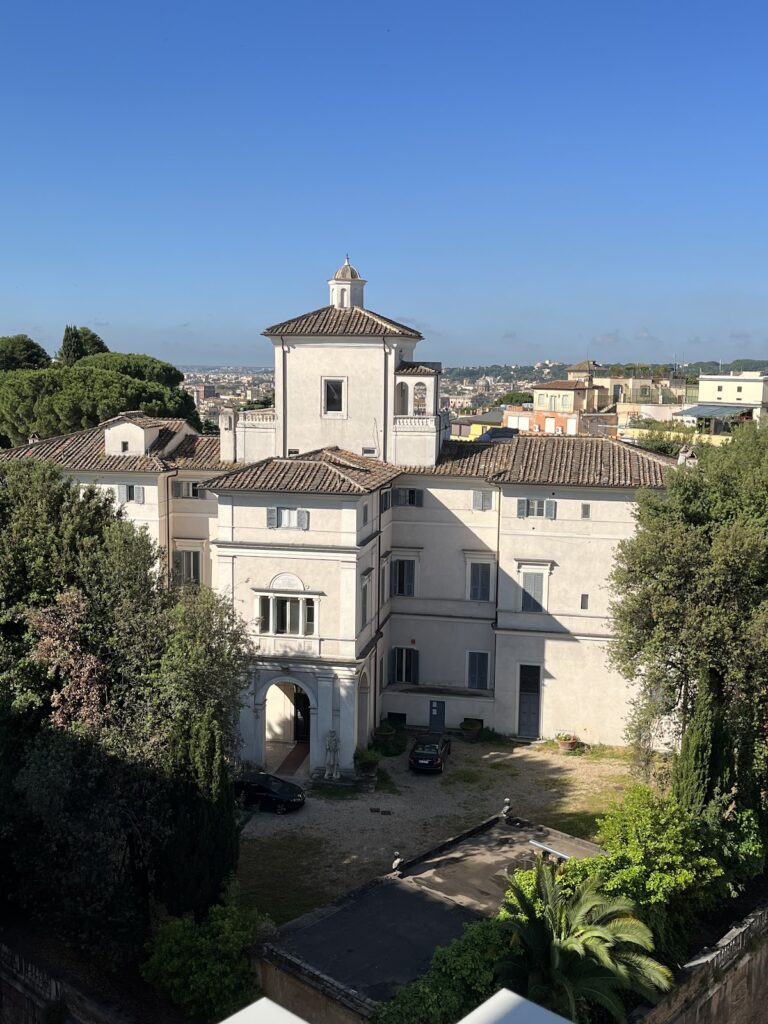
Palazzo Gabrielli-Mignanelli forms the eastern backdrop of Piazza Mignanelli and overlooks both the piazza and Piazza di Spagna. It began as a two-storey building and now rises through four floors. Its area was enlarged in the late nineteenth century at the expense of the earlier garden. Within the inner courtyard, the Gabrielli coat of arms preserves a visible sign of the palace’s original owners.
The principal entrance is a large arched portal with rusticated stonework, a treatment that gives the doorway a strongly articulated surface. It bears the coat of arms of Propaganda Fide, reflecting the building’s late nineteenth-century institutional phase. A second entrance opens onto Via Gregoriana and corresponds with the adjacent Palazzetto Gabrielli, whose corner is marked by the Gabrielli arms.
Roman mosaic
A large Roman-period mosaic showing a lion attacking a leopard was once kept in the palace garden and was later moved to an interior room. Girolamo Gabrielli had brought it from the ancient theatre of Gubbio. The Mignanelli family subsequently sold the mosaic to Thomas Coke, 1st Earl of Leicester, who installed it at Holkham Hall, where it remains.
Frescoes and conservation
The conservation work of 2014 and 2015 included the interior frescoes as well as the facades. The treatment brought the original color scheme back into view, preserving an important part of the palace’s decorative character alongside its later architectural additions.