Château de Quintigny: A Medieval Fortified Manor House in France


Site at a Glance
- Rating
- 4.6
- Popularity
- Very Low
- Country
- France
- Primary era
- Medieval
- Eras represented
- Medieval
- Civilizations
- Holy Roman Empire
- Site type
- Domestic
- Remains
- Castle
On this page9 sections
History
Château de Quintigny is a medieval fortified manor house in France, begun in the thirteenth century by the lords of Quintigny. It belonged to the former lordship of Quintigny in the Jura, within the former County of Burgundy, and stands about 3 kilometres northwest of L’Étoile and 9 kilometres northeast of Lons-le-Saunier.
The Lordship of Quintigny
The lordship of Quintigny was a feudal lordship held under the authority of the neighboring lordship of L’Étoile. The earliest surviving written references to the village and castle date from 1290 and 1358. These records place the manor within a network of aristocratic holdings in the medieval County of Burgundy.
Among the recorded holders was Jean de Jauche, known as Bouton, a knight and lord of Saligny. He was married to Jeanne de Champagne. Their eldest son, Huguenin Bouton, became squire and lord of Quintigny, but died without descendants. His brother Guillaume inherited the lordship and also held Saligny, Varennes-Saint-Sauveur, and La Barre. Guillaume’s wife was Jeanne de Montmoret, and their only daughter became his heir.
That daughter, Jeanne Bouton, was lady of La Barre and Quintigny. She married N. de Sainte-Croix, lord of Clémencey. Their children, Jean and Jeanne de Sainte-Croix, were recognized as co-heirs of their father in 1431.
Later Noble Ownership
The Desprez family acquired the lordship in the sixteenth century. During the seventeenth century, it was held by Guillemette Joubard de Quintigny, whose heir was Claude Déprel, a squire. Around 1670, Joachim de Beaurepaire acquired the fief, meaning the land or property held within a feudal relationship.
A few years before the French Revolution of 1789, ownership was associated with Alexandre de Fauchier, Marquis de Lullin, and Antoine de Mailly-Château-Renaud. The castle is now privately owned and functions as a wine estate within the L’Étoile Jura appellation, a regulated French designation linking wine to a defined area and production standards. It has been registered as a historic monument since 15 April 1987.
Remains
Courtyard and Fortified Residence
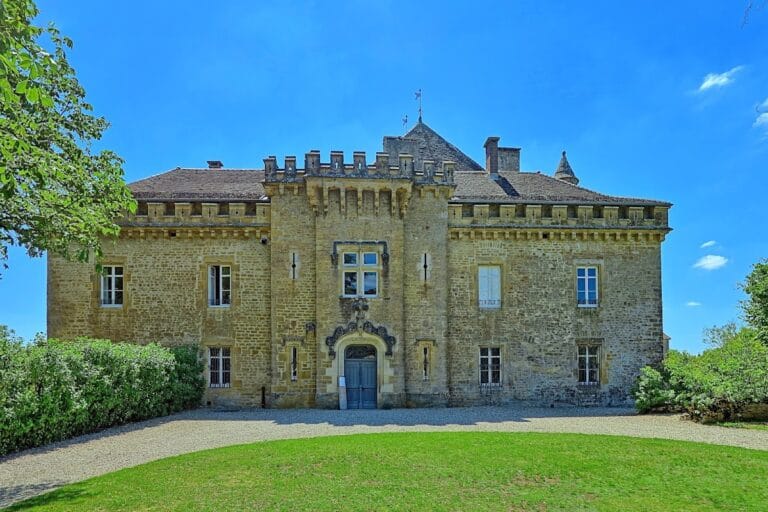
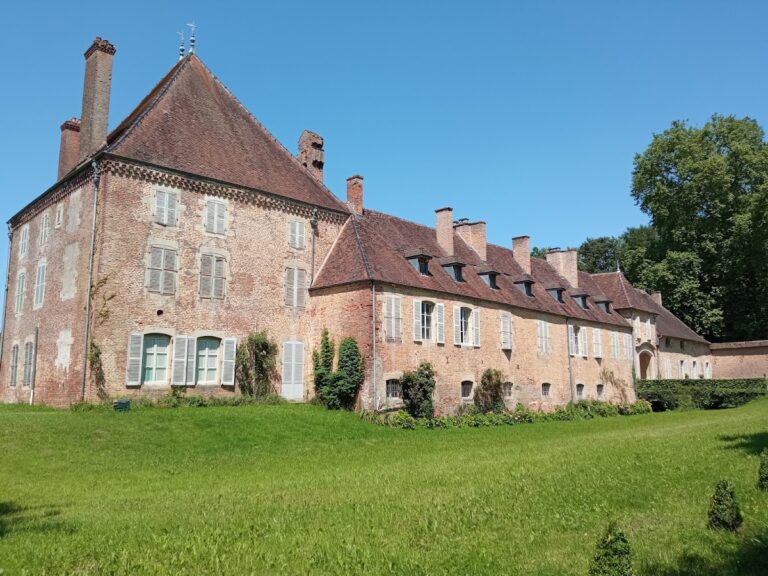
Quintigny Castle is arranged around a central courtyard that opens toward the vineyard. Buildings enclose the courtyard on three sides, forming the core of the medieval fortified manor house, or maison forte, a residence that combined the household of a lord with defensive features.
Entrance Gateway
The seigneurial residence, meaning the lord’s principal dwelling, includes a vaulted entrance gateway topped by two corbelled turrets. These turrets project outward from supporting masonry and give the gateway its defensive character. The complex also contains agricultural buildings and other farm dependencies.
Chapel and Estate Grounds
Chapel of Saint Claude
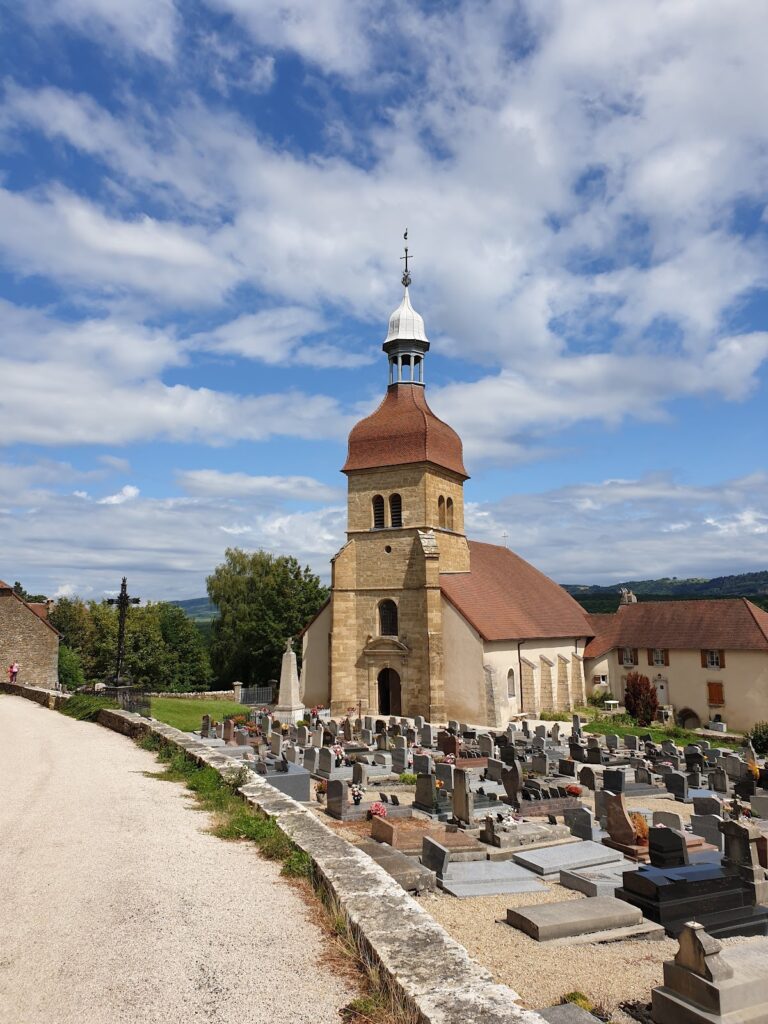
The chapel is dedicated to Saint Claude, a seventh-century bishop of Besançon and abbot traditionally venerated in the Jura. Its pointed-arch window belongs to the Flamboyant Gothic style, a late Gothic phase known for elaborate, flame-like stone tracery. The chapel now serves as the village church.
Former Agricultural Estate
The former estate covered 7 hectares and included woodland, vineyards, a kitchen garden, an orchard, and facilities for raising cattle. Its surviving organization reflects the combined residential and agricultural functions of the manor. The property remains associated with the L’Étoile vineyard and is used as a private wine estate.
Nearby sites