Schloss Neuwaldegg: Baroque Palace and Landscape Park in Vienna
Site at a Glance
- Rating
- 3.8
- Popularity
- Very Low
- Country
- Austria
- Primary era
- Early Modern
- Eras represented
- Early Modern, Modern
- Civilizations
- Austria-Hungary, Habsburg, Holy Roman Empire
- Site type
- Domestic
- Remains
- Palace
On this page13 sections
History
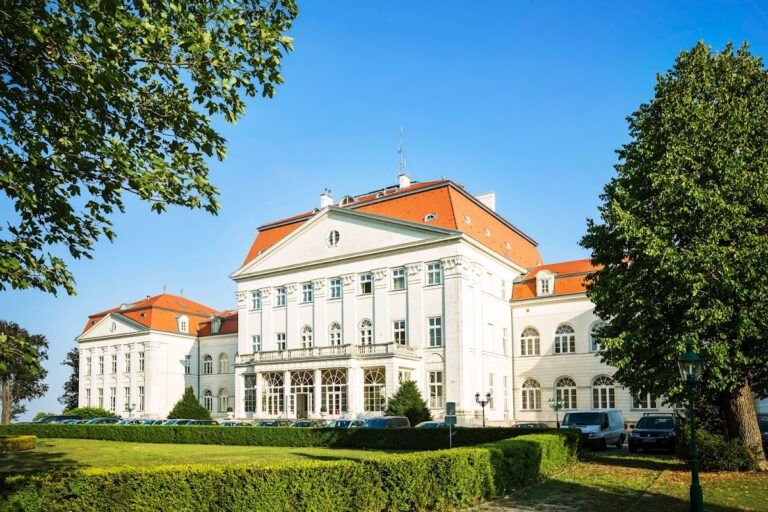
Schloss Neuwaldegg is a Baroque palace in Vienna, Austria, built between 1692 and 1697 for Count Theodor Heinrich von Strattmann, probably to designs by the architect Johann Bernhard Fischer von Erlach. Known originally as Gartenpalais Strattmann, it formed the centre of an aristocratic estate whose history reaches back to the sixteenth century.
From estate to palace
The Neuwaldeggerhof estate is documented from 1535. It began as a farm acquired by the imperial adviser Stefan Agler after the Ottoman siege of Vienna in 1529. Emperor Ferdinand I later ennobled Agler, who received the titles of Baumgarten and Neuwaldegg. The estate was destroyed during the Ottoman campaign of 1683, after which the palace was constructed for Strattmann.
A regular terraced garden was laid out with the new palace. This formal arrangement belonged to the Baroque style, an aristocratic culture of geometric design, terraces, sculpture, and carefully controlled views.
Count Lacy and the landscape park
Field Marshal Count Franz Moritz von Lacy acquired the palace at auction in 1765. Lacy was an Austrian military commander and adviser to Empress Maria Theresa and Emperor Joseph II. Until his death in 1801, he enlarged the grounds into a broad landscape park reaching toward the hunting grounds of the Dornbach valley and the Vienna Woods, extending as far as the modern Vienna city boundary. It was regarded at the time as one of Austria’s largest and most attractive parks.
Lacy transformed the earlier formal setting into what is regarded as Austria’s first English-style landscape garden. This approach used lawns, groves, winding routes, and designed natural scenery instead of relying mainly on symmetrical beds and straight axes. Lacy opened the grounds to the public, making them a popular destination for Viennese day-trippers.
Later ownership and conservation
After Lacy’s death, the palace and park passed to the Schwarzenberg family, a prominent Central European noble house. The family transferred many works of art to Český Krumlov Castle in Bohemia, and Schloss Neuwaldegg and its gardens subsequently fell into neglect. Under Hereditary Princess Therese of Schwarzenberg, the palace garden acquired its present Neo-Baroque appearance around 1890. Neuwaldegg became part of Vienna’s seventeenth district, Hernals, in 1892.
The Archdiocese of Vienna acquired the palace in 1951, and its interior was adapted as an educational centre between 1978 and 1986. Vienna’s municipal government acquired the Schwarzenbergpark in 1985 for recreational use. A private foundation acquired the palace in 2002, enabling its renewed use for public and private events and exhibitions. The Franz Schubert Conservatory occupied the building from 2010 to 2016. The garden is regarded as one of Austria’s important garden-architectural monuments. The palace and park form part of the Hernals–Vienna Woods Landscape Conservation Area, while the garden and relevant parts of the park are protected under Austria’s monument-protection legislation.
Remains
Schloss Neuwaldegg survives as a Baroque palace associated with a garden complex that combines a formal terraced design with a later English-style landscape park. The grounds extend toward the Dornbach valley and the Vienna Woods, incorporating avenues, meadows, sculptures, guest houses, and commemorative architecture.
Palace and formal garden
Schloss Neuwaldegg
The palace was constructed between 1692 and 1697 for Count Theodor Heinrich von Strattmann, probably according to designs by Johann Bernhard Fischer von Erlach. Its Baroque architecture belongs to the formal and theatrical building culture of seventeenth- and early eighteenth-century European courts and aristocratic estates. After the Schwarzenberg family removed many artworks, the interior experienced neglect before being adapted for educational use between 1978 and 1986.
Terraced garden
The original garden was arranged as a regular series of Baroque terraces. Its surviving garden features include a gallery of 24 figures known as “dwarfs,” produced in the workshop of the Baroque sculptor Matthias Bernhard Braun around 1719. The figures were originally made for the palace park at Citoliby. The later garden was simplified and eventually reshaped into its present Neo-Baroque appearance around 1890.
Landscape park
Schwarzenbergallee
The later landscape park includes the Schwarzenbergallee, an avenue approximately 2.2 kilometres long. Two obelisks and a series of statues representing Greek gods form part of this designed route through the grounds.
Marswiese
Open meadows form another element of the park, including the Marswiese. Its name comes from Ruhender Mars, a sculpture made by Johann Martin Fischer in 1774.
The Hameau
The Hameau, also called the Holländerdörfl, was a settlement of 17 guest houses built on a hill to accommodate Count Lacy’s guests. It belongs to the group of features created during the expansion of the estate into a landscape park.
Moritzruhe
Moritzruhe is a Classical temple and mausoleum, a monumental burial building, associated with Count Lacy. Constructed around 1800, it became his burial place in 1801.