Schloss Wilhelminenberg: A Historic Palace Complex in Vienna


Site at a Glance
- Rating
- 4.4
- Popularity
- Medium
- Country
- Austria
- Primary era
- Modern
- External website
- Open
- Eras represented
- Modern
- Civilizations
- Austria-Hungary, Habsburg
- Site type
- Domestic
- Remains
- Palace
On this page12 sections
History
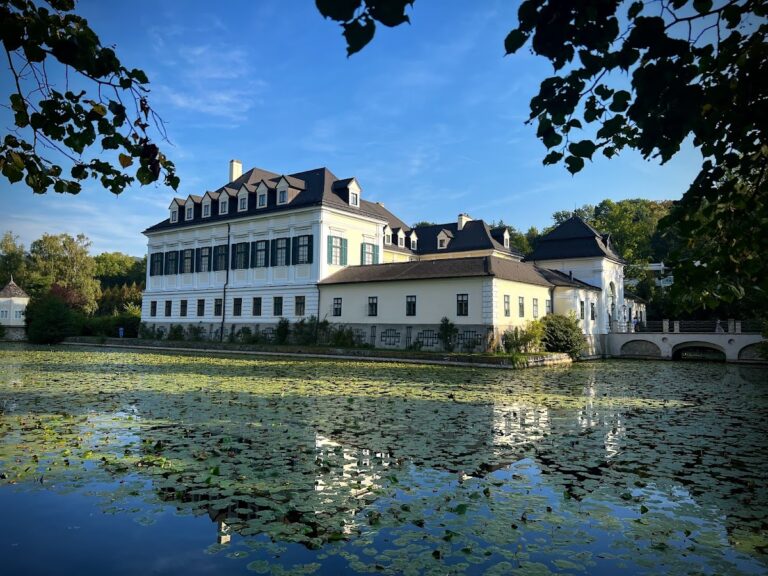
Schloss Wilhelminenberg is a palace complex in Vienna, Austria, whose present Neo-Empire building was constructed between 1903 and 1908. It stands on the Gallitzinberg in the 16th district of Ottakring, continuing a history that began with an eighteenth-century aristocratic estate.
Origins on the Gallitzinberg
In 1781, Field Marshal Franz Moritz Graf von Lascy, a senior military commander, acquired property on the mountain known as Predigtstuhl and began constructing a château. His friend Prince Demetrius Michalowitsch von Gallitzin, the Russian ambassador to Vienna, later purchased the property and obtained additional woodland and grazing land from the municipality of Ottakring. He reorganized these holdings as a park, which included several ponds, a round temple, Roman ruins, and a hunting lodge. After Gallitzin died in 1793, the estate passed to Nikolai Petrovich Rumyantsev.
The Montléart estate
Following several changes of ownership, Prince Julius von Montléart and his wife, Maria Christina, acquired the château in 1824. The building already required renovation, and in 1838 it was enlarged with two side wings. After Julius von Montléart’s death, an inheritance dispute resulted in a court-ordered sale for 125,000 gulden. His son Moritz von Montléart ultimately received the property and presented the château and its grounds to his wife, Wilhelmine, in 1866.
Moritz unsuccessfully asked for the Gallitzinberg to be renamed Wilhelminenberg. He responded by placing panels bearing the name “Wilhelminenberg” at every entrance to the château, creating an unofficial change of name. Julius von Montléart died on 16 March 1887 and was buried near the château in a Neo-Gothic mausoleum, a nineteenth-century revival funerary building modeled on medieval Gothic forms. Wilhelmine later distributed the inheritance among her relatives while retaining her personal property and the income from Wilhelminenberg. Her generosity to the poor earned her the popular designation “Angel of Wilhelminenberg.” When she died on 26 March 1895, she was buried beside her husband.
The Neo-Empire palace
By the beginning of the twentieth century, the château had become dilapidated. It was demolished between 1903 and 1908 and replaced by a Neo-Empire palace designed by Eduard Frauenfeld and Ignaz Sowiński. Neo-Empire was a historicist style based on the monumental forms and ornament of the French and European empires. The project included ancillary buildings and cost 1.4 million crowns. The new palace was intended as a residence for Austrian archdukes, members of the imperial family below the emperor in rank. Archduke Rainer became its first lord, meaning the dynastic holder of the residence. After his death on 27 January 1913, his nephew Archduke Leopold Salvator succeeded him.
War and institutional use
During the First World War, the palace was converted into a military hospital and convalescent home for war victims. A convalescent home provided care for people recovering from illness, injury, or physical hardship. Wilhelm Ammann, a bank director from Zurich, acquired the property in 1922. On 16 November 1926, the City of Vienna bought the palace, its ancillary buildings, and the park at a forced sale, a court-ordered auction used to dispose of property during legal or financial proceedings. The city established a municipal children’s home there in 1927.
From 1934 to 1939, Schloss Wilhelminenberg housed the Vienna Boys’ Choir, a Viennese choral institution in which boys receive musical training while performing as a choir. In March 1938, the National Socialists confiscated the property and transferred it to the Austrian Legion. During the Second World War, the palace again served as an army hospital connected with the nearby Wilhelminenspital.
Post-war care and the abuse investigation
In 1945, the palace became a home for children requiring convalescence and for former concentration-camp prisoners. In 1950, the therapeutic-educational observation station was transferred from Spiegelgrund to Schloss Wilhelminenberg. From 1961 to 1977, the building served as a residential institution for girls attending special schools, with a group for boys added later.
In 2011, numerous assaults and rapes of girls housed at the institution during this period became known. The City of Vienna established a commission to investigate the criminal abuses, which were legally time-barred, and to examine whether political authorities had known about them and how they had responded. The victims’ organization White Ring identified the Wilhelminenberg children’s home, together with the institution at Eggenburg, as the worst “hotspot of abuse” among Vienna’s children’s homes. A total of 2,384 former institutionalized children who reported abuse received a combined 52 million euros in compensation from the City of Vienna. The abuses also contributed to demands for changes to limitation periods for such crimes.
Conversion to a hotel
On 1 July 1986, Deputy Mayor Hans Mayr announced plans to renovate the palace and convert it into a guesthouse and youth apartment hotel. After fourteen months of construction, the three-star Gästehaus Schloss Wilhelminenberg opened in 1988. It became Hotel Schloss Wilhelminenberg in 2000, and after a three-year renovation it was reclassified as a four-star hotel.
Remains
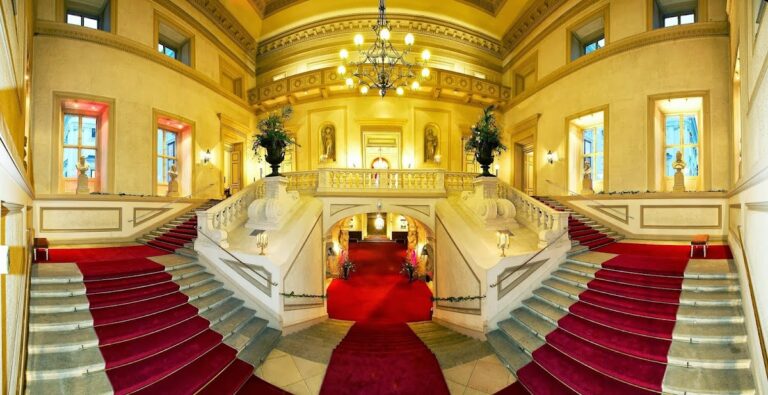
Schloss Wilhelminenberg occupies the eastern slopes of the Gallitzinberg at an elevation of about 339 metres. Its front faces south-south-east across a park of approximately 120,000 square metres, which slopes gently toward the Liebhartstal. The complex includes the palace, ancillary buildings, the park, and a Neo-Gothic mausoleum. Today, the palace functions as a four-star hotel with a restaurant and conference facilities within the park.
Park and estate landscape
The park was formed from woodland and grazing land acquired from the municipality of Ottakring and reorganized during Prince Gallitzin’s ownership. Its historically described features included several ponds, a round temple, Roman ruins, and a hunting lodge. These elements belonged to the landscaped estate surrounding the earlier château and help explain the complex as a combination of residence, grounds, and ancillary structures rather than a single isolated building.
Palace and funerary building
Neo-Empire palace
The present palace replaced the earlier château during the rebuilding carried out from 1903 to 1908. It was designed in the Neo-Empire style by Eduard Frauenfeld and Ignaz Sowiński as a residence for Austrian archdukes. The construction scheme also included ancillary buildings. The complex now accommodates hotel rooms, a restaurant, and conference facilities.
Montléart mausoleum
A Neo-Gothic mausoleum stands near the palace. It was built for Julius von Montléart and Wilhelmine von Montléart, who were both buried there. The freestanding funerary building preserves the burial place established for the couple near their former château and its later replacement.