Palais Augarten: A Baroque Palace and Cultural Institution in Vienna


Site at a Glance
- Rating
- 4.6
- Popularity
- Very Low
- Country
- Austria
- Primary era
- Early Modern
- External website
- Open
- Eras represented
- Early Modern, Modern
- Civilizations
- Habsburg, Holy Roman Empire
- Site type
- Domestic
- Remains
- Palace
On this page7 sections
History
Palais Augarten is a Baroque palace in Vienna, Austria, completed in 1692 on the site of an earlier imperial hunting château. Its elaborate European architectural style, associated with formal planning and rich ornament, developed under the direction of Johann Bernhard Fischer von Erlach after the property was sold to Zacharias Leeb.
Imperial Hunting Ground and Baroque Garden
Before the eighteenth century, the present Leopoldstadt area was forestland used by the emperor and his court as a hunting ground. Emperor Matthias built a hunting château there in 1614, and Emperor Ferdinand III added Dutch-style gardens in 1649. As the area became more settled by nobles and Carmelite monks, members of a Catholic religious order, it was gradually incorporated into Vienna.
Emperor Leopold I expanded the grounds in 1677 with an extensive Baroque garden. During the Battle of Vienna in 1683, when the city was attacked by Ottoman forces, the area served as a military base for the Turkish forces, and the gardens were destroyed by the end of the war.
Construction and Habsburg Ownership
In 1688, the hunting château was sold to the businessman Zacharias Leeb. He commissioned Johann Bernhard Fischer von Erlach to construct a palace on the site, while the Augarten park remained in imperial ownership. Completed in 1692, the building was first known as Palais Leeb. It was enlarged and remodeled several times in the following decades, and ownership changed more than once.
In 1712, Emperor Charles VI commissioned the landscape gardener Jean Trehet to redesign the Baroque park in the French style. The palace entered the possession of Joseph II, Holy Roman Emperor, in 1780. The Holy Roman Emperor was the elected ruler of the Holy Roman Empire, a central European political entity that lasted until 1806. Palais Augarten remained in Habsburg ownership, under the dynasty that ruled the Austrian lands, until the beginning of the twentieth century.
Nineteenth- and Twentieth-Century Changes
Palais Augarten hosted balls, particularly during the nineteenth century, and also contained a salon. The largest ball was held during the 1873 Vienna World’s Fair, with Emperor Franz Joseph I and Alexander II of Russia in attendance. In 1897, the palace was substantially remodeled for the family of Archduke Otto, the nephew of Emperor Franz Joseph I. Austrian Chancellor Kurt Schuschnigg lived there from 1934 to 1936.
The palace suffered severe damage during the Second World War but was completely restored afterward. In 1948, it was given to the Vienna Boys’ Choir, a historic Austrian boys’ choral institution whose members receive schooling alongside their musical training. Today, the palace is used as the choir’s home and rehearsal space and contains a school for its children. The Vienna Porcelain Manufactory Augarten is also located there, while the palace and the rest of Augarten remain owned by the Austrian state.
Remains
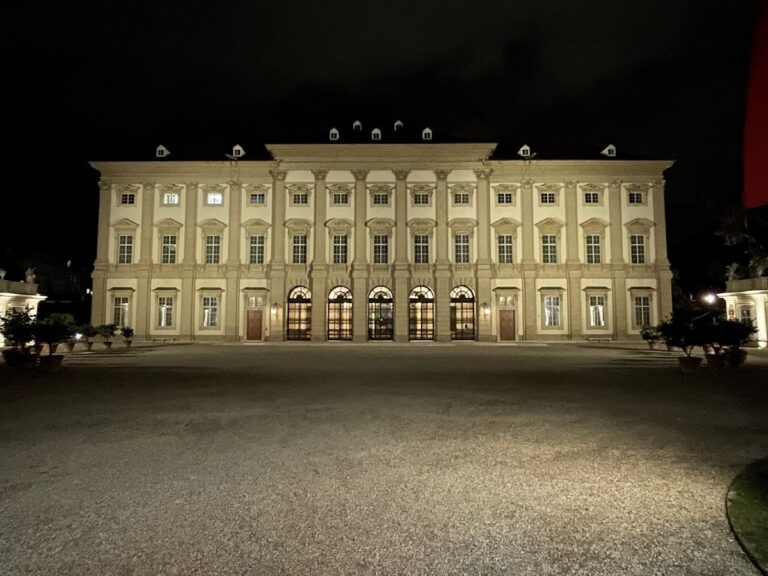
Palais Augarten stands within Augarten park, a 130-acre Baroque garden. The palace is a Baroque building constructed on the site of the earlier hunting château and associated gardens. Despite severe damage during the Second World War, it has been restored and retains almost its original appearance, including many original furnishings.
The Palace
The surviving palace preserves the form created after Fischer von Erlach’s construction and the later expansions and remodeling that altered the building over the following decades. Its present fabric reflects the postwar restoration, while the retention of many original furnishings preserves elements of its earlier interior. The building continues to accommodate the Vienna Boys’ Choir and the Vienna Porcelain Manufactory Augarten.
Augarten Park
Augarten park surrounds the palace as a 130-acre formal garden. Its present character derives from the French-style redesign commissioned by Charles VI in 1712, following the destruction of Leopold I’s Baroque garden during the Battle of Vienna. The park is Vienna’s oldest Baroque garden and remains part of the state-owned Augarten complex.
Nearby sites