Schloss Feldegg: Historic Castle in Austria


Site at a Glance
- Rating
- 4.6
- Popularity
- Very Low
- Country
- Austria
- Primary era
- Early Modern
- External website
- Open
- Eras represented
- Medieval, Early Modern
- Civilizations
- Habsburg, Holy Roman Empire
- Site type
- Domestic
- Remains
- Castle
On this page15 sections
History
Schloss Feldegg is a historic castle in Austria, in the locality of Feldegg within the municipality of Pram, and was newly built in the sixteenth century on the site of an earlier castle. The present building took shape through a complete rebuilding between 1589 and 1594, giving the estate the form that remains central to its history.
The Pilch and Retschan Estates
The earlier castle probably stood on an island in the pond below the present Schloss Feldegg. It belonged to the Pilch, or Pillich, family. Hans I Pilch of Baumgarten, who served as administrator of Wernstein on the Inn, is mentioned in 1414. In 1442, Toman, also known as Thomas Pilch, was described as being of Feldeck and Paumgarten, showing that the Feldegg name was already in use.
Toman established a second castle roughly 500 metres north of the first, directly beside the Pram. The earlier castle lay to the south and was simply called “Am Feld.” Hanns II Pillich inherited the lordship of Feldegg in 1461. When the last male member of the family, Stephan Pilch, died in 1494, his daughter Barbara brought the estate into her marriage with Caspar von Retschan, the imperial pledge-holder of the lordship of Wolfsegg.
Barbara’s grandson Christoph Abraham von Retschan rebuilt Schloss Feldegg completely between 1589 and 1594. Some building material was reportedly taken from the former moated house. Christoph Abraham also commissioned a richly figured epitaph, a commemorative monument for his ancestors, on the northeast side of the parish church of Pram.
Seventeenth- and Eighteenth-Century Owners
After Christoph Abraham von Retschan died on 1 December 1604, the estate passed to his sister Rosina, who was married to Ferdinand von Hochberg of Styria. Their son, Christof Melchior von Hochberg of Feldegg, Riedau, and Zell, married Euphemia von Bergheim, who died in 1615. Their son Christoph Ferdinand von Hochberg usually lived at Schloss Schwarzgrub. He remained unmarried and died in 1640.
Ehrenreich Freiherr von Pranckh, a title broadly equivalent to baron, purchased Feldegg from Christoph Ferdinand’s estate in 1642. His son Franz Adam Gottlieb von Pranckh, who served the Archbishop of Salzburg, inherited the property in 1648 and sold it in 1713 to Johann Achaz Wiellinger von der Au of Feldegg and Hinterndobl.
Johann Achaz Wiellinger held the property until his death in 1760, when Feldegg was auctioned. It passed to Franz Karl Pogner, who sold it in 1768 to Beneventura von Roo, a member of a Dutch noble family. Beneventura von Roo died on 9 June 1809 and was succeeded by his son Felix.
Fire, Ownership Changes, and Decline
A fire in 1811 destroyed the roof storey, the onion-domed tower, the chapel, and the hunting lodge. Franz Manzador bought the castle at auction in 1826, after it had passed from the estate of Felix von Roo. During the nineteenth century, the castle and its estate changed hands repeatedly. The recorded owners included Franz Maximilian von Heyß in 1836, Karoline Hauer in 1851, Josef and Anna Mayrhofer in 1853, Angelo Saullich in 1855, Johann Niedermayr in 1861, Eva Ringl in 1864, Johann and Rosa Ringl in 1867, Josef Mühlböck in 1878, Josef and Maria Berger in 1910, and Josef Irger-Berger, who owned the Furthmühle and served as mayor of Pram.
In 1913, the property dealer Georg Kaisinger intended to demolish the castle. Three sides of the farm building had already been removed, and the associated parcels had been sold. The estate passed to Josef Witzeneder in 1916.
War, Rescue, and Cultural Use
During the First World War, Schloss Feldegg housed 120 refugees from Trentino from 1915, together with their own priest, Father Angelo Cazzanelli. A further 68 refugees from Galicia and another 80 from Trentino were later accommodated there. After the last refugees from Trentino left in 1917, the castle was in an almost derelict condition.
Also in 1917, the art historian and collector Alfred Walcher Ritter von Molthein acquired Schloss Feldegg. He began extensive renovations that saved the castle from ruin. His son Johann Georg inherited the property in 1929. The castle remained undamaged during the Second World War and was not used to billet troops. Alfred’s widowed wife, Anselma, née Welzl von Wellenheim, died on 30 April 1945. Johann Georg and his two sisters remained unmarried and left no successors.
In 1964, Johann Georg Walcher von Molthein, known as “Schlosshans,” sold the property to Georg Hanreich. Hanreich is credited with preserving and revitalizing Schloss Feldegg in varied ways. His son Bernhard Hanreich, a furniture restorer trained in Florence, acquired his mother Liselotte’s share in 2002. The Friends of Schloss Feldegg association, founded in 2001, has supported the castle’s public cultural use through exhibitions, readings, and lectures.
Remains
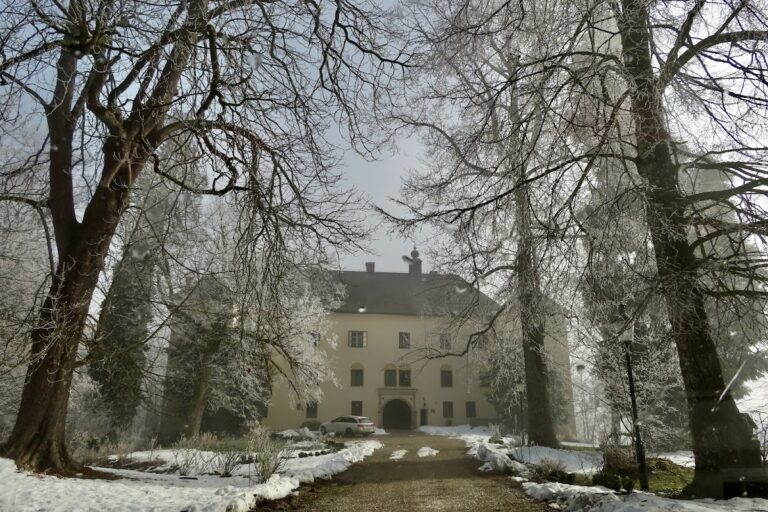
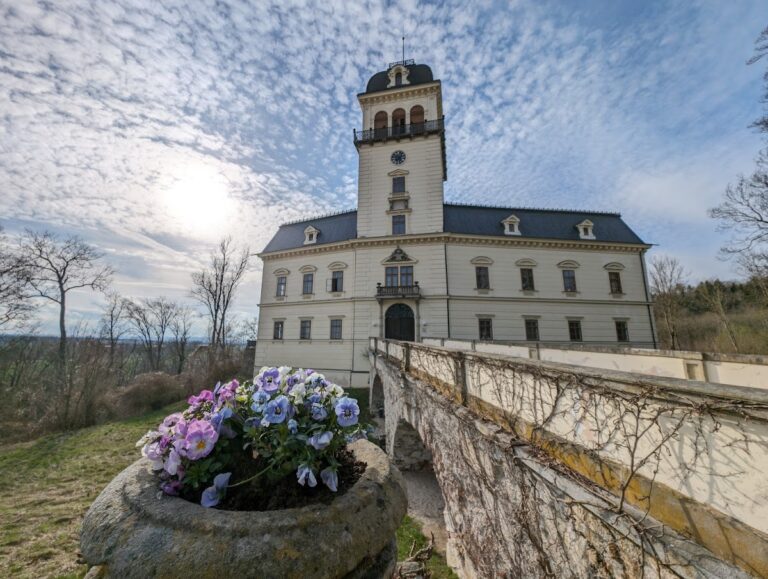
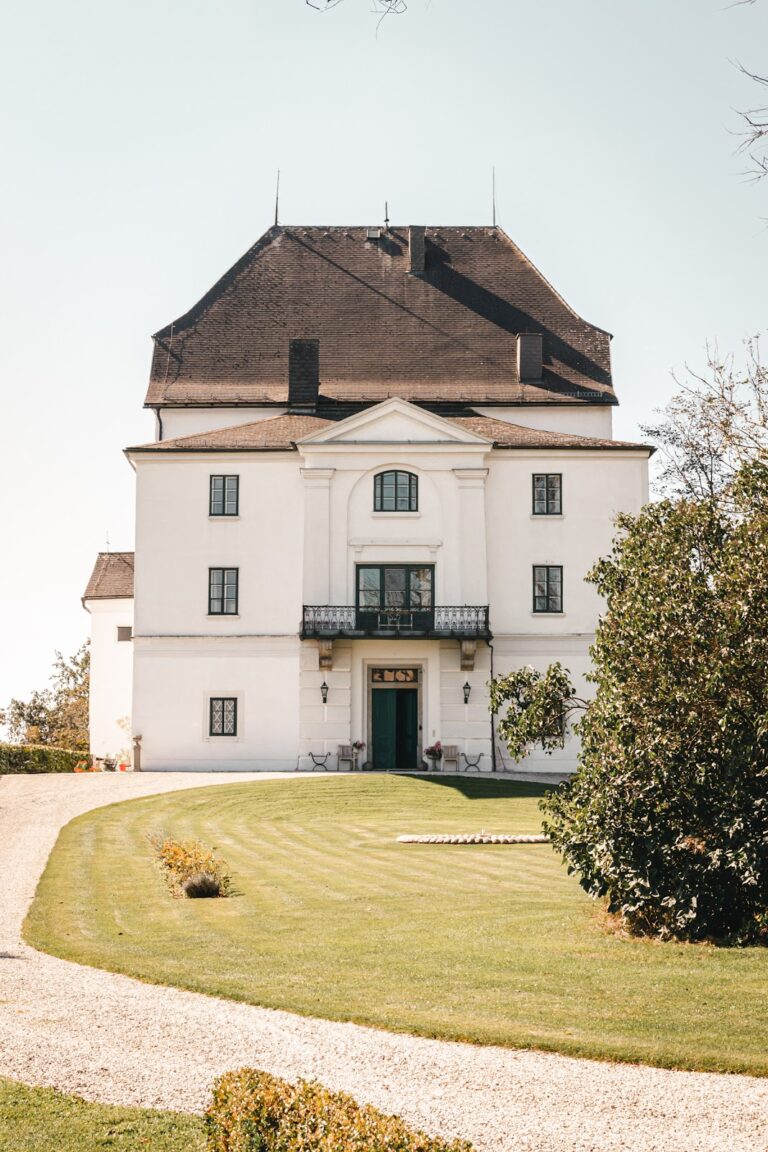
Schloss Feldegg stands at the highest point of a gently rising park that extends down to a pond. The main building is a three-storey quadrangular castle with a square tower and a steep roof. Its chimneys rise 10 metres above the attic and are partly made of clay. Red, white, and red wooden shutters mark the windows, while vaulted ceilings survive in the ground-floor rooms, two first-floor rooms, and the stairwell.
Main Castle
The rebuilding dates are visible on the structure itself. The year 1593 appears above the entrance on the southeast side and again on the rear of the castle, while the year 1589 is marked in the cellar. Ivy covers the front facade and the north and west sides. Foundations of the predecessor castle remain in the pond area below the present building, linking the surviving castle to the earlier settlement of the site.
Park and Associated Buildings
Chapel and Water Features
A small chapel stands in front of the castle. Its two columns carry the letters “C A V R.” Within the chapel area is a water basin dated 1797, together with a small crowned coat of arms bearing the initials “M. P.”
Pond and Barn
Beside the pond, a former duck house was replaced by the upper storey of a barn transferred from the former Schönmühle in Gstöcket. The park, pond, castle, and agricultural buildings form the surviving physical setting of the estate.
Feldegg History Trail
The castle’s European historical context is presented on the rear wall of a 36-metre-long tent beside the pond. Known as the “Feldegg History Trail,” it places the history of the estate within a wider historical framework.
Collections and Later Cultural Spaces
Gustav Gurschner Collection
The studio furnishings of the Viennese sculptor Gustav Gurschner came into the possession of the castle owner in 1968. Some objects are exhibited at Schloss Feldegg, while most of the material was transferred to the Army History Museum and the Museum of Applied Arts.
Gallery in the Troadkasten
A grain store dated 1726 was brought to the castle from Engelhartszell in 1992. Called the “Gallery in the Troadkasten,” it uses the traditional grain-store building for temporary exhibitions, mainly by contemporary Upper Austrian artists, in cooperation with the Innviertel Artists’ Guild.
Farm Buildings and Workshops
Since 1993, Bernhard Hanreich’s furniture-restoration workshop has occupied the northern farm building. In 1998, its attic was converted into a painting studio for Lilly Hagg, the youngest daughter of the castle owner.
Nearby sites