Schloss Groß-Söding: A Historic Castle Estate in Austria


Site at a Glance
- Rating
- 4.6
- Popularity
- Very Low
- Country
- Austria
- Primary era
- Early Modern
- Eras represented
- Early Modern, Modern
- Civilizations
- Habsburg, Holy Roman Empire
- Site type
- Domestic
- Remains
- Castle
On this page12 sections
History
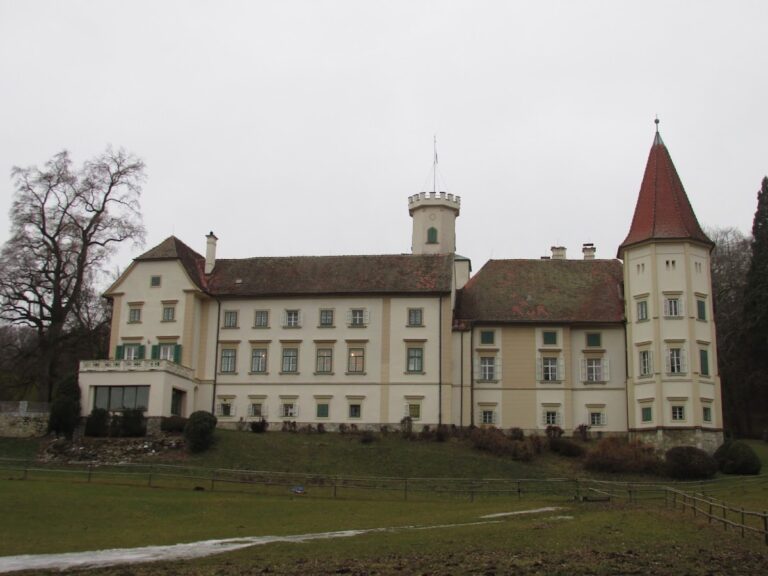
Schloss Groß-Söding is an eighteenth-century castle estate in Söding-Sankt Johann, Austria, with Baroque architectural elements and origins reaching back to the early twelfth century. Also known as Schloss Söding and formerly called Staigerhof, it stands at the northwestern end of the village of Groß-Söding in the Voitsberg district of western Styria.
Medieval estate and monastic administration
A small wooden defensive structure probably occupied the site by the eleventh century. Followers of the Eppensteiners, a medieval ruling dynasty whose influence extended across parts of Styria and Carinthia, probably administered it. The first documentary reference to the place, as villa Sedinge, dates from 1103. In that year, Henry III, Duke of Carinthia, donated the defensive estate to St. Lambrecht Abbey.
In 1147, St. Lambrecht exchanged the property with Rein Abbey for other lands. Rein had earlier received another estate in Söding from King Conrad III. The abbey used Groß-Söding as an economic estate connected with the two combined properties. These monasteries held land and managed dependent estates, giving the site an administrative and agricultural role during the medieval period.
Lay ownership and the transformation into a castle
During the fourteenth century, Groß-Söding passed to the Stadecker family. In 1369, Hans von Stadeck granted it to Mert den Perner, a ministerial, meaning a dependent retainer who could perform administrative or military service for a lord. Mert’s descendants later adopted the name Söding from the estate.
The Neuburger family acquired Groß-Söding during the fifteenth century. In 1529, while a levy was being raised to finance wars against the Ottoman Turks, the estate passed to Wolfgang Staiger of Graz and his family. Gotthard Schober began converting the farm into a castle in 1563. Ownership continued to change, with Wilhelm von Gleisbach holding the property in 1567 and Erasmus Neuburger in 1629. A castle peace agreement, a legal arrangement governing rights and protection within a fortified estate, was recorded in 1591, although its extent at Groß-Söding is unknown. On 25 October 1632, Christina Neuburger, born a Staiger, sold the castle to Sebald Roll.
The Kellersperg estate
From 1665, Groß-Söding became an entailed estate held by the Kellersperg family. This form of ownership legally bound property to a designated family line rather than allowing it to be freely divided or sold. The family enlarged its lordship in 1671 by incorporating Altenberg, and again in 1784 through the addition of Winterhof and the Rollau estate. By the end of the eighteenth century, the lordship comprised 116 houses in 32 municipalities and three administrative offices.
During the second half of the eighteenth century, the Kellerspergs extensively remodelled the castle. The work was so extensive in places that it amounted partly to a new construction, producing the eighteenth-century building that survives today. Ernst zu Kellersperg leased the property briefly to Anton von Moscon in 1802 and to Count Joachim von Lengheimb from 1804 to 1810.
Twentieth-century use and preservation
During the Second World War, the castle housed a school of weaving. The Kellersperg family retained ownership until 1960. Since 1967, the property has belonged to the Sparowitz family, which converted part of the castle into rental apartments. In 1972, wall paintings in the upper-floor central hall were uncovered and restored. The castle is surrounded by a park containing old trees.
Remains
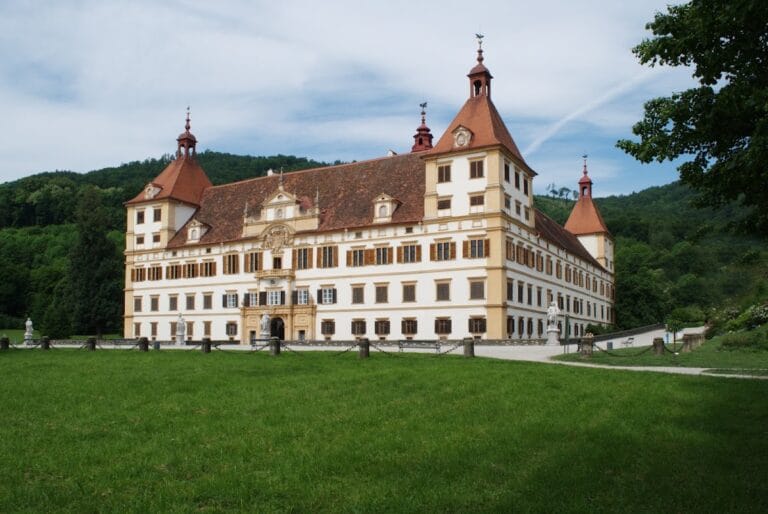
Schloss Groß-Söding occupies a rising slope on a small hill at the northwestern end of Groß-Söding. Its present building is an eighteenth-century, three-storey block arranged on a four-sided plan and covered by a hipped roof. The entrance front is organized around a central projecting section with a bay-like form and column decoration. Above it rises a small Baroque roof turret capped by an onion dome.
Exterior and court
Southern extension and corner tower
A southern extension contains a square corner tower, adding a distinct vertical element to the castle block. The courtyard of honour is flanked by one- and two-storey service buildings erected around 1800. Together, these buildings define the court associated with the principal residence and show the continued development of the estate after the eighteenth-century remodelling.
Interior decoration
Central hall wall paintings
Parts of the original interior decoration survive in the halls and rooms. The wall paintings in the upper-floor central hall date from the end of the seventeenth century. They depict dancing musicians in the manner of the Commedia dell’arte, an Italian theatrical tradition built around stock characters, set scenarios, and improvised performance. The paintings were uncovered and restored in 1972.
Castle chapel
The castle chapel was built in 1687 and retains contemporary stucco decoration. Its high altar, installed around 1700 by Johann Veit Hauck, carries an altarpiece depicting the Holy Kin. This Christian devotional subject presents the extended family of Jesus and traditionally includes Saint Anne and other relatives.
Transferred frescoes
Fresco fragments from the chapel of Graz Castle, which had been demolished, were transferred to Groß-Söding during the nineteenth century. Egyd de Rye painted the frescoes around 1600, and the surviving sections are now set into the walls of the castle chapel.
Nearby sites