Palace of Justice in Soave: A Medieval Courthouse in Italy

Site at a Glance
- Rating
- 4.6
- Popularity
- Very Low
- Country
- Italy
- Primary era
- Medieval
- Eras represented
- Medieval, Early Modern
- Civilizations
- Venetian
- Site type
- Civic
- Remains
- Palace
On this page8 sections
History
The Palace of Justice in Soave, Italy, is a courthouse built in April–July 1375 under Cansignorio della Scala, the fourteenth-century ruler of Verona and head of the Scaliger dynasty. It was conceived from the beginning as a judicial building and formed part of the civic administration of Soave. The palace is distinct from the separate Palazzo del Capitano, which later became the town hall.
Scaliger foundation
Cansignorio appointed Pietro Montagna of the Montagna family as rector, governor, and judge of the site. He is also described as Soave’s captain or bailiff, an official who governed the local territorial jurisdiction. Twenty-two villages subject to the Captaincy of Soave helped pay for the construction. Their names and financial contributions were set out in a Gothic inscription beneath the loggia, linking the building’s creation to the wider civic organization of the territory.
An inscription beneath the balcony associates the palace with Pietro Montagna’s tenure as judge and with Cansignorio’s rule of Verona. It also refers to the ruler’s enclosure of the stronghold with walls, placing the courthouse within the political and defensive development of Scaliger Soave.
Visconti and Venetian administration
The building was altered during the periods of Visconti and Venetian rule. The Visconti were the ruling dynasty of Milan, while the Republic of Venice later governed Soave for a long period. Under Venetian administration, the upper floor contained the offices of the captain and rector together with municipal offices. Captain Girolamo Gelsi directed a major restoration in 1528.
The loggia also became the home of the Monte di Pietà, a charitable lending institution that offered loans on more moderate terms than usurious lenders. The institution was founded in 1542 by the archpriest Lazzaro Dal Fior after Jews expelled from Verona arrived in Soave. It continued to operate in the loggia until a recent period.
Modern judicial and civic use
The old staircase connecting the loggia with the upper floor was replaced in 1850. Municipal administration moved to its present building in 1853, but the palace retained a judicial role. Until 2013, its upper floors housed the detached section of the Verona Tribunal, including judicial offices and a courtroom. The ground floor now has a commercial wine-shop function, while the building’s modern name is also given as Palazzo della Pretura.
A late-nineteenth-century restoration altered earlier material in the façade. Monument-preservation authorities halted the work before it was completed. In 1982, restoration uncovered the stone coat of arms of Pietro Montagna in the room opening onto the balcony. The façade’s painted decoration also has a recorded history: work was carried out in 1626, and in 1673 the images around the Virgin were restored while Saint Lawrence and Saint John the Baptist were painted.
Remains
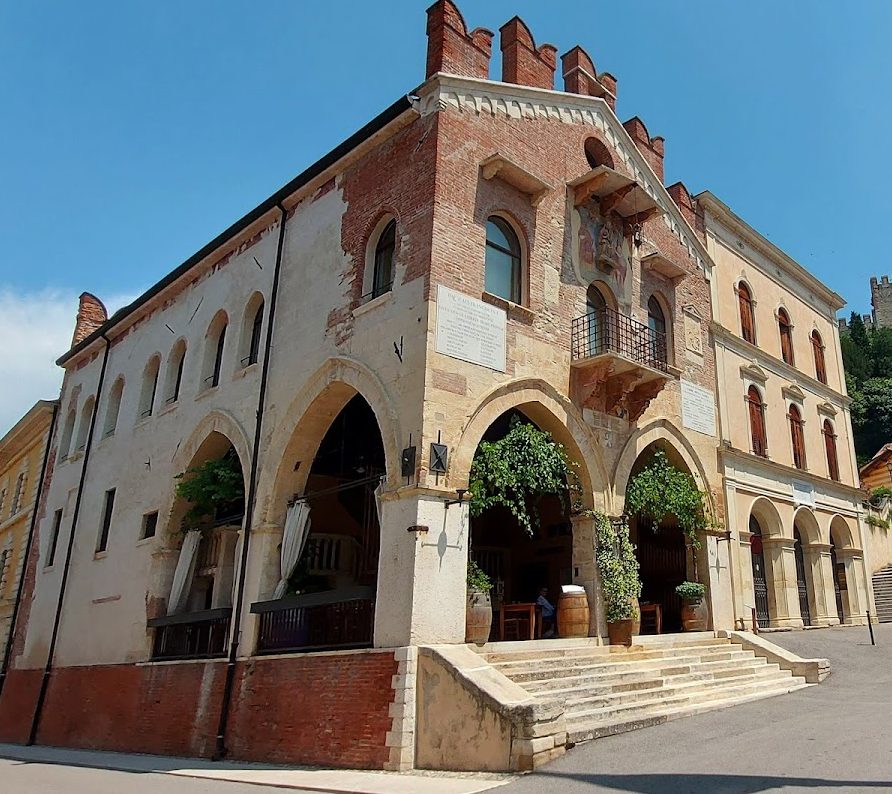
The palace stands in Piazza dell’Antenna at the centre of Soave. Its ground floor is formed by an open-sided, roofed loggia, while the upper level contains rooms that formerly served the captain, rector, municipality, and courts. The façade combines shaped stone, pointed arches, carved heraldic elements, a central balcony, and religious imagery, preserving features from several phases of the building’s history.
Loggia façade
Four shaped-stone portals with pointed arches open onto the loggia. The façade also contains ogival windows, window sills with simple carved ornament, and heraldic arms. Beneath two window sills, the coat of arms of the Visconti survives as evidence of a later phase of regional political control.
A balcony with a rough railing projects from the centre of the façade. Above it is a high-relief Madonna and Child carved in tufa, a porous volcanic stone often used for architectural carving. The Madonna dates from the sixteenth century, while the surrounding paintings of Saint Lawrence and Saint John the Baptist date from the seventeenth century. The recorded façade work of 1626 and 1673 forms part of the history of this surviving decoration.
Inscriptions and commemorative features
A round framed stone beneath the balcony bears the inscription “14 B G 52.” It commemorates Giovanni Bembo, captain of Soave in 1452. The stone originally carried his Scaliger coat of arms, which was chiselled away by the French in 1797. Another inscription on the façade commemorates the services of Michele Battaglia, who served as captain in 1538.
Interior spaces and staircase
The upper-floor rooms retain the building’s connection with public administration and justice through their former arrangement as offices and a courtroom. The staircase leading from the loggia was rebuilt in 1850 in a modern style, with small columns replacing the earlier access. The stone coat of arms of Pietro Montagna, uncovered in 1982 in the room opening onto the balcony, connects the interior with the palace’s Scaliger foundation.
Nearby sites