Schloss Ginselberg: An Industrial Estate Transformed into a Castle


Site at a Glance
- Rating
- 4.8
- Popularity
- Very Low
- Country
- Austria
- Primary era
- Modern
- External website
- Open
- Eras represented
- Modern
- Civilizations
- Austrian Empire, Habsburg
- Site type
- Domestic
- Remains
- Castle
On this page6 sections
History
Schloss Ginselberg is a nineteenth-century castle in Austria, near Scheibbs, that developed from an industrial site established at Viertellehen. Its origins lay in a hammer works, followed by a large mirror-grinding and silvering factory built in 1827 by Ignaz and Anton Dittrich. The factory employed 54 people, received raw glass from the Bohemian Forest, and sold finished mirrors as far as the Levant.
From industrial works to family estate
Several smaller works operated nearby, processing iron, leather, and gypsum. The mirror factory passed to Andreas and Sophie Ziegler in 1853, then to Alexius and Josephine von Wettstein in 1857. Constantin Gilani acquired it in 1859. In 1863, Anton Reichsgraf von Schönfeld bought the property and converted the industrial building into a count’s castle through alterations and extensions.
Schönfeld also created the castle park and assembled surrounding land into the approximately 350-hectare Ginselberg estate. The property has remained with the Schönfeldt family since 1863. Carl Ludwig Schönfeldt is identified as its current owner.
The chapel and the twentieth century
In 1880, Moritz Graf Almasy sold Schloss Lehnhof and gave its chapel furnishings to his sister-in-law Elisabeth Gräfin Schönfeld. The furnishings were installed in a chapel at Ginselberg in 1881. During the Second World War, parts of the castle were requisitioned for use as a military hospital, and the chapel was removed.
Heinrich Graf Schönfeldt was born at Schloss Ginselberg in 1884 and lived there until his death in 1963. He was a racing driver identified as the driver of the world’s first tank. After his death, the castle increasingly deteriorated before renovation work was carried out in 2009 and 2010.
The estate also acquired changing social and religious uses. In 1935, Schönfeldt established a residential boarding house in the ancillary building at Ginselberg 12, probably for economic reasons. After his death, the building became a home for blind people. In 1975, it was given to the Buddhist Centre Scheibbs, an institution for Buddhist religious practice, study, and teaching, which is regarded as one of the oldest Buddhist institutions in the German-speaking region.
Remains
Castle and park
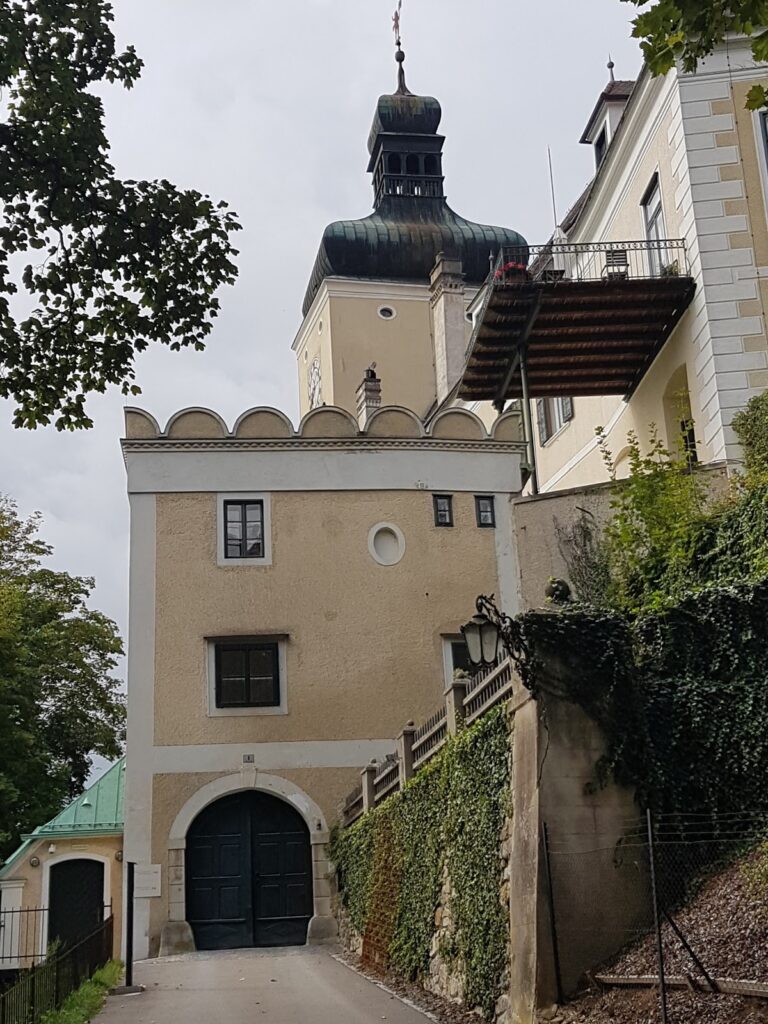
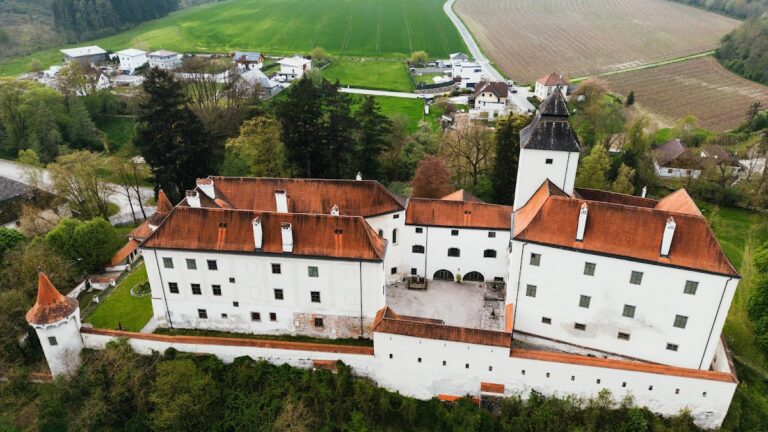
Schloss Ginselberg stands on a small hillside terrace above a tuff quarry in the Erlauftal, somewhat southwest of the Werkssiedlung Neustift in the municipality of Scheibbs. Tuff is a relatively soft rock formed from compacted volcanic ash. The broad complex is arranged symmetrically around a central projecting section and matching projecting sections at the sides. It is a plain two-storey building beneath a hipped roof, which slopes down on all sides.
Parts of the ground floor open onto arcades covered by groin vaults, while the interior rooms have flat ceilings. The castle complex formerly included a chapel, whose furnishings had been installed there in 1881. The chapel was removed during the Second World War, when parts of the building were used as a military hospital. The nineteenth-century park created by Anton Reichsgraf von Schönfeld survives, although it has been heavily altered.
Ancillary properties
The wider site includes several associated properties. The former horse stable stands at Ginselberg 11, while the former manor house is at Ginselberg 12. The house at Ginselberg 16 also forms part of the group. The building at Ginselberg 12 retains a history of successive uses as a residential boarding house, a home for blind people, and the Buddhist Centre Scheibbs.
Nearby sites