Schloss Hirschhügel: A Former Hunting Lodge in Germany


Site at a Glance
- Rating
- 4.7
- Popularity
- Very Low
- Country
- Germany
- Primary era
- Medieval
- Eras represented
- Medieval
- Civilizations
- Holy Roman Empire
- Site type
- Domestic
- Remains
- Elite Residence
On this page8 sections
History
Schloss Hirschhügel is a former hunting lodge in Kuhfraß, Germany, now part of the municipality of Uhlstädt-Kirchhasel in Thuringia. It developed from a fortified outlying estate belonging to Kochberg Castle and later became the property of the Parry and Henckel von Donnersmarck families. Its history also includes major changes in ownership and use during the twentieth century.
The fortified estate at Kuhfraß
The predecessor of Hirschhügel Castle was a fortified estate on pastureland beside the Haselbach. The area was recorded as “Kuhfraß” in 1428 and was protected by a rampart, a moat, and bastions. These defenses formed the early setting from which the later hunting lodge developed, although very little of the fortification survives.
The Parry family and the hunting lodge
The wealthy Irishman James Patrick von Parry built Hirschhügel Castle after acquiring a noble title from the Duke of Altenburg. He was married to Luise von Stein, a granddaughter of Charlotte von Stein and the daughter of Gottlob Carl Wilhelm Friedrich von Stein. Parry also reshaped the names associated with the surrounding landscape, calling the Haselbach valley Hirschgrund, the Eichenborn spring Hirschbrunnen, and the meadow Hirschwiese. The Luisen Tower near Kleinkochberg commemorated his wife.
Charles Edward von Parry, a Royal Prussian lieutenant colonel who lived from 1828 to 1882, held the majorat of Hirschhügel Castle and Kuhfraß until his death. A majorat was an inheritance arrangement that kept an estate largely intact for a designated principal heir. His sister Emma Luise, who lived from 1834 to 1912, then inherited the property and married Leo Count Henckel, Baron von Donnersmarck-Gröditzberg, the son of botanist Leo Victor Felix Henckel von Donnersmarck.
The Henckel von Donnersmarck estate
Dr. jur. Viktor senior, Count Henckel von Donnersmarck, probably did not inherit the estate until 1912. His wife was Marie Countess Bassewitz-Wesselstorf. The last landowner was the physician Viktor Henning Guido Leo Parry, Count Henckel, Baron von Donnersmarck, born in 1905. He initially held the property as a minorat, a related family arrangement in which an estate passed to a younger or secondary heir, and also maintained a secondary residence in Berlin.
Institutional use and restitution
The building known as the “New House” became a children’s rural home in 1941. In 1945, the castle and estate were expropriated without compensation. The former owner was still living in West Berlin during the 1960s. After expropriation, the complex was successively used as an old-age home and a psychiatric institution. By 2010, it served as an old-age home operated by a social-welfare organization and as a social-therapeutic support facility for 125 guests, while residential support groups were located in Etzelbach in the Saale valley.
In 1994 and 1995, surviving movable contents were restituted to the Henckel von Donnersmarck family. The family placed the material under a permanent loan agreement with the Weimar Classic Foundation, a German cultural-heritage institution preserving collections connected with Weimar’s literary and artistic history. The restituted contents included paintings, graphic works, furniture, other works of art, and manuscripts by well-known writers. The collection also contained 39 drawings by Johann Wolfgang von Goethe, the German writer, poet, and statesman, although the restitution did not include all drawings associated with it.
Remains
The lodge and park
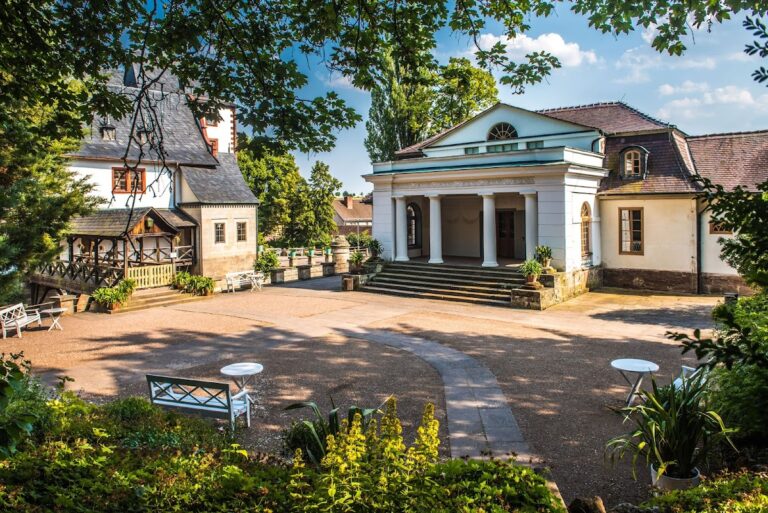
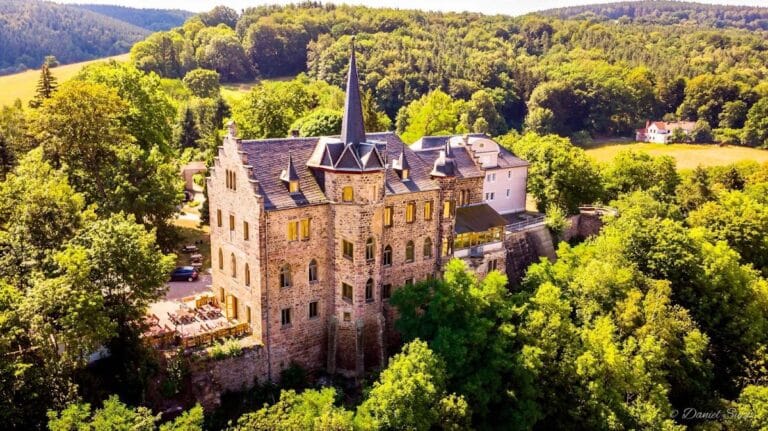
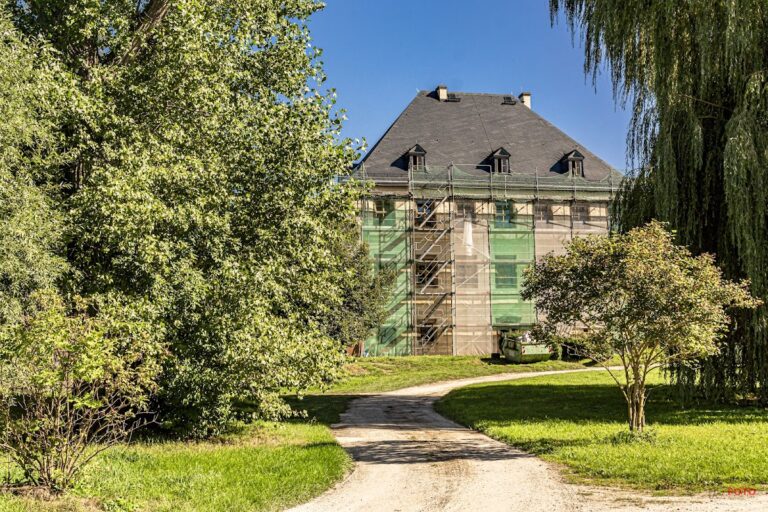
The surviving complex consists of a historically renovated hunting lodge set within a park of approximately eight hectares. The grounds preserve the overall setting of the estate, while the earlier rampart, moat, and bastions survive only to a very limited extent. The New House remains part of the complex and reflects the estate’s later institutional history through its conversion into a children’s rural home in 1941.
Movable heritage
The estate’s surviving contents included paintings, graphic works, furniture, other works of art, and manuscripts by well-known writers. Among these were 39 drawings by Johann Wolfgang von Goethe. Their restitution and subsequent permanent loan connected the former estate’s collections with the Weimar Classic Foundation, while the incomplete transfer of the Goethe drawings reflects the distinct treatment of the collection’s individual items.