Carli Palace of Verona: An Italian Army and NATO Headquarters

Site at a Glance
- Rating
- 4.5
- Popularity
- Very Low
- Country
- Italy
- Primary era
- Early Modern
- Eras represented
- Early Modern
- Civilizations
- Venetian
- Site type
- Civic
- Remains
- Palace
On this page9 sections
History
Carli Palace of Verona is an eighteenth-century Neoclassical civil building in Italy, commissioned in the second half of the eighteenth century and later transformed into a court and military headquarters. Located on Via Roma in Verona’s historic center, it stands along the route connecting the Bra area with Castelvecchio. Its history is closely linked to the military and governmental commands that occupied it over more than two centuries.
Construction and the Carli family
Marquis Giuseppe Della Torre commissioned the palace during the second half of the eighteenth century. After his death in 1778, ownership passed to his wife, Elena Carli. Her brother, Count Alessandro Carli, subsequently rebuilt and improved the building. In 1780, Alessandro commissioned the sculptor Gaetano Cignaroli to create a statue of Pallas Athena for the entrance atrium. The Carli family sold the palace to the Basilea brothers in 1812.
Austrian administration
The Imperial authorities acquired the palace in 1839, when Verona was under Austrian rule. Until 1851, it housed the Supreme Imperial Royal Court of Justice for the Kingdom of Lombardy–Venetia. The building was also intended to function as a center of imperial power in the kingdom.
Field Marshal Johann Joseph Radetzky, an Austrian commander and leading military and administrative figure in the Habsburg Kingdom of Lombardy–Venetia, lived at the palace from 1853. In 1857, the building was converted into accommodation for high-ranking guests. Two years later, Archduke Albrecht, Duke of Teschen and commander-in-chief of the Veneto Army, established his headquarters there.
Transfer to the Kingdom of Italy
On 16 October 1866, the act transferring Verona and the Veneto to the Kingdom of Italy was signed in the palace’s Sala degli Stucchi. The transfer followed the Third War of Italian Independence, the conflict that brought Venetia into the Italian kingdom. Carli Palace then retained a military role under Italy and became the headquarters of the army corps stationed in Verona.
Cold War command center
An Italian four-star Army headquarters was activated in the palace on 22 February 1951. From 10 July that year, the building also housed Allied Land Forces Southern Europe, known as LANDSOUTH, NATO’s land-forces command for southern Europe. This followed a dual-hat arrangement, in which the same senior command structure carried both Italian national and NATO responsibilities.
In its Italian role, the headquarters was responsible, in the event of an eastern invasion, for the defense of the Gorizia threshold, the eastern Alpine arc, the Veneto–Friulian plain, and the Po Valley. Operations could be directed from the protected West Star cavern site or from the secondary Back Yard site. In its NATO role, the command was subordinate to Allied Forces Southern Europe in Naples. That command was led by a US Navy admiral, and its wartime operations were associated with the Proto cavern site at Monte Massico near Sessa Aurunca.
Carli Palace therefore served as a central location for the joint Italian and NATO defense of Italian territory during the Cold War. The command based there was connected with three of Italy’s most secret and important bunkers. On 17 December 1981, the Red Brigades abducted US General James Lee Dozier, the headquarters’ deputy chief of staff for logistics. Italy’s NOCS, its national police special-operations unit, freed him in a raid on 28 January 1982.
Reorganization after 1991
The dissolution of the Warsaw Pact and the Soviet Union in 1991 reduced the strategic need for a headquarters dedicated to the defense of northern Italy. The Italian command was reorganized and, on 1 October 1997, renamed the Italian Army Operational Land Forces Command, or COMFOTER. LANDSOUTH was later reappointed as Joint Command South, or JC SOUTH, in 1999.
NATO reorganized its land forces in 2004. The command was suppressed or deactivated on 1 July that year, after 53 years of NATO activity. A new NATO command for all land forces in Europe was established in Madrid and had no further connection with the Italian command remaining at the palace.
In 2014, the Italian command at Carli Palace was replaced by the Command of Support for the Operational Land Forces, transferred from Cecchignola in Rome. That command was suppressed on 30 September 2016 and replaced by the Command of the Operational Land Forces of Support, or COMFOTER SPT, a high command directly subordinate to the Chief of Staff of the Italian Army. The palace remains in use and is owned by the Italian Army.
Remains
Palace layout and exterior
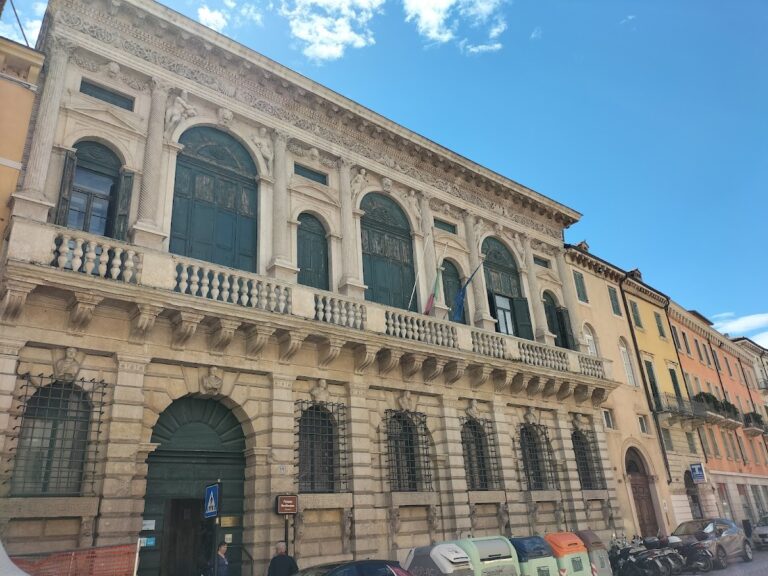
Carli Palace is an eighteenth-century Neoclassical complex arranged within the block between Via Roma and an inner courtyard. The building facing the street is a secondary wing, while the principal body stands farther inside and faces the courtyard, which contains a fountain. This arrangement places the main architectural focus beyond the street frontage.
The principal facade is divided vertically into three registers. Its rusticated ground level, faced to give the masonry a strongly textured appearance, contains arches and classical pillars. Above it, the piano nobile, the principal and usually more elaborately finished upper story of a palace, includes the loggia of the main hall. A pediment surmounts this central feature. The main hall and courtyard were restored in 1930 according to designs by the architect Ettore Fagiuoli.
Interior decoration
The entrance atrium contains the statue of Pallas Athena commissioned by Alessandro Carli from Gaetano Cignaroli in 1780. Several interior rooms preserve eighteenth-century Veronese frescoes by Giambettino Cignaroli, Domenico Pecchio, and Marco Marcola. Together with the atrium sculpture, these surviving works retain evidence of the palace’s eighteenth-century decorative program within a building that later served administrative and military purposes.