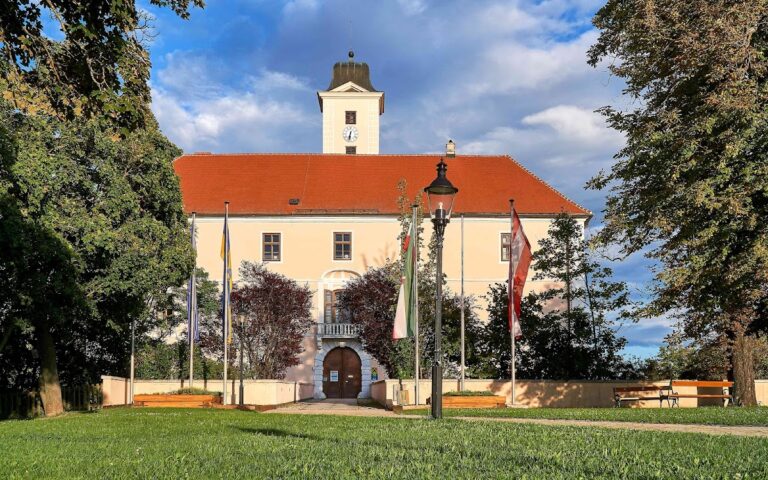
Schloss Altkettenhof: A Baroque Castle and Justice Complex in Austria


Site at a Glance
- Rating
- 4.3
- Popularity
- Very Low
- Country
- Austria
- Primary era
- Modern
- Eras represented
- Early Modern, Modern
- Civilizations
- Habsburg, Holy Roman Empire
- Site type
- Domestic
- Remains
- Castle
On this page9 sections
History
Schloss Altkettenhof is a Baroque castle in Austria, located in Schwechat near Vienna, whose origins reach back to a smaller thirteenth-century complex. Repeated enlargement, destruction, rebuilding, and twentieth-century remodeling shaped the building that survives today. It remains in use as a district court and federal justice school and is protected as an Austrian monument.
Medieval Origins and Ottoman Destruction
The area was associated with the Lords of Ebersdorf in 1270. The original complex stood in what is now Alt-Kettenhof and was enlarged several times. After the area was plundered during the Ottoman siege of Vienna in 1529, a fortified structure was built while the village of Kettenhof continued to be inhabited.
During the first half of the seventeenth century, the property belonged to the Counts of Hoyos and later passed as a fief to other noble families. A subsequent Ottoman invasion destroyed the fortress. Count Otto Christoph von Volkra then rebuilt it in the Baroque style, giving the estate a new architectural form.
The Blümegen Estate and the Kettenhof Factory
Heinrich Kajetan von Blümegen, Austria’s archducal First Chancellor, acquired the castle in 1760 and enlarged it. Six years later, he founded the Kettenhof calico and cotton factory with two partners. After his death, his son Franz Heinrich Count von Blümegen lived at the castle with his daughters Josefine and Eleonora until 1813.
Moritz Count von Fries, an art patron and banker, and his brother Philip Jacob acquired the estate in 1814. Ownership later passed to Johann Ziegler, director of the Kettenhof calico and cotton factory, and to Eleonora Countess von Kálnoky. In 1826, the brothers Josef, Moritz, and Johann Freiherr von Ziegler became owners, and they sold the castle to Karl Mayer in 1830.
Nineteenth-Century Owners and the Dreher Rebuilding
The Austrian diplomat Johann Bernhard von Rechberg bought the castle in 1850. While serving as Austrian prime minister and foreign minister, he received the Prussian prime minister Otto von Bismarck there in August 1864. Rechberg sold the property to the Schwechat brewing industrialist Anton Dreher junior in 1872 and continued to live at the castle until his death on 26 February 1899.
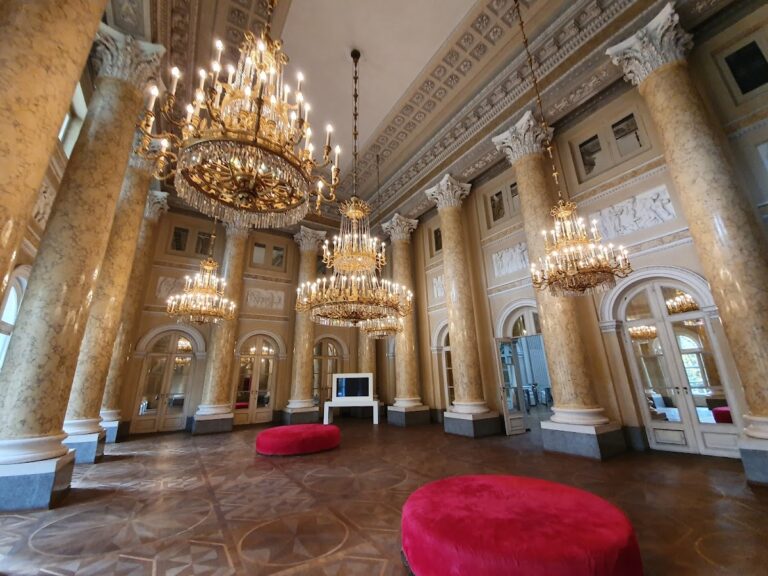
Anton Dreher commissioned a comprehensive rebuilding in 1902. Emil Bressler and the Schwechat master builder Johann Miksch carried out the work in the neo-Baroque style, a later revival of the elaborate forms and decoration associated with Baroque architecture. The Viennese firm Portois & Fix produced the interior furnishings.
Municipal Transfer, Nazi Rule, and Postwar Administration
After Anton Dreher died in 1921, his wife Katharina lived at the castle until her death in 1937. In 1938, at the request of their son and sole heir Eugen Dreher, the property was given to the municipality of Schwechat. Following the Anschluss, Nazi Germany’s annexation of Austria in March 1938, the Nazi-appointed mayor Josef Rupprecht transferred the building to the German Labour Front, the regime organization that replaced independent trade unions.
After conversion by the architect Hans Jaksch, the castle became a Reich training castle for the German Labour Front. Its opening took place on 25 July 1938 in the presence of Nazi Party Reich Leader Robert Ley and the Gauleiters Odilo Globocnik and Josef Bürckel. A military hospital was established there in 1942.
In 1945, the Red Army took over the building. Soviet forces administered the part of Austria containing Schwechat until 1955. After the Austrian State Treaty was signed on 15 May 1955, the property returned to the municipality of Schwechat under Mayor Alfred Horn. The municipality transferred it to the Federal Ministry of Justice in 1956.
Justice Uses and Conservation
The Schwechat District Court has occupied the castle since 1960. Since 1964, the building has also housed a federal justice school. Federal Minister of Justice Christian Broda and State Secretary Franz Hetzenauer opened the school after repairs to the building. An associated boarding building with 103 residential units and 110 beds was completed for its intended use in 1993.
Schloss Altkettenhof underwent renovation between 1995 and 1999. It is now owned by the state-owned Federal Real Estate Company and continues to serve its institutional functions while retaining its protected monument status.
Remains
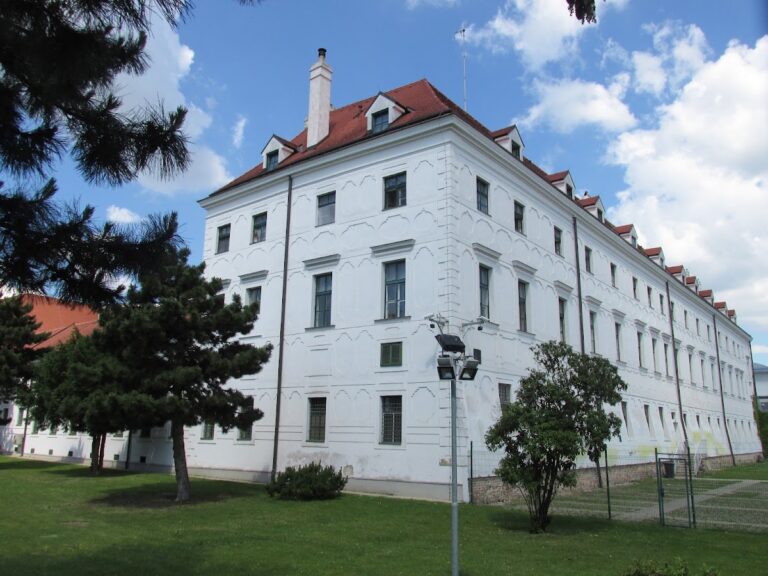
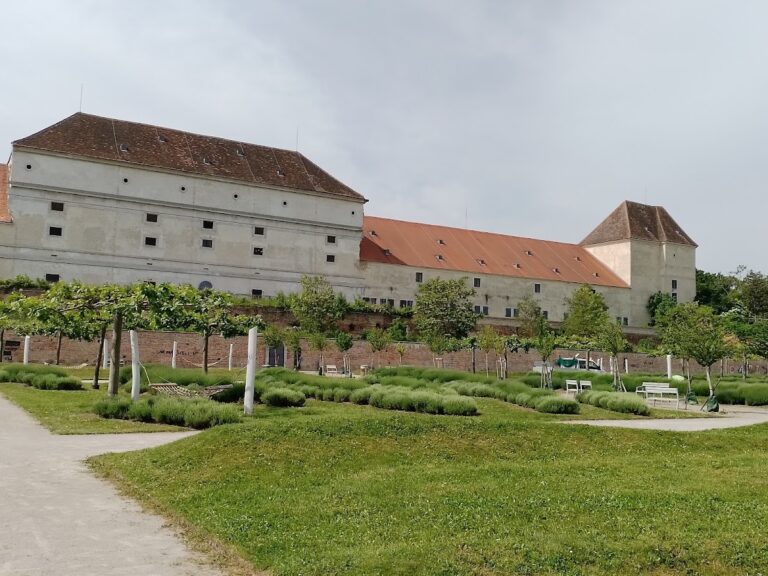
Schloss Altkettenhof is an elongated U-shaped building set within an extensive park and open toward the east. Its present appearance combines the earlier Baroque castle with the extensive neo-Baroque remodeling undertaken in 1902. The surviving complex is renovated and remains in use.
Castle Facades and Upper-Level Features
The facades are richly articulated with pilasters, shallow vertical elements attached to the walls like columns, and projecting sections known as risalits. A large conservatory occupies the south side. On the north side, a projecting upper-level feature called a Söller functions as a terrace. These elements form part of the castle’s later neo-Baroque architectural character.
River Setting and Former Bridge
The castle stands between the Schwechat and Kalter Gang rivers, near the point where the Liesing flows into the Schwechat. A bridge formerly crossed the river near the castle. The bridge was destroyed during the Second World War, but its foundations remained until 2009. Flood-protection works along the Schwechat in 2009 and 2010 led to their complete removal.