Thun Palace: A Parliamentary Palace in Prague

Site at a Glance
- Rating
- 4.4
- Popularity
- Very Low
- Country
- Czechia
- Primary era
- Early Modern
- External website
- Open
- Eras represented
- Medieval, Early Modern, Modern
- Civilizations
- Habsburg, Holy Roman Empire, Kingdom of Bohemia
- Site type
- Civic
- Remains
- Palace
On this page11 sections
History
Thun Palace is a historic palace in Czechia, located in Prague’s Malá Strana district. Developed from five Gothic houses and rebuilt as a Baroque palace, it is dated to 1726 and later became an important centre of Bohemian and Czechoslovak parliamentary life.
From Roupov House to Thun Palace
The site originally contained five Gothic houses. After Jan z Roupova acquired them, three were joined in 1490 to form a residence known as Roupov House. Markéta Anna Thunová, a countess of the Thun family, bought the property in 1650. The Thuns acquired adjoining buildings in 1662 and 1694, after which the older structures were rebuilt into a Baroque palace.
The palace became a theatrical venue in 1779, when an Italian opera company directed by Pasquale Bondini began operating there. Emperor Joseph II, the Habsburg ruler associated with Enlightenment-era reforms, attended performances. A fire in 1794, attributed to the carelessness of actors, destroyed the theatre and valuable frescoes by the Baroque painter J. M. Rottmayer. The theatre subsequently moved to another location.
Parliamentary transformation
Countess Anna Maria Thunová sold the palace to the Czech Estates in 1801. The Czech Estates were the representative institutions of the Kingdom of Bohemia. The building was then remodelled in the Classical style for the needs of the Bohemian Diet, the kingdom’s representative assembly.
After 1860, the palace was extended and received a new principal assembly hall. From 1861, it officially served as the meeting place of the Bohemian Diet. Its parliamentary role continued during the formation of Czechoslovakia. On 14 November 1918, the first session of the Revolutionary National Assembly was held there. Czechoslovak independence was proclaimed in the palace, Tomáš Garrigue Masaryk was elected president, and Karel Kramář became the first prime minister. The Czechoslovak Constitution was adopted in the building on 29 February 1920.
The Czechoslovak Senate met at Thun Palace from 1919 to 1938, while the Chamber of Deputies later moved to the Rudolfinum. Repairs and reconstruction undertaken from 1936 to 1940 were intended to prepare the palace for the Senate, but occupation and the Second World War made those changes unusable.
Later institutional use
After the Second World War, the palace served as an office building for several ministries, including the Ministry of National Defence and the Ministry of Health. It was the seat of the Czech National Council, the Czech legislative body of the later Czechoslovak period, from 1968 until 1992.
Since 1993, Thun Palace has again been the seat of the Chamber of Deputies of the Parliament of the Czech Republic. Modernization took place in 1985–1989 and in 1993. The palace has been protected as a cultural monument since the mid-twentieth century and as a national cultural monument since the 1990s. It forms part of the national cultural monument comprising the seat of the Czech Parliament.
Remains
Palace fabric and public frontage
Gothic and Baroque structures
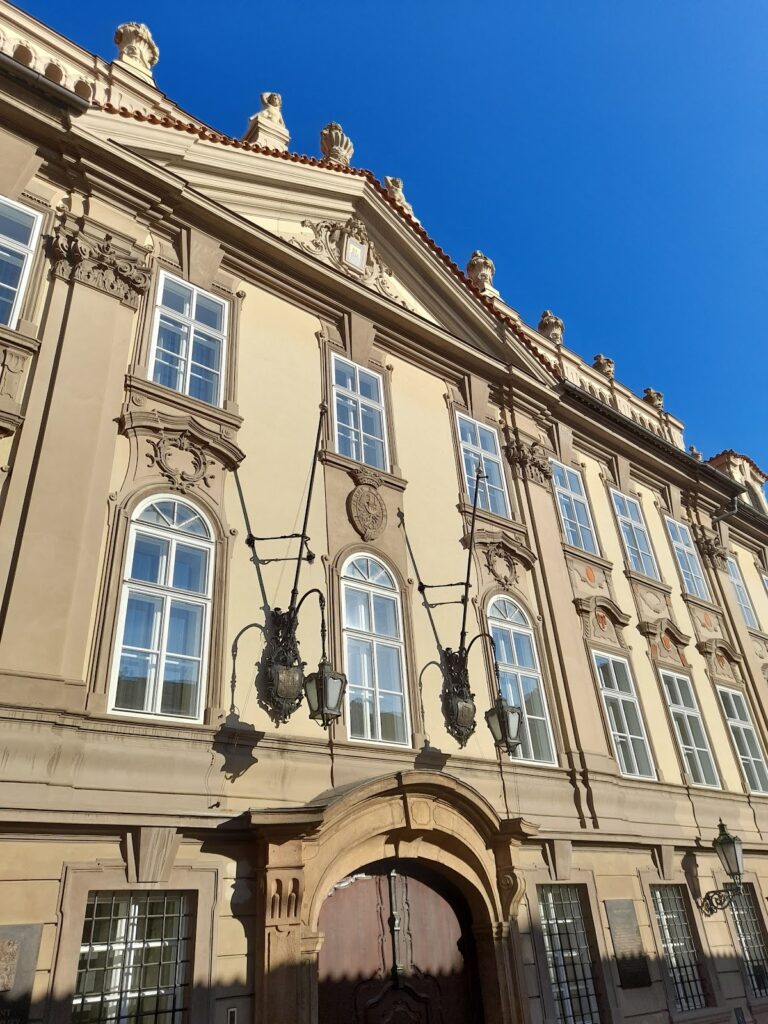
Thun Palace is a Classical building that incorporates surviving elements of the earlier Gothic houses and the Baroque complex. Remnants of the five Gothic houses remain in the basement, preserving physical evidence of the property’s original arrangement. The former Baroque complex also retains its monumental staircase.
Facade and pediment
The palace has one of Prague’s longest facades. Above the portals, the central pediment bears the Czech state arms, including the lion and the Crown of Saint Wenceslas. Before the establishment of the republic in 1918, the pediment carried the Latin inscription “FRANCISCO II. AVSPICE REBVS PATRIAE AGVNDIS BOHEMIAE ORDINES MDCCCI.” It was later replaced by “SALVUS REI PUBLICAE SVPREMA LEX ESTO.”
Parliamentary spaces and connections
Principal assembly hall
The principal assembly hall was arranged in the nineteenth century in the Neo-Renaissance style. It contains two balcony galleries and gilded stucco decoration. Czech lions stand above its two entrances, while linden and oak branches symbolize the former joint seating of Czech- and German-speaking deputies.
Parliamentary bridge and extensions
A bridge built in 1903 crosses Thunovská Street and connects Thun Palace with neighbouring parliamentary palaces, including Sternberg Palace. These links enlarged the assembly premises. The Smiřický and Sternberg palaces were also connected with the Thun complex, creating a group of interrelated parliamentary buildings. The palace contains the principal assembly hall used by the Chamber of Deputies, along with rooms and connected premises developed through successive parliamentary extensions and modernizations.
Nearby sites