Palazzo Rocca: A Historic Palace and Museum Complex in Chiavari


Site at a Glance
- Rating
- 4.2
- Popularity
- Very Low
- Country
- Italy
- Primary era
- Early Modern
- External website
- Open
- Eras represented
- Early Modern, Modern
- Civilizations
- Genoese
- Site type
- Domestic
- Remains
- Elite Residence
On this page10 sections
History
Palazzo Rocca is a historic palace and museum complex in Chiavari, Italy, built between 1629 and 1635 for the Costaguta marquises. The family commissioned the Genoese architect Bartolomeo Bianco, and the palace remained their residence for more than a century. Today, the complex houses the Civic Gallery and the Archaeological Museum of Chiavari.
The Costaguta Residence
The Costaguta family held the title of Marquises of Spicciano, granted by Pope Innocent X, the papal name of Giovanni Battista Pamphilj, who served as pope from 1644 to 1655. They were also lords of Rocca Alvecce. Among the family’s prominent members were the cardinals Vincenzo Costaguti and Giovanni Battista Costaguti, both sons of Prospero Costaguti. A cardinal is a senior dignitary of the Roman Catholic Church.
Ownership changed in 1760, when the property passed to the Ranieri family. It later belonged to the Grimaldi family, who enlarged the palace, and then to the Pallavicini family.
From Private Estate to Civic Complex
Giuseppe Rocca acquired the property in 1912 and donated the entire estate, including the palace and park, to the municipality of Chiavari. Before the donation, he had commissioned the transformation of the garden into a park in 1908. The work, along with general recovery and restoration of the complex, was entrusted to Polinice Caccia of Genoa.
The complex was established as a museum complex in 1635 and listed as having opened in 1987. During the 2000s, the park was replanted and the architectural elements were restored. The Archaeological Museum is devoted to the prehistory and protohistory of the Tigullio, the coastal area of Liguria centred on the Gulf of Tigullio, and includes material recovered from excavations at the Chiavari necropolis, a cemetery or burial area.
Remains
Palace and Museums
Palace and Civic Gallery
The palace stands on Via Costaguta near the historic Piazza delle Carrozze in Chiavari’s old centre. It is entirely surrounded by the Rocca Botanical Park. The palace floors contain the Civic Gallery, whose collections include paintings from the Genoese, Italian, Spanish, and Flemish schools. Its picture gallery devoted to the local marquis Pietro Torriglia preserves works dating from the sixteenth to the eighteenth centuries.
Among the gallery’s paintings are The Three Fates by Gioacchino Assereto, The Sacrifice of Noah, signed and dated 1653 by Giovanni Benedetto Castiglione, known as Grechetto, and Still Life with Dog and Game, painted around 1630 by Jan Roos. The collection also includes two allegories by Domenico Piola and Stefano Camogli, works by Orazio De Ferrari such as Christ Carrying the Cross and Ecce Homo, and portraits by Genoese painters including Anton Maria Vassallo and Cesare Corte. Ceramic and porcelain objects, together with period prints, form further parts of the collection.
Archaeological Museum
The former stables house the Archaeological Museum, which occupies rooms on the ground floor. Its displays contain material excavated from the Chiavari necropolis and focus on the prehistoric and protohistoric past of the Tigullio region.
Botanical Park
Terraces and Garden Structures
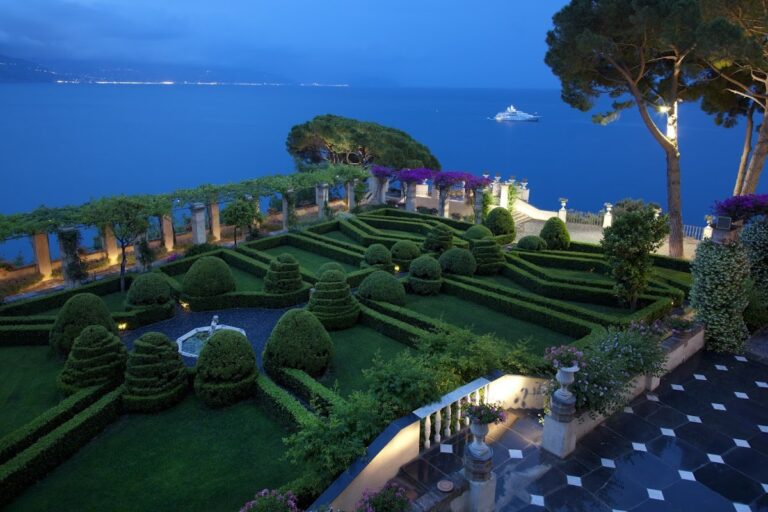
The Rocca Botanical Park covers approximately 21,000 square metres and rises vertically across several levels. A monumental staircase on the axis of the palace connects it with the original garden beside the building. The staircase includes a nymphaeum, an ornamental grotto or fountain feature inspired by ancient and Renaissance garden design.
Plantings and Decorative Features
The park contains olive groves, holm-oak woods, succulent plants, cycads, bamboo, and exotic conifers from equatorial regions. Their cultivation benefits from the microclimate of the Ligurian Riviera. Artificial features include grottoes, small waterfalls, ponds, a Neo-Pompeian temple modeled on decorative forms associated with the ancient Roman cities preserved at Pompeii, and the Tea Pavilion.
Nearby sites