Schloss Götzendorf: A Medieval Castle Complex in Austria


Site at a Glance
- Rating
- 4.4
- Popularity
- Very Low
- Country
- Austria
- Primary era
- Medieval
- Eras represented
- Medieval, Early Modern, Modern
- Civilizations
- Holy Roman Empire
- Site type
- Military
- Remains
- Castle
On this page9 sections
History
Schloss Götzendorf is a medieval castle complex in Austria, in the municipality of Oepping in Upper Austria. Its history reaches back to around 1180, when the Lords of Götzendorf probably built an earlier castle on behalf of the bishops of Passau, whose ecclesiastical territory and feudal authority extended into the region.
The Lords of Götzendorf
The name Walter von Gocynesdorf appears in a parchment issued by Wilhering Abbey in 1180. It later developed through the forms Gecynesdorf and Gezendorf into Götzendorf. The family belonged to the ministeriales, formally unfree service nobles who could hold substantial administrative, military, and political responsibilities for an ecclesiastical or secular lord.
Wernhart von Götzendorf was named in 1303 as a vassal of Haichenbach, while Chunrat von Gozenstorf held the office of land judge above the Enns in 1306. This judicial office covered the historical territory known as above the Enns, corresponding broadly to Upper Austria. The family ended with Jakob von Götzendorf. On 10 November 1422, the fief passed in equal shares through the marriages of his two daughters to Heinrich von Vichtenstein and Jörg Hauzenberger.
The Vichtenstein, Hauzenberg, and Oedt periods
In 1453, the sons of Heinrich and Jörg sold the castle and lordship to Martin von Oedt after 31 years of possession. Martin had served since 1450 as the Passau administrator of Schloss Sprinzenstein, an official responsible for managing a lord’s castle, estate, or jurisdiction. He acquired Götzendorf on 10 September 1453 and thereafter styled himself Martin von Oedt zu Götzendorf. Further acquisitions enlarged the lordship.
After Martin’s death in 1480, his sons divided the inheritance. Mathias became lord of Götzendorf, while Marx received Lichtenau. Mathias held Götzendorf until his death in 1526, followed by his son Balthasar von Oedt from 1526 to 1551. In 1551, King Ferdinand I confirmed Balthasar’s nobility, and he adopted the designation Oeder von Oedt zu Götzendorf. Because his marriage to Benigna produced no children, the estate passed after his death to Sebastian, the son of his brother Wolfgang.
Sebastian von Oedt held Götzendorf from 1551 to 1583 and was buried in Rohrbach parish church, where a red-marble memorial stone commemorates him. His son Hans Christoph von Oedt zu Götzendorf succeeded him and held the estate from 1583 to 1630. During his tenure, the castle was further developed, including the rebuilding of the farmyard and the creation of arcades and gardens.
Counts of Oedt
Philip Heinrich von Oedt zu Götzendorf owned the estate from 1630 to 1655. After his death, Erasmus Anton Graf von Oedt zu Götzendorf became its owner. Emperor Charles VI raised Erasmus Anton to the rank of Imperial Count in 1714, recognizing his service to the Empire during the War of the Spanish Succession, the conflict over the succession to the Spanish monarchy. Erasmus Anton died in 1719 and was buried in Rohrbach parish church.
Johann Christoph Heinrich Graf von Oedt zu Götzendorf held Götzendorf from 1719 to 1750. He served as chamberlain to Empress Eleonore, privy councillor and chamberlain to Emperor Charles VI, monastic councillor, and vice-governor and regent in Lower Austria. In 1719, he founded a benefice at Götzendorf, an endowed ecclesiastical foundation whose income supported its appointed cleric, and appointed a castle chaplain.
After Johann Christoph Heinrich’s death, bankruptcy administration was imposed on the lordship. His political involvement in Vienna had contributed to the neglect of the ancestral castle. The estate passed to his underage grandson Johann Christoph, under the guardianship of Baron Briccius. When Johann Christoph died in 1756 at the age of twelve, the Oedt line at Götzendorf ended. The guardian then sold the castle and lordship to Prince Johann Nepomuk Friedrich von Lamberg.
The Lamberg period and municipal ownership
The Lambergs used Götzendorf mainly as a capital investment. Land and property were gradually sold in small parcels. A fire destroyed the castle in 1899, and only part of the complex was rebuilt in 1901. The west wing was not reconstructed. In 1912, Count Karl Emil von Lamberg sold the castle to the municipality of Oepping, while the remaining Lamberg land went to Franz Böck of Sarleinsbach. The farmyard and land later passed to various owners.
After the municipal purchase, the castle rooms continued to house the elementary school. The school had opened on 3 June 1871 in rooms provided by Prince Anton von Lamberg. It began as a one-class school with 84 Sunday pupils divided by ability; enrolment later ranged from 72 to 113. From 1901 it had two classes. In its final year, only 21 pupils attended four grades, and the school closed at the end of the 2010 school year. The first opening was attended by Rohrbach’s first district captain Franz Sanna and first district school inspector Michael Walz. Josef Ringler of Kollerschlag was the first headmaster, and Maria Roth was the final director.
The castle chapel
The chapel remains used for worship under the dedication of the Assumption of Mary, the Christian feast commemorating Mary’s being taken into heaven. Its late Gothic Götzendorf Madonna is represented by a copy. In the second half of the twentieth century, the chapel received a projecting apse and a modern interior. Storm damage led to the replacement of its former onion dome, a bulb-shaped cupola, in 1931 with the present roof turret and pointed helmet.
Remains
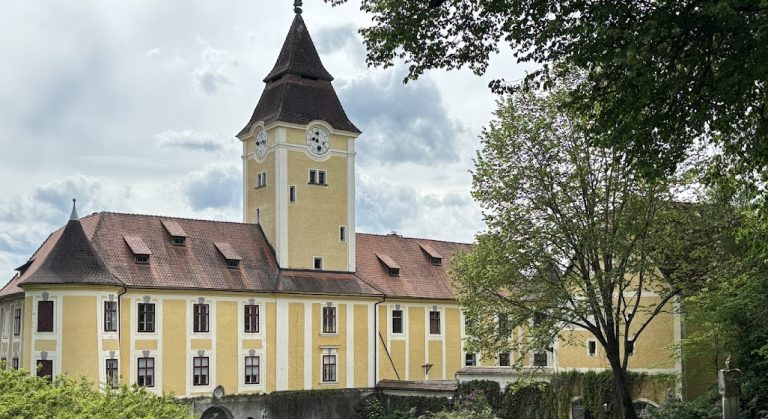
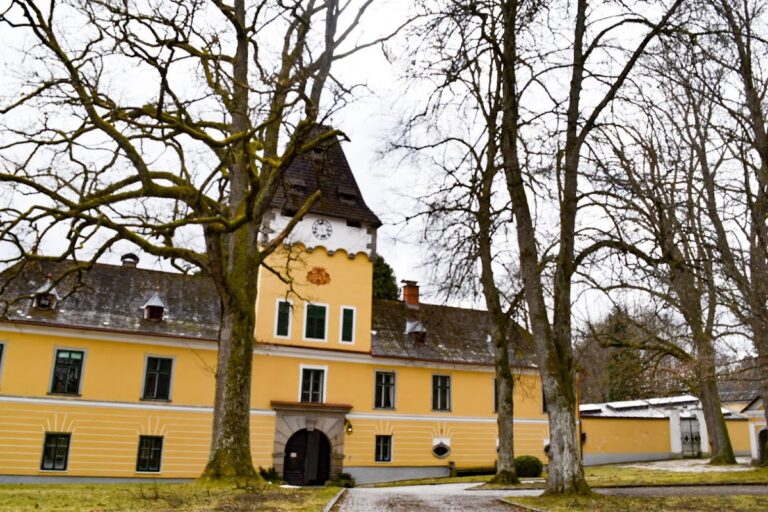
Schloss Götzendorf survives as a small, irregular four-winged complex. Two- and three-storey wings surround an inner courtyard, while the exterior still follows the course of the medieval ring wall. The residential wings were built against this earlier defensive boundary. The complex is architecturally well preserved, although the west wing remains unreconstructed after the fire of 1899.
Wings and courtyard
Entry to the courtyard is through a barrel-vaulted passage on the north side. The nearly square courtyard has arcades on the upper storey of the east and north wings. At ground level, arcades survive in the east wing. A covered staircase leads to the first floor, and the courtyard side of the entrance gate bears the coat of arms of the Oedt family. The former Princely Rooms in the south wing were later adapted for use by the elementary school.
Chapel and medieval defenses
The chapel opens directly from the courtyard. Its projecting apse belongs to the second half of the twentieth century, while the 1931 roof turret replaced the earlier onion-domed tower after storm damage. The late Gothic Götzendorf Madonna is represented inside by a copy. At the foot of the surviving ring wall, a pond is probably a remnant of the former castle moat.