Rothenthurn Castle: A Historic Fortress in Austria

Site at a Glance
- Rating
- 4.7
- Popularity
- Very Low
- Country
- Austria
- Primary era
- Early Modern
- External website
- Open
- Eras represented
- Medieval, Early Modern, Modern
- Civilizations
- Holy Roman Empire
- Site type
- Military
- Remains
- Castle
On this page9 sections
History
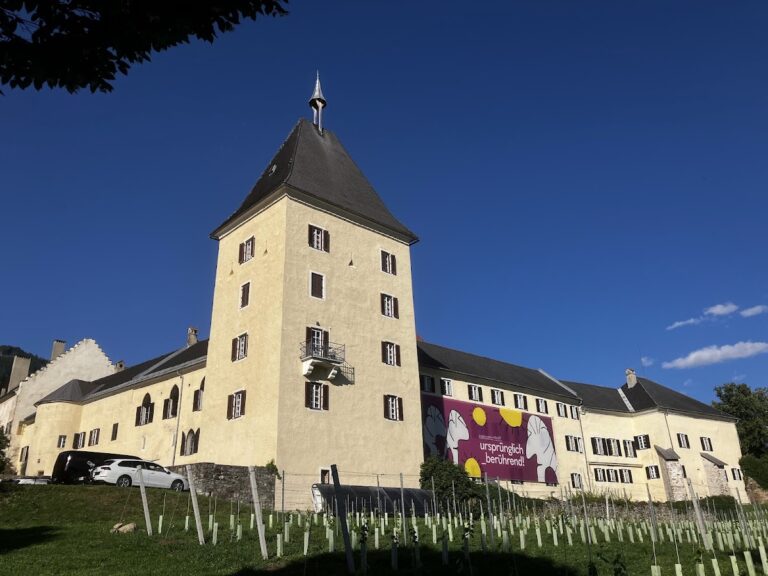
Rothenthurn Castle is a historic fortified residence in Austria, above Rothenthurn in the municipality of Spittal an der Drau, Carinthia. Its origins probably reach back to the eleventh century, when the site was centered on a red defensive and lookout tower. This tower gave Rothenthurn its name, meaning “Red Tower,” and formed the core of the complex that later developed on the slope above the settlement.
Medieval origins and noble fiefs
The estate was held as a fief by the Counts of Ortenburg and later by the Counts of Celje, a powerful late-medieval noble dynasty in Central Europe, and the Counts of Gorizia-Tirol, whose territories included parts of the eastern Alps. A castle at Rothenthurn is documented in 1478, when the surrounding area was under the House of Gorizia.
The Kreuzer family reportedly received the castle as a princely fief around 1450. Hans Kreutzer is recorded as its first demonstrable owner in 1478. By 1508, Johann Meixner was lord of Rothenthurn. Major alterations and renovations carried out under his authority are why he is regarded as the builder of the castle in its surviving form.
Expansion and changing ownership
The original tower was expanded into a fortified courtyard complex. Around 1525, Barbara, Johann Meixner’s daughter and the wife of Johann von Manstorff, dedicated the family chapel to Saint Barbara. Through the marriage of Barbara’s relative Elisabeth to Christoph Khevenhüller von Aichelburg, ownership passed by inheritance to the Khevenhüller family, an influential Austrian noble house active in Carinthia and other Habsburg lands.
Hans von Gschrey acquired the lordship in 1564 and sold it to Franz Balthasar von Eschey in 1570. The castle remained with Eschey’s descendants until 1662, when Maria Salome Freiin von Aichelburg acquired it. Ownership then changed more frequently. Georg Sigmund von Mandorff became lord in 1688, followed by Johann Heinrich von Aineth in 1726. The property returned to the Mandorff family in 1738 and later passed through the Münch-Bellinghaus and Sorgo families.
Nineteenth-century restoration and later use
Konstantin Count Normann von Ehrenfels acquired Rothenthurn in 1880, and the property was in the possession of the Normann-Ehrenfels family by 1882. That year, the palace façades were remodelled in the historicist manner, a nineteenth-century practice of reviving and recombining forms from earlier architectural periods. The work partly reinstated the complex’s earlier appearance.
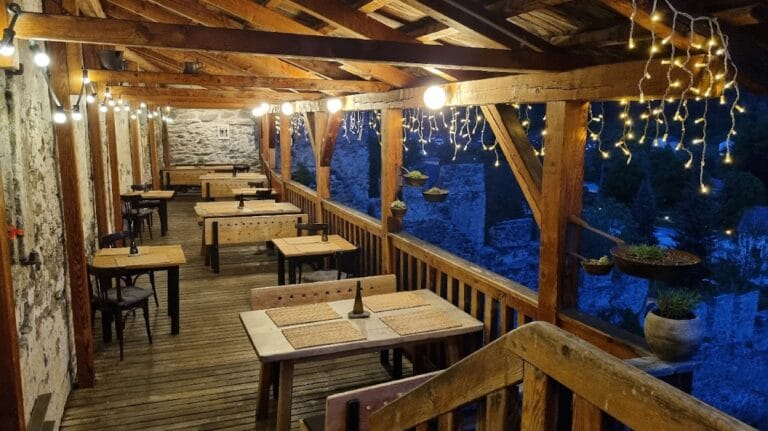
A mausoleum for Konstantin Normann-Ehrenfels was built north of the castle in 1882, the year of his death. Rothenthurn later passed by marriage or inheritance to Maria and Georg Pereira-Arnstein. The Pereira-Arnstein family operates a lodging establishment there, and the privately owned property remains in use. The Republic of Austria protects Rothenthurn as a monument under registration number 34727.
Remains
Rothenthurn occupies a narrow plateau on the southern slope of the Insberg, approximately 70 metres above Rothenthurn, between the Drava Valley and Lake Millstatt. The elongated complex follows gently sloping ground and consists of several irregular two- and three-storey wings. Most are covered by hipped roofs, while stairways built within the walls connect different parts of the building. The central Red Tower remains the oldest and tallest element, with a small roof turret above its central section.
Castle complex
Red Tower and entrances
The core of the Red Tower probably dates from the eleventh century. It was expanded as the surrounding fortified residence developed, and most of the other structures were built during the sixteenth and seventeenth centuries. The extensive complex was already depicted by Valvasor. An underground passage led from the Red Tower to Maximiliansburg, a castle site between Molzbichl and Rothenthurn.
The main entrance lies on the north side of the Red Tower. Its arched portal is flanked by Tuscan pilasters, which are flat wall-attached supports based on the simplest classical Roman column order. Paired windows rise above the entrance, and the broken-segment pediment bears the Khevenhüller coat of arms. The portal and windows were remodelled during the nineteenth-century restoration, although the entrance incorporates a sixteenth-century component.
Saint Barbara Chapel
The Saint Barbara Chapel occupies a pre-existing room in the eastern main wing. Established around 1525 and renovated in 1644, it is a single-nave chapel with three bays covered by an irregular groin vault, a ceiling formed where two barrel vaults intersect along diagonal curves.
The chapel’s frescoes date from the eighteenth century and have been restored. Water damage revealed an older image of Saint Kümmernis beneath the later decoration. In medieval and early-modern devotional tradition, Saint Kümmernis was associated with an unusual crucifixion image of a bearded woman. The chapel’s 1710 altar contains a sculptural Coronation of Mary, with statues of Saint Barbara and Saint Dorothy beside it.
West wing and northern grounds
A Renaissance portal with a stone frame survives in the west wing. Above it is a fragment of a commemorative plaque bearing the Khevenhüller coat of arms. A small pond lies in front of the castle. To the north stands the tomb monument of Konstantin Normann-Ehrenfels, built in 1882 as a three-sided open arbor, or loggia.
Nearby sites