Schloss Heiligenstedten: A Former Noble Estate and Manor House in Germany


Site at a Glance
- Rating
- 3.4
- Popularity
- Very Low
- Country
- Germany
- Primary era
- Early Modern
- Eras represented
- Early Modern, Modern
- Civilizations
- Holy Roman Empire
- Site type
- Domestic
- Remains
- Manor House
On this page14 sections
History
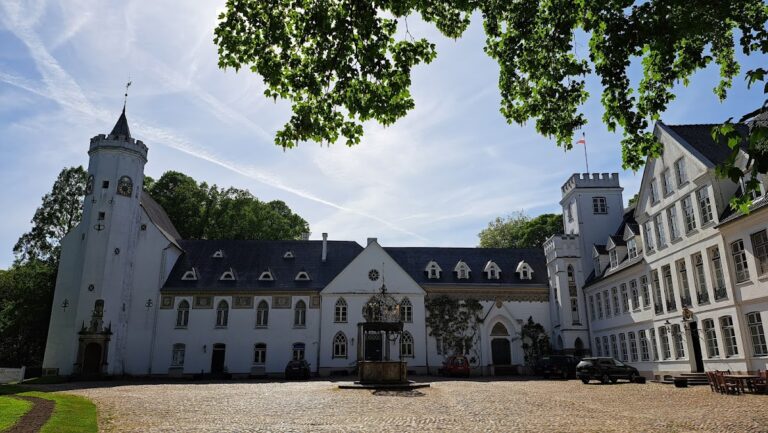
Schloss Heiligenstedten is a historic manor house in Heiligenstedten, Germany, near Itzehoe, developed by successive noble families from the sixteenth century onward. Although it is technically a manor house, it has long been popularly called a castle. The present building retains the core of a Late Baroque house begun in 1769, while its façades were remodeled in an approximately Neo-Gothic style between 1851 and 1853.
From Medieval Estate to Renaissance Manor
The lands of the estate belonged to the von Krummendiek family in the late Middle Ages. During the sixteenth century, ownership passed to the Rantzau family, who also lived at nearby Breitenburg, and soon afterward to the Ahlefeldt family. Both families belonged to the Equites Originarii, the hereditary native nobility of Schleswig-Holstein.
In 1583, Balthasar von Ahlefeldt commissioned the master builder Franz von Roncha to construct the first manor house. It was built in the Renaissance style, a period that revived classical forms and Greco-Roman design principles. The estate later passed to the Blome family in 1691, beginning a period of ownership that continued until 1926.
Rebuilding and Nineteenth-Century Remodeling
A new manor house was erected in 1717, but a storm surge severely damaged it in 1756. From 1769, Otto von Blome commissioned another new house in the Late Baroque style. This later phase, characterized by elaborate forms and ornamental design, became the structural core of the present building.
Between 1851 and 1853, the house underwent a major remodeling in an approximately Neo-Gothic manner. Neo-Gothic architecture revived medieval Gothic forms and historically inspired façades during the nineteenth century. At Heiligenstedten, the earlier floor plan was largely retained, while the principal changes affected the exterior elevations.
The Blome Memorial
In 1796, Otto Blome I erected an obelisk in memory of his brother Wulf Blome, who had died in 1784. A later legend linked the dog represented on the monument with a story that the animal had saved its master’s life. The weathered inscription was intended to commemorate Wulf Blome, however, and the monument’s original meaning is connected with his memory.
State Ownership and Changing Uses
In 1926, the Blome family sold the estate to the state of Schleswig-Holstein. The furnishings and library were auctioned, and part of the library was transferred to Husum Castle. Until 1939, the house served as a home for young people considered difficult to educate.
At the beginning of the Second World War, the building was temporarily converted into a military hospital. During the war it returned to use as an educational home. After the war, it accommodated refugees from the former German eastern territories. From 1958 until the home closed in 1987, the building functioned as an old-age home.
Private Ownership and Failed Redevelopment
The house was occupied in 1988. An association formed afterward received temporary permission to use part of the grounds. A private investor then became interested in the property, and the state of Schleswig-Holstein, represented at the time by Finance Minister Heide Simonis, sold the castle for the symbolic price of DM 10,000.
The property soon changed hands again. By 1994, the manor house had been completely renovated and converted into a castle hotel. Restaurants were established in the ancillary buildings, and a sport-horse training center was planned. The project failed partly because of disagreements between its operators and the municipality of Heiligenstedten and partly because visitor numbers were lower than expected. The estate is privately owned, over-indebted, and seeking a new purchaser.
Remains
Schloss Heiligenstedten stands on a rectangular island within a loop of the River Stör. The principal house occupies the historic estate center, while ancillary buildings stand before its main façade and the surviving part of the garden. The complex combines the retained core of the Late Baroque manor house with nineteenth-century Neo-Gothic exterior changes and later alterations to the surrounding grounds.
Manor House and Estate Buildings
The Manor House
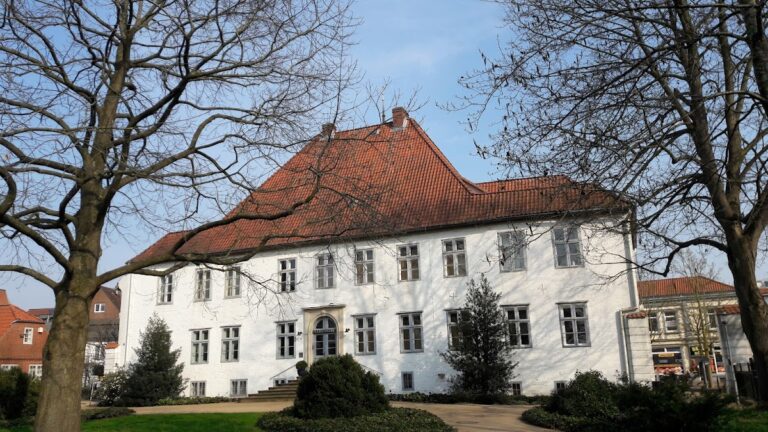
The present manor house preserves the core of the construction begun in 1769. Its earlier floor plan survived largely intact through the remodeling of 1851 to 1853, when the main work focused on the façades. The building therefore contains an eighteenth-century Late Baroque core expressed through a nineteenth-century exterior treatment.
Ancillary Buildings
Several ancillary buildings occupy the area in front of the main façade and the surviving garden. They formerly served as an estate farm building and an orangery, a structure used for cultivating and sheltering plants. Some of these buildings were later adapted for restaurants.
Island, Park, and Waterworks
Landscape Park
The estate formerly included an English-style landscape park. After the surrounding dike was enlarged, much of the park was absorbed into the wider landscape. Another section was replaced by a large riding hall, changing the relationship between the surviving garden and the former parkland.
Moat Sluice
The sluice serving the castle moat is a controllable water gate connected with the Stör dike system. After the 1962 storm surge, almost all sluices in the Heiligenstedten section of the dike were decommissioned and filled in. The castle’s sluice was retained and replaced by a cast-iron structure with a gate.
Obelisk at the Park Edge
A roughly 12-meter-high obelisk stands at the end of Schlossstraße and at the southern end of the castle park, beside the inner foot of the Stör dike. The tall monument is assembled from numerous blocks and carries a sculpture of a dog. Its inscription has become illegible, so the precise significance of the dog cannot be established from the surviving text. The obelisk remains associated with the memory of Wulf Blome, who died in 1784.
Nearby sites