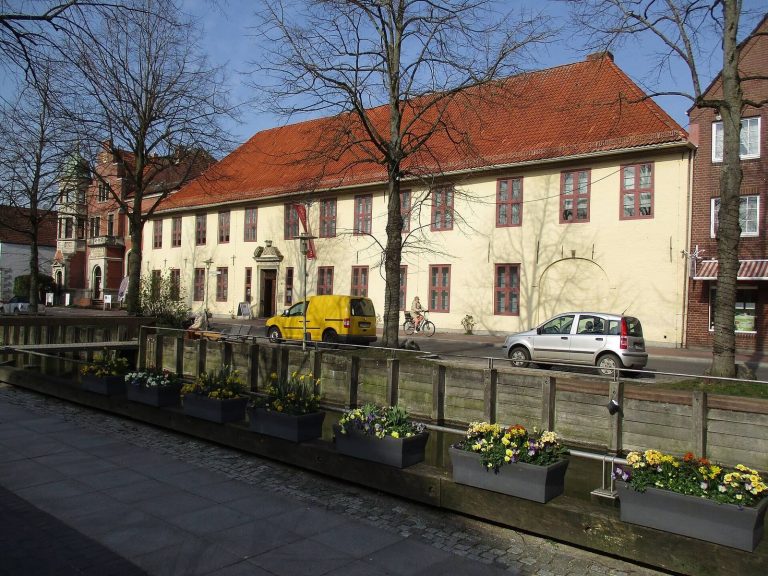
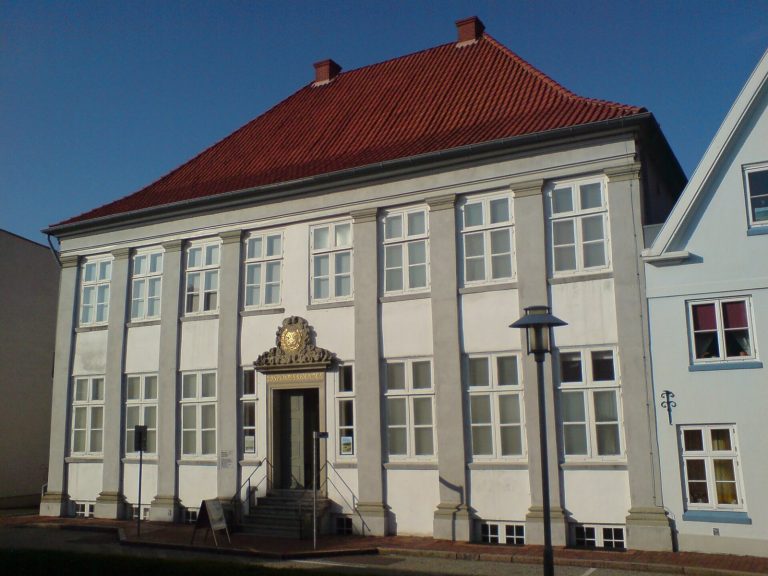
GeSCHICHTENberg Itzehoe: A Bronze Age Burial Site and Memorial
Site at a Glance
- Popularity
- Medium
- Country
- Germany
- Primary era
- Modern
- Eras represented
- Stone Age, Bronze Age, Modern
- Civilizations
- German
- Site type
- Burial
- Remains
- Burial Mound
On this page15 sections
History
GeSCHICHTENberg Itzehoe is a Bronze Age burial site beneath a later memorial building in Itzehoe, Germany. Its cemetery was used around 1500 to 1200 BCE, during Periods II and III of the Early Nordic Bronze Age. Later associated with the gallows of Itzehoe’s Cistercian nunnery, the site was excavated in 1937 and recast in Nazi propaganda as a supposed Germanic ancestral shrine. That interpretation gave rise to the misleading name Germanengrab.
Bronze Age cemetery
Burials accumulated over more than 200 years and at least six generations. Their sequence has been interpreted as evidence that members of a settler family honored their ancestors at the mound. The labor invested in its construction and the value of its grave goods also point to elevated social standing, productive agriculture beyond subsistence, and participation in trade.
Medieval and early modern use
The mound later served as the gallows hill of Itzehoe’s Cistercian nunnery, a community of Catholic nuns. The nunnery was founded in 1256. In 1541, following the Reformation, the sixteenth-century movement that reshaped Western Christianity, it became a Protestant foundation for women of noble families.
Itzehoe’s Galgenberg, or gallows hill, is another historical name associated with the site, though it does not identify a single gallows ground precisely. From 1617 until 31 March 1861, four jurisdictions in Itzehoe each had a gallows hill.
Excavation and Nazi-era interpretation
In 1937, archaeologist Günther Haseloff investigated the mound for the Steinburg district heritage association and the Kiel Museum of Antiquities. New building threatened the site. A test trench on the eastern side exposed two graves, leading to a full excavation.
Haseloff interpreted the cemetery as a place where a Bronze Age family honored its ancestors. He also used Roman-period texts to connect the people buried there with later Germanic identity and to attribute Germanic family laws to the mound, although no contemporary evidence supports that connection. Nazi ideologues adopted his interpretation, presenting the Bronze Age community as ancestors of the Germanic population in support of the racist myth of a Germanic master race. A direct continuity between Bronze Age life and later Germanic customs cannot be established across the gap of more than a thousand years.
Memorial building and later name
After the excavation, plans initially called for the mound to be rebuilt to its former height. Instead, the burial site was placed beneath a protective structure, with its basal graves preserved as a setting for Nazi Germanic-cult observances. The building and its grounds were completed in time for Itzehoe’s 700th-anniversary celebrations in 1938 and served Nazi propaganda. The exterior grounds were prepared as a parade area for local Nazi organizations. Further plans proposed a park, a local-history hall, and a Hitler Youth home.
An interior frieze conceived by artist Wilhelm Petersen was never made. The proposed work would have extended 50 metres in length and stood two metres high, depicting a life-sized gathering of blond, blue-eyed Germanic mourners in a romanticized, heroic style. Wartime priorities and a lack of funds prevented its completion. After the war, the parade area became a memorial to people killed or displaced in the world wars. The site has been officially named GeSCHICHTENberg Itzehoe since 2020; Germanengrab remains a misleading name rooted in the Nazi-era interpretation.
Remains
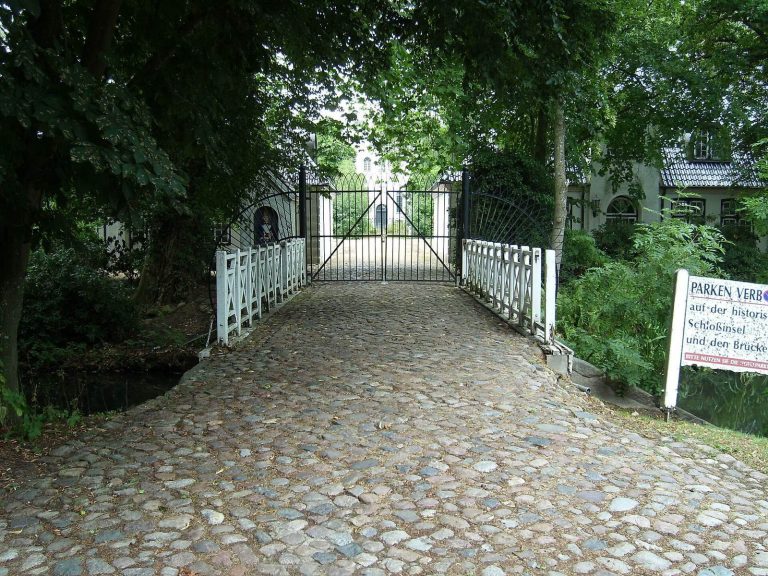
The site occupies a sandy rise at the edge of Itzehoe’s city centre, near Timm-Kröger-Straße and Langer Peter. This raised ground sits above nearby marshland, beside an old route west toward northwestern Dithmarschen. Before urban growth surrounded the site, its position looked out over the marshes of the Stör and Elbe rivers.
Protective building
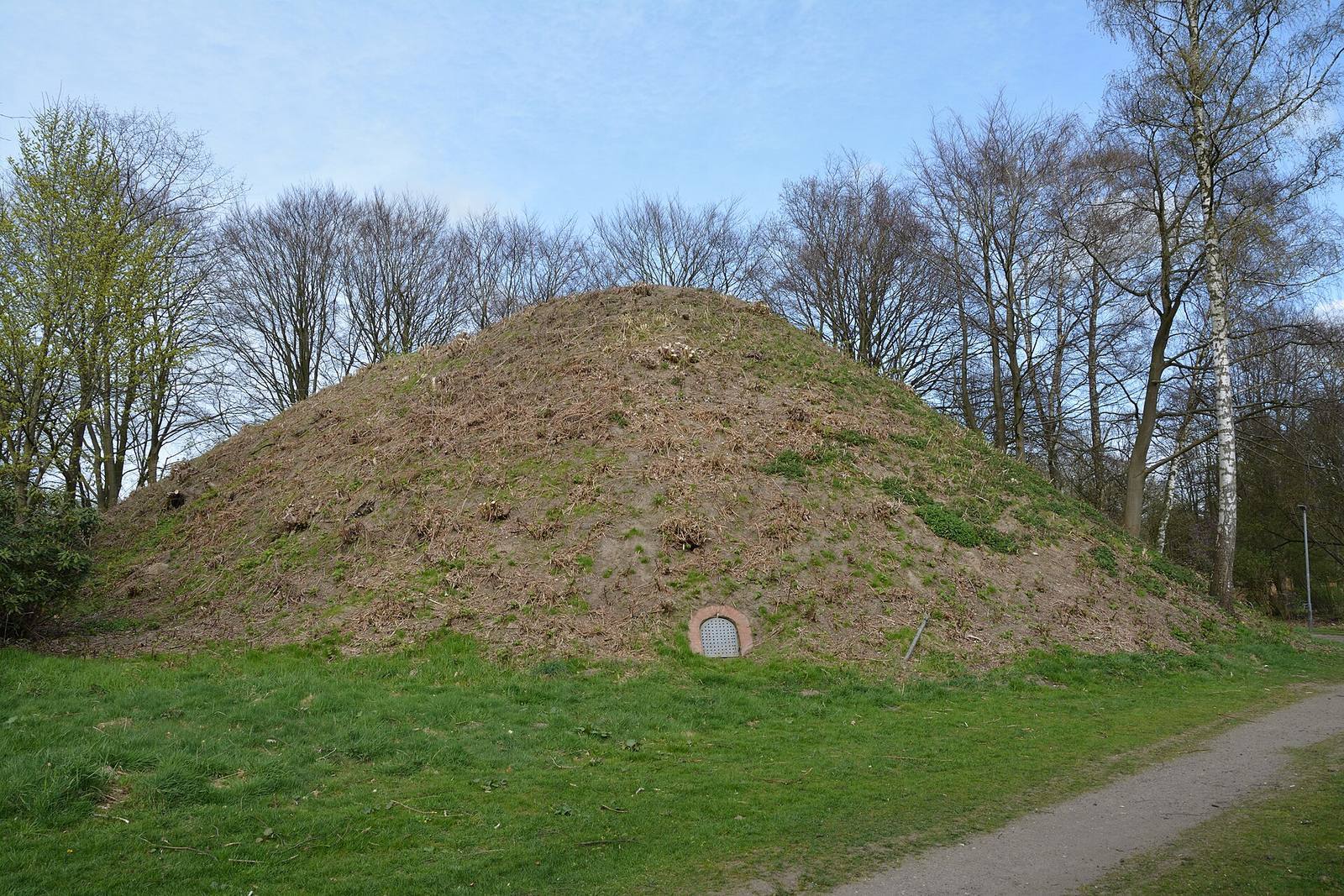
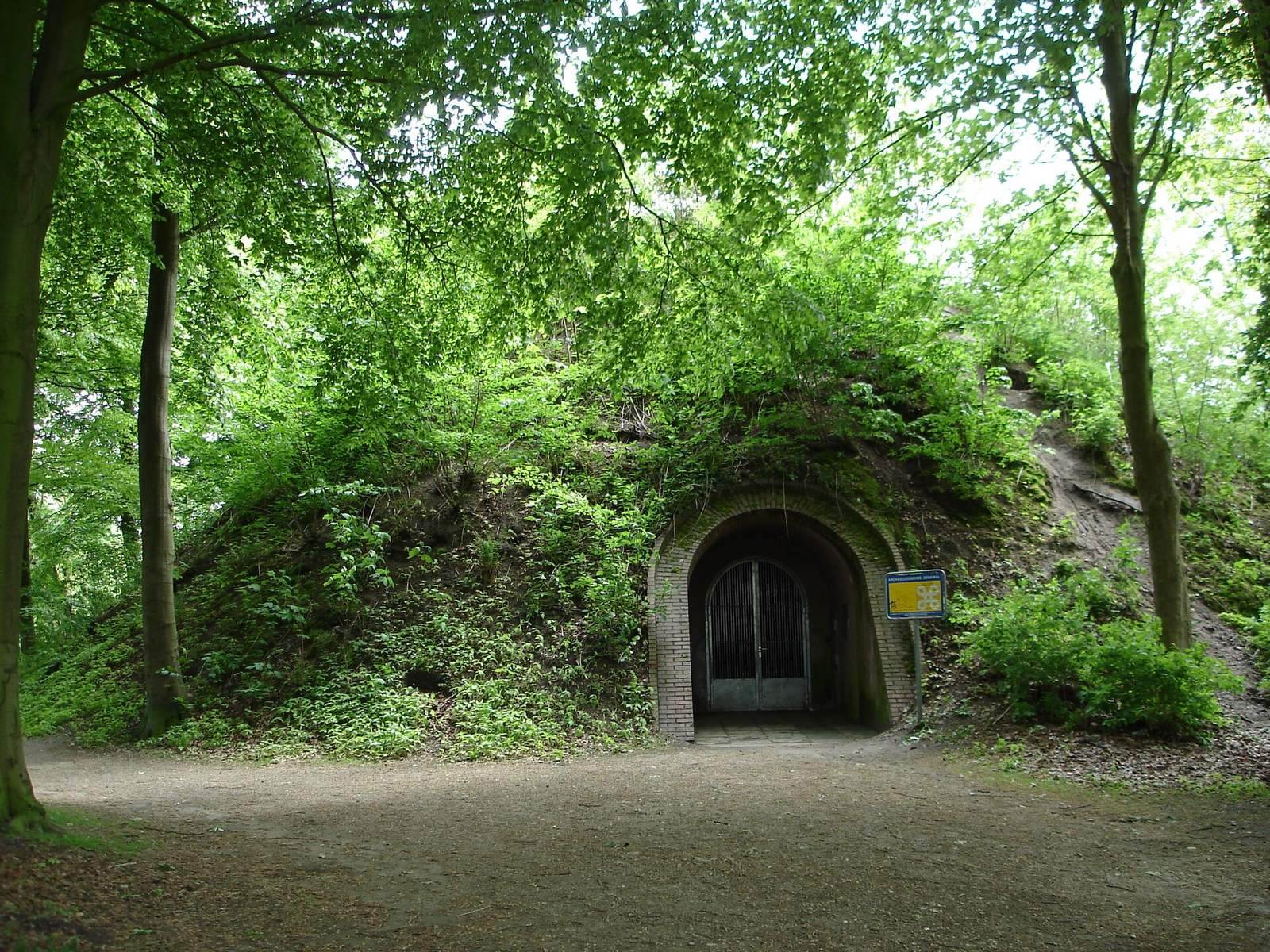
The present structure is an earth-covered brick building shaped to recall the original mound. Its circular domed chamber stands above Grave 1, while an entrance hall with a barrel vault, a tunnel-shaped ceiling, covers Graves 2 and 3. The entrance is on the north side. Built from local sand-lime brick, the structure reflects steel-conservation requirements during preparations for war. The dome rises 9.20 metres above Grave 1, leaving clearance around its stone circle. The entrance vault is 5.40 metres high. Earth piled over the building formed an exterior mound almost ten metres high.
Bronze Age cemetery
Early mound and basal graves
The cemetery began as two adjoining mounds. The older, southern Mound I enclosed the founder’s grave. It measured 13 metres across and stood 2.70 metres high, with a border of head-sized stones and larger blocks. The deceased lay on their back in an extended position inside a coffin hollowed from a tree trunk, surrounded by stones.
Mound II lay immediately south of Mound I. It held the tree-trunk coffin, stone packing, and stone ring of Grave 2, a woman’s burial, as well as child Grave 3. The child’s burial consisted of a tree-trunk coffin within a stone packing. These two graves lie beneath the building’s entrance vault. The protective structure also preserves Grave 1 beneath its dome.
Later mound construction
Graves 4 and 4a were placed over Mound II, then covered by Mound III, which rose nearly as high as Mound I. Together the mounds created a two-peaked form. Two more separate, overlapping mounds joined the complex at ground level and extended its base northward. Mound VI reshaped the group into one mound 3.75 metres high.
Graves 8 and 9 were later placed on the mound’s summit. Grave 8 lay in a depression, while Grave 9 was covered by a low mound. Mound VIII eventually covered the cemetery above the notably large Grave 10. The completed Bronze Age mound reached 5.5 metres in height and 30 metres in diameter.
Excavated graves and burial materials
The 1937 excavation uncovered twelve graves: ten burials of bodies and two containing cremated remains. Grave goods identified three male and four female burials; eleven of the dead were adults and one was a child. Two later urn burials may also have belonged to the mound’s outer covering. The number of graves, the mound’s height, and their undisturbed condition made the cemetery particularly notable among Nordic Bronze Age burial mounds.
The finds were principally made of flint, bronze, clay, and decorative stones. A textile belt fragment from Grave 6 survived well enough to be reconstructed. It used tablet weaving, in which small tablets control the threads, alongside braiding.
Graves 1 to 3
Grave 1 contained a fire-striking stone and a piece of pyrite, parts of a fire-making set. The 25-centimetre bronze wheel-headed pin from Grave 2 served as clothing fastener and ornament. Its origin in the Lüneburg area indicates exchange and may also point to the wearer’s origins.
Graves 4 to 6
The rich warrior burial in Grave 4 included a locally made sword, with traces of its wooden scabbard, and a stop-ridge axe, whose raised ridge helped secure its handle. Other finds included facial-hair tweezers, an unworked piece of amber, and a hook from a leather belt. A blue glass bead worn on the chest points to trade with southern Germany. It is regarded as the oldest glass find in a male grave in Schleswig-Holstein.
Two roughly made grey-brown cups stood at the foot of the burial in Grave 5. They measured 6.5 and 8.8 centimetres high. Grave 6 held a smooth, rounded vessel 17.6 centimetres high, with two knobs attached at its sides. The female burial there also contained a bronze knife blade, the woven belt end with a hanging braided ornament, a decorative pin with a flared head, and a piece of urn resin.
Graves 7 to 10
Grave goods indicate that Grave 7 was a male burial and Grave 7a a female one. Grave 7 contained a 22.9-centimetre bronze dagger blade with a broken point and a Period II spiral-plate brooch, a prehistoric fastener with spiral-shaped plates and a narrow bow. Grave 7a held a bronze arm ring and a twisted bronze neck ring damaged by fire.
Grave 8 contained a green-oxidized fragment of another Nordic brooch. Its end spiral was made from round wire, and its needle head thickened into a spiral. The piece dates to the transition into Period III. Female Grave 9 held three amber chain links, a decorated arm ring, and a heavily corroded bronze pin with several mouldings. The pin came from southern Germany and dates to Period III. A small spiral fragment in Grave 10, made from hammered wire, probably also belongs to Period III.
Re-erected dolmen
Southeast of the mound, remains of an extended dolmen, an elongated-chamber megalithic tomb, from Warringholz were re-erected.