Château Dillon: Historic Wine Estate and Agricultural School in France
Site at a Glance
- Rating
- 4.5
- Popularity
- Very Low
- Country
- France
- Primary era
- Early Modern
- External website
- Open
- Eras represented
- Early Modern, Modern
- Civilizations
- French
- Site type
- Domestic
- Remains
- Castle
On this page7 sections
History
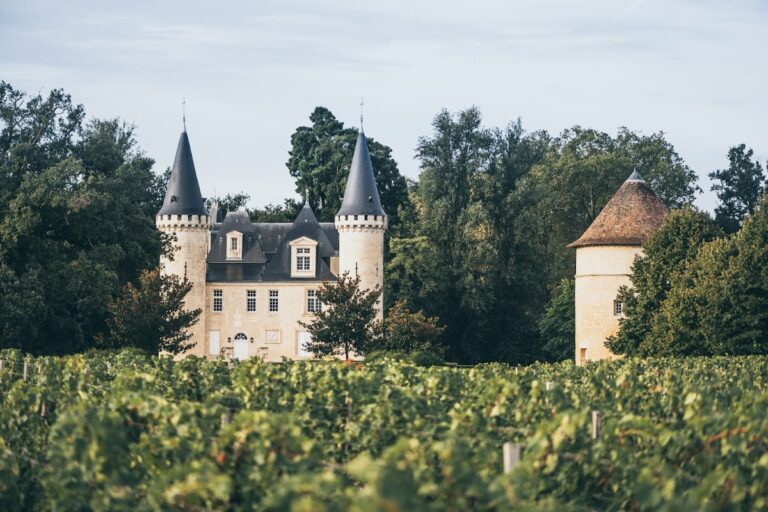
Château Dillon is a historic wine estate in Blanquefort, France, built from the late seventeenth century into the beginning of the eighteenth century. It developed on the site of an earlier fortified house and later became associated with the Dillon and Seignouret families, Bordeaux wine production, and agricultural education.
From Terrefort to Château Dillon
A fortified house called Château de Terrefort stood in the locality of Terre-Fort before the present estate was built. Henri de Laussade is the earliest known owner, while his widow bought vineyards there from a ploughman in 1596. Château Dillon itself took shape between the late seventeenth century and the very beginning of the eighteenth century. The year 1705 is carved on the estate well.
Robert Dillon, an Irish merchant born in 1710, settled in Bordeaux in 1753 to manage the affairs of his deceased brother. Louis XV, king of France from 1715 to 1774, had granted him French citizenship. On 29 July 1754, Dillon used the success of his banking business to acquire the Terrefort property, alongside an urban house in Bordeaux. He died suddenly in 1764.
During the French Revolution, the monarchist owners of the property emigrated to England. As a result, the state confiscated part of the estate in 1792. One of Robert Dillon’s sons gradually bought back the confiscated parcels, completing the reassembly of the property by 1806. The estate then passed through several owners before François Seignouret purchased it in 1829.
The Seignouret wine estate
Seignouret, a native of Bordeaux, had made his fortune in Louisiana by manufacturing high-quality furniture. When he acquired the property, it covered seven hectares. In 1830, he founded a wine-export company and transformed his New Orleans cabinetmaking workshops into wine cellars. He also created the Château Dillon brand, which became known in the United States because several members of the Dillon family had taken part in the American War of Independence.
Seignouret built wine cellars in 1840. A fire later destroyed them, and they were rebuilt on a larger scale. After Seignouret died in 1852, his widow continued to develop the estate. By 1890, it extended across 125 hectares, including 52 hectares of vineyards.
From family property to public agricultural institution
The estate remained with the Seignouret family through two successive female descendants. Marie-Thérèse Filippini, Seignouret’s great-granddaughter and widow of the Viscount d’Arlot de Saint-Saud, inherited it in 1937. She sold the property to the French Ministry of Agriculture in 1956.
The land had been leased to the Blanquefort School of Agriculture, Viticulture, and Horticulture since 1923. The institution became a Regional School of Agriculture on 2 December 1955 and the Bordeaux-Blanquefort Agricultural High School on 21 April 1963. The school, commonly called the Blanquefort viticultural school, provides education from secondary level through higher education. In 2010, it joined with the Blanquefort and Libourne viticultural schools and the La Tour Blanche School of Viticulture and Oenology to form EPLEFPA Bordeaux-Gironde, a French public institution grouping agricultural education and training establishments.
Château Dillon is now owned by the French state and houses an agricultural high school. Its wine is a Haut-Médoc red classified as Cru Bourgeois, a recognized Bordeaux classification outside the 1855 classification. The entire site has held ISO 14001 certification since 2004, reflecting an international environmental-management standard. The château was listed as a historic monument on 5 December 1984.
Remains
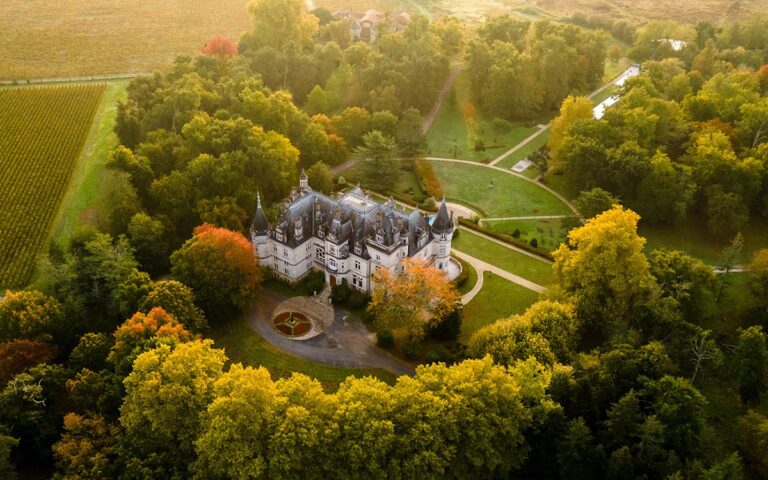
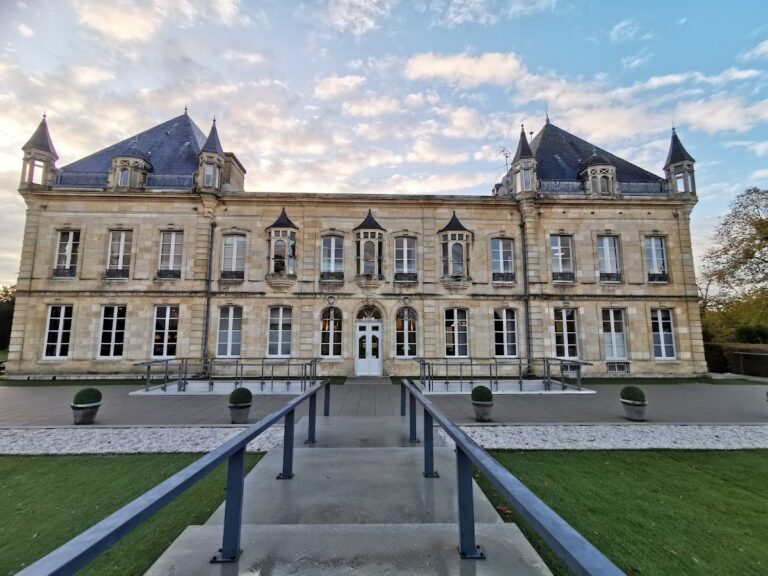
The estate combines the château, its entrance features, a well, nineteenth-century wine buildings, and a vineyard. The protected architectural fabric includes the main building’s facades and roofs, the staircase enclosure and staircase, the wrought-iron stair railing, stucco decoration, and a ground-floor fireplace.
Entrance and château
The approach to the estate includes an entrance portal with an iron grille and the well bearing the date 1705. Within the château, the staircase and its enclosure form part of the protected structure, together with the wrought-iron railing, stucco decorations, facades, roofs, and a ground-floor fireplace. These elements preserve the character of the residence built around the transition from the seventeenth to the eighteenth century.
Wine cellars and vineyard
The wine cellars built in 1840 originally had three traditional Médoc gables. After the fire, they were reconstructed on a larger scale and now serve as reception rooms. The present vineyard covers 40 hectares on gravel and clay-limestone soil. Cabernet Sauvignon makes up 52 percent of the vines, Merlot 41 percent, Petit Verdot 6 percent, and Carménère 1 percent. Annual production is approximately 250,000 bottles.
Nearby sites