Château Bel-Air: A Historic Estate and Football Centre in Le Haillan


Site at a Glance
- Rating
- 4.5
- Popularity
- Low
- Country
- France
- Primary era
- Modern
- Eras represented
- Early Modern, Modern
- Civilizations
- French
- Site type
- Domestic
- Remains
- Castle
On this page12 sections
History
Château Bel-Air is a historic estate in Le Haillan, France, whose present stone château incorporates eighteenth-century elements and was transformed around 1845. Known in the Middle Ages as the Bourdieu de Lanneblanque, it was associated with the noble house of Bussac and later became a private residence, agricultural estate, vineyard, and municipal property. Since 1986, it has served as the international football centre and headquarters of FC Girondins de Bordeaux.
Medieval and Early Modern Origins
The estate was linked to the Battle of Haillan during the Hundred Years’ War, a series of conflicts between the English and French crowns from 1337 to 1453. Bordeaux’s forces attacked troops belonging to Charles VII of France, and the resulting massacre on 1 November 1450 was remembered locally as La Male Journade, meaning “the bad day.” By the sixteenth century, when Le Haillan formed part of Eysines, a residence known as the Bourdieu de Lanneblanque stood on the property. The term bourdieu referred to a rural country estate or country house in the Bordeaux region.
On 21 January 1761, the Caribbean merchant and colonist Alexis Nouguès bought the estate from the Disnemartin family for 50,000 livres. After his death in December 1762, it passed to his 19-year-old nephew, Dominique Leblanc-Nouguès. Following his return from Martinique in 1781, Leblanc-Nouguès demolished the earlier residence and commissioned a new cut-stone château. He also obtained exceptional permission from the archbishopric to construct a chapel.
Transformation into Bel-Air
Dominique Leblanc-Nouguès sold the property on 24 April 1787 to Pierre Lafargue, a Bordeaux merchant who also traded with the Caribbean and lived in Martinique. During Lafargue’s ownership, the estate’s agricultural operation was restored, its vineyards were replanted, and the farm worker’s house was rebuilt. He planted the cedars that remain visible on the property and changed the estate’s name to Bel-Air.
Jean Augustin Bousquet acquired Bel-Air on 11 July 1820 for 100,000 francs. He enlarged and embellished the property and created an English-style garden supplied by underground pipes. After his death in 1837, his handwritten will, known as a holographic will, was challenged by his heirs. The estate was then sold through the court for 97,000 francs to the Bordeaux merchant Nicolas Darolle, who resold it in 1845 for 90,000 francs.
Francisco Antonio de Los Heros, a Spaniard living in Bordeaux, later acquired the château. He raised the main residential block by one storey, placed it on a raised earth platform, and expanded the estate to 100 hectares. In 1858, he helped secure Le Haillan’s religious and administrative separation from Eysines by donating land for a parish church, cemetery, and girls’ school entrusted to the Sisters of the Immaculate Conception, a Catholic congregation involved in religious education.
Late Nineteenth-Century Ownership
The property was sold on 6 August 1891 for 200,000 francs to Joseph Prom, a Bordeaux merchant associated with the Maurel family. Together they founded the Maurel et Prom peanut-oil company. Prom maintained the estate until his death in 1894. After his widow died in 1916, the property remained jointly owned and was offered for sale through the Bordeaux civil court.
Emilien Dussaq, a Bordeaux shipowner, became the final private purchaser. Under his ownership, the vineyard prospered as a Médoc Cru Bourgeois, a recognized classification traditionally applied to quality wine estates in the Médoc.
War Damage and Municipal Uses
During the Second World War, German forces occupied the château and used it as a munitions depot. When they withdrew, the stored ammunition was destroyed, severely damaging the building and tearing apart the estate’s woods. The property was subsequently looted.
From 1948, Mme de Sillac leased the grounds around the château to the municipality of Le Haillan. A meadow was converted into a football field, and further sports fields were added during the 1950s. The château’s cellars were converted into changing rooms. In 1963, the city of Bordeaux acquired much of the estate, including the château, after Le Haillan considered the asking price too high. The property then accommodated municipal plant nurseries, a horticultural school, and a day centre. In 1968, Mme de Sillac transferred several hectares to Le Haillan for a symbolic franc, enabling the municipality to create its municipal stadium.
Football Centre
Since 1986, following an initiative associated with Girondins coach Aimé Jacquet, Bel-Air has been the international football centre and headquarters of FC Girondins de Bordeaux. The club had previously operated its facilities at Rocquevielle in Mérignac. The château was restored and remodelled for the club. The estate remains owned by the city of Bordeaux and is administered by FC Girondins de Bordeaux, bringing its professional, training, and football-school operations together within one complex.
Remains
Château and Historic Grounds
Main Château
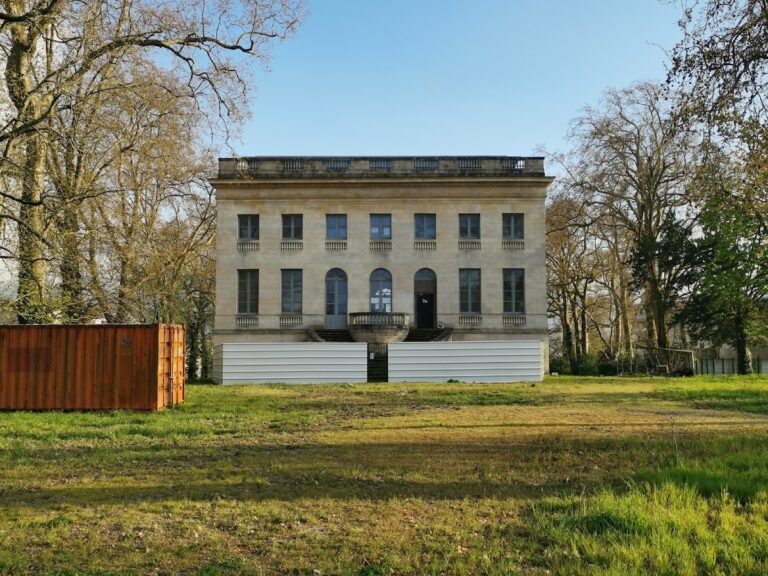
Château Bel-Air is a two-storey stone building whose construction date remains uncertain, although eighteenth-century elements survive within it. Its nineteenth-century transformation included the addition of a storey to the main residential block and its placement on a raised earth platform. The façades combine rough and dressed stone. Window openings are topped by pediments, triangular features above windows, and the exterior is further decorated with sculptures and a coat of arms.
The roof combines slate and tile. During the modern restoration, one pavilion received a pointed roof to produce greater symmetry. The building’s present uses reflect its adaptation for FC Girondins de Bordeaux: the basement contains a club shop, the ground floor includes a restaurant, reception rooms, and a bar, while the upper floors contain offices together with security and computer facilities. The château also houses the editorial offices of Girondins Mag and the club’s official website.
Eighteenth-Century Fountain
A fountain with a water feature survives among the estate’s eighteenth-century elements. Its decoration includes a mascaron, an ornamental sculpted face or mask. The fountain forms part of the historic fabric retained alongside the later château and football facilities.
Football Facilities
The football centre surrounding the château occupies 11 hectares. Its layout includes nine football pitches, two of them synthetic, as well as a wooded jogging route of about 3 kilometres. The professional centre, training centre, and football school occupy the wider grounds around the historic building.
Professional Centre
The professional centre is a light building with glass walls positioned among the practice fields. It provides 850 square metres of floor space. Its facilities include a dressing room with 30 lockers, showers, a physiotherapy room, a weight room, and a video room with 30 seats.