Rheinbaben Palace: A Cultural Centre in Siemianowice Śląskie, Poland


Site at a Glance
- Rating
- 4.6
- Popularity
- Very Low
- Country
- Poland
- Primary era
- Modern
- Eras represented
- Early Modern, Modern
- Civilizations
- German, Holy Roman Empire
- Site type
- Domestic
- Remains
- Elite Residence
On this page6 sections
History
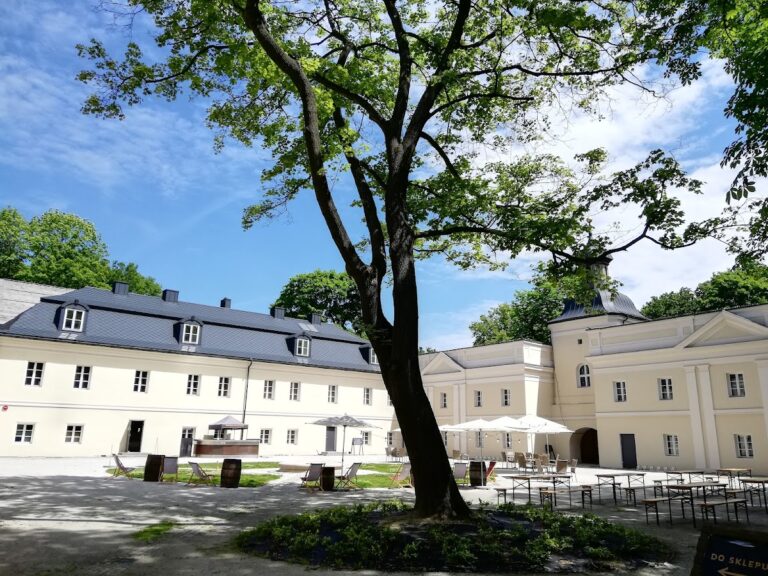
Rheinbaben Palace is a nineteenth-century palace in Siemianowice Śląskie, Poland, developed on the site of a manor associated with the Mieroszewski family. The palace was erected by the Rheinbaben family in either 1836 or 1870, although its construction date remains uncertain. Today, the building serves as a municipal cultural centre and hosts artistic, educational, and commemorative activities.
From manor to palace
The site began as a manor in Michałkowice owned by the Mieroszewski family. The original structure was wooden, with masonry foundations. From the sixteenth century, it was strengthened with masonry upper levels arranged in square or rectangular forms. The complex also acquired an enclosure and a tower rising above the gate.
In 1741, Jan Krzysztof Mieroszewski, the last representative of the family, married his daughter to a German second lieutenant from the Schwellengröbel family. Michałkowice consequently passed first to the Schwellengröbel family and later to the Rheinbaben family. The Rheinbabens then erected the palace, with the surviving evidence placing its construction in either 1836 or 1870.
Nineteenth- and twentieth-century transformations
Hugo zu Hohenlohe-Öhringen, a German nobleman and industrialist, acquired the palace in 1892. It was remodelled in 1906 or 1907, when an orangery, a specially designed building for cultivating and overwintering plants, was added. This intervention extended the residence’s architectural and functional arrangement.
After the Second World War, the Michał coal mine became the owner and converted the palace into a workplace cultural centre. Ownership later passed to the Siemianowice coal mine, and the building underwent a general renovation in 1986. Since 2009, it has belonged to the Municipality of Siemianowice Śląskie, which pursued a court dispute lasting more than a decade with a coal company over ownership of the property.
Since January 2016, the palace has been a branch of the Siemianowice Cultural Centre, a municipal institution organising artistic, educational, and sporting activities. Its programme includes concerts, conferences, and cultural and commemorative events. The first stage of revitalisation took place in 2017–2018 and included renewing the façades, replacing the roof covering, and replacing the window joinery. Rheinbaben Palace is entered in the register of immovable monuments of the Silesian Voivodeship under registration number A/1661/95, dated 20 June 1995.
Remains
Palace building
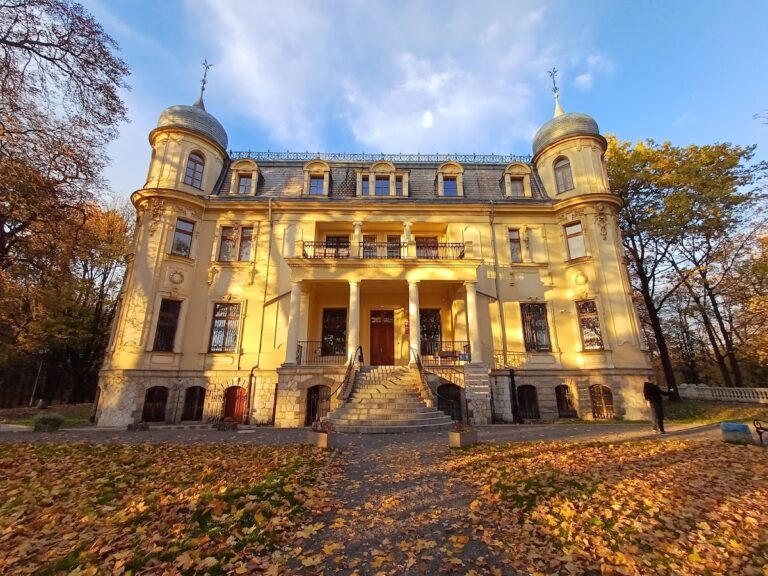
Rheinbaben Palace is a single-storey brick building on a rectangular plan, with plastered façades and gabled roofs. A two-storey projecting bay occupies the centre, while a lateral projection rises to three storeys. The main entrance is marked by a cast-iron canopy with an arabesque pattern, composed of interlacing, flowing plant-like or geometric forms. On the park-facing side, steps lead to a terrace.
The interior contains a fireplace room and a ballroom connected to the orangery. It also includes a mirror hall with capacity for 130 people, the orangery itself, and several smaller rooms used as art studios. The façades, roof covering, and window joinery were renewed during the first stage of revitalisation in 2017–2018.
Park and associated buildings
The palace stands within an extensive park that is now the municipal Górnik Park. Among the park’s features is a Neo-Gothic forester’s and gardener’s house, which forms part of the surviving architectural setting of the residence.
Nearby sites