Palazzo dell’Accademia ligustica di belle arti: An Academy Palace in Genoa


Site at a Glance
- Rating
- 4.7
- Popularity
- Very Low
- Country
- Italy
- Primary era
- Modern
- External website
- Open
- Eras represented
- Modern
- Civilizations
- Italian, Kingdom of Sardinia
- Site type
- Civic
- Remains
- University
On this page9 sections
History
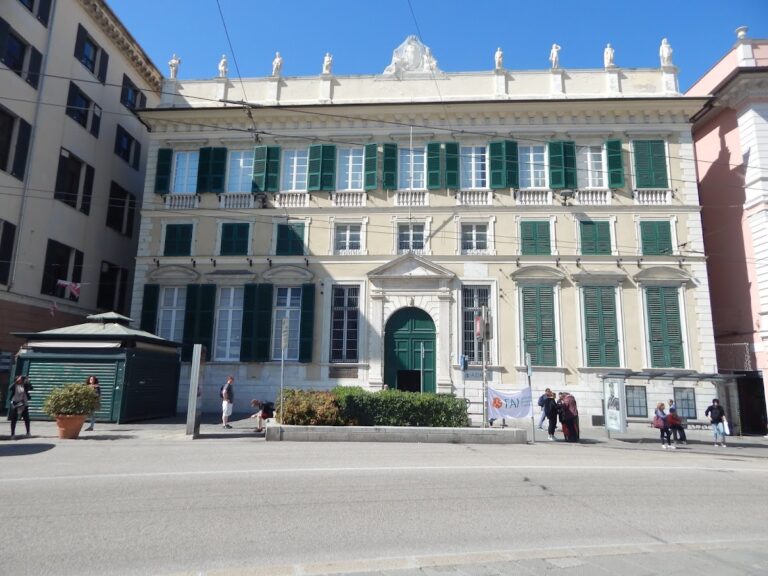
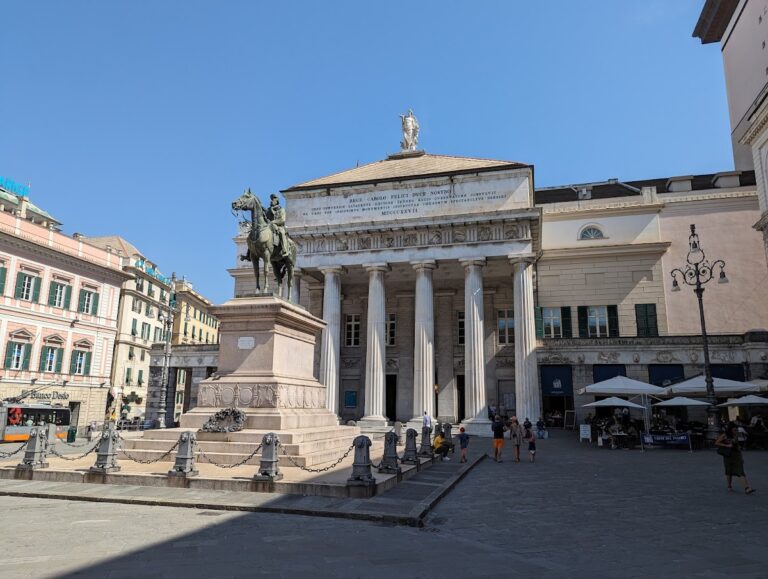
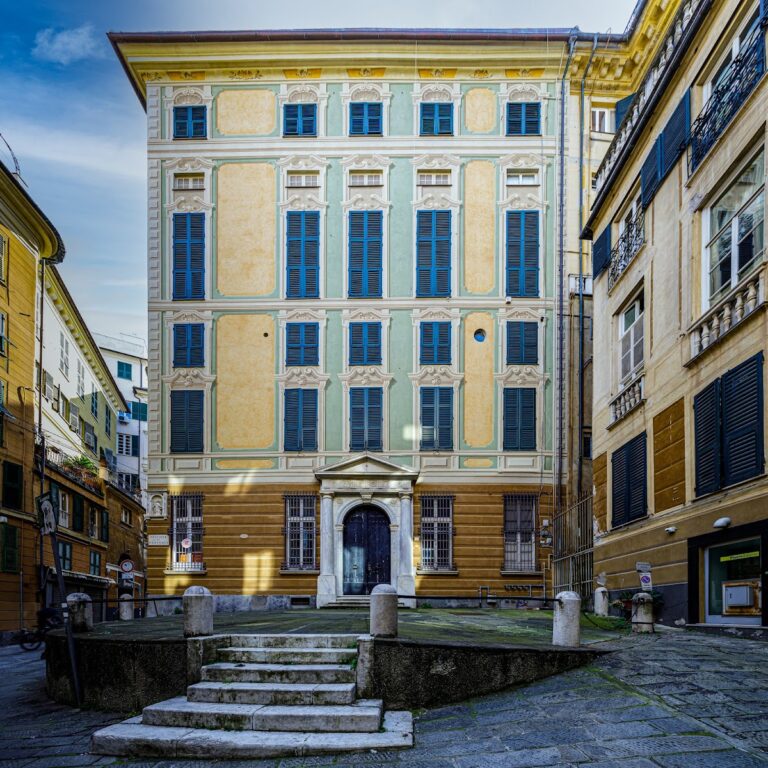
Palazzo dell’Accademia ligustica di belle arti is a nineteenth-century palace in Genoa, Italy, built in the Ligurian Neoclassical style for the city’s artistic and civic institutions. Its planning began in 1826 and ended in 1831 under designs by Carlo Barabino, an architect closely associated with the transformation of Genoa’s urban and monumental architecture. The palace rose on the site of the demolished San Domenico convent and church, while the Teatro Carlo Felice was later built on the former church site.
Planning and institutional use
The project developed through several proposals during the demolition of the church and convent. The porticoes along the north and west sides were constructed first and were intended to serve as a barracks. They formed part of an original plan for a building with porticoes surrounding the entire square.
From 1831 to 1997, the palace housed both the Berio Civic Library, Genoa’s municipal public library, and the Ligustica Academy of Fine Arts. The academy remains based in the building, and its Academy Museum has occupied the palace since 1980. In this way, the building has continued to combine educational, artistic, and civic functions.
Alterations and wartime restoration
The eastern side originally had no portico, stood against the hillside, and included the Santo Varni Hall. Around 1900, the opening of Via XX Settembre and Via Ettore Vernazza led to the hall’s demolition and the extension of the portico along the eastern side. These changes altered the relationship between the palace and the surrounding streets.
Bombing during the Second World War caused structural damage to the building. Its postwar restoration followed a project by the Italian architect Mario Labò. The palace now stands in Genoa’s historic city centre, at Piazza De Ferrari.
Remains
Facade and porticoes
The palace presents a nineteenth-century Ligurian Neoclassical facade. Neoclassicism draws on the forms and principles of ancient Greek and Roman architecture. Porticoes extend along the north and west sides, with the eastern portico added around 1900 after the removal of the Santo Varni Hall. The monumental columns on the second-floor loggia, an open or partly open gallery defined by columns, were taken from the demolished San Domenico church.
Entrance and ceremonial interior
Octagonal atrium
An octagonal entrance atrium contains four marble statues in niches. Luigi Orengo made the figures of Luca Cambiaso and Filippo Parodi in 1935, while Guido Galletti created the statues of Bernardo Strozzi and Bernardo Schiaffino in 1939. The arrangement connects the entrance space with prominent figures associated with Genoese artistic culture.
Monumental staircase
The atrium opens onto a monumental staircase with cantilevered flights projecting from their supporting structure without conventional supports beneath the projecting sections. The staircase is built around a central well and makes extensive use of polychrome marble.
A niche at the top of the first flight holds a statue of Saint Catherine of Alexandria. The sculpture was probably produced by Guglielmo della Porta and his father’s workshop, and came from the sixteenth-century Acquasola Gate, which was demolished in 1837. Statues of Saints James and Philip, also dating from the sixteenth century, stand at the tops of the other staircase flights and came from the church dedicated to those saints. A bust of Nicolò Barabino, made by Antonio Allegretti in 1894, occupies the landing opposite the staircase.
Second-floor loggia
The second-floor loggia preserves monumental columns from San Domenico church. Four wall niches contain busts honoring figures connected with the palace and Genoese art. Giovanni Battista Cevasco made the bust of Carlo Barabino in 1844, Giulio Monteverde made that of Ernesto Rayper in 1874, Allegro Agostino created the bust of Pietro Resasco in 1874, and Vittorio Lavezzari produced the bust of Raffaele Granara in 1885.
Nearby sites