Hallbergsches Schloss (Fußgönheim): A Baroque Castle and Church Complex in Germany


Site at a Glance
- Rating
- 4.6
- Popularity
- Very Low
- Country
- Germany
- Primary era
- Early Modern
- External website
- Open
- Eras represented
- Early Modern, Modern
- Civilizations
- Electoral Palatinate, Holy Roman Empire
- Site type
- Domestic
- Remains
- Castle
On this page12 sections
History
Founding and Catholic Foundation
Hallbergsches Schloss is a Baroque castle complex in Germany, built in Fußgönheim between 1728 and 1731 for Baron Jakob Tillmann von Hallberg, chancellor of the Electoral Palatinate. The Electoral Palatinate was a major state of the Holy Roman Empire ruled by an elector of the Wittelsbach dynasty. The castle was established on the eastern edge of the settlement as the seat of a member of the House of Hallberg.
Jakob Tillmann von Hallberg converted an entire wing of the complex into a church and opened it as a Catholic place of worship for the surrounding area. The castle church was reportedly completed in 1741, and in 1742 Hallberg founded Fußgönheim’s first Catholic parish since the Reformation. Local tradition, recorded by the parish priest Stephan Lederer, identifies Hallberg as a figure in the church’s high-altarpiece painting. The image is regarded as the only known depiction of him.
Hallberg Ownership and Later Uses
From 1788 to 1792, Hallbergsches Schloss belonged to Heinrich Theodor von Hallberg, an Electoral Palatinate-Bavarian envoy in Vienna. The term refers to the political connection between the Palatinate and Bavaria. The castle was forcibly auctioned in 1815 and subsequently passed through several ownership changes. Its later uses included a shop, barn, and warehouse, as well as a cigar factory, a prisoner-of-war camp, and a Raiffeisen warehouse, a cooperative agricultural storage establishment associated with the rural movement founded by Friedrich Wilhelm Raiffeisen.
Restoration and Community History
In 1972, the Catholic parish of Fußgönheim acquired the castle and began an extensive restoration. A large church space was created in the formerly secular central section and partly furnished with Baroque furnishings. This space became the present Catholic Church of St. James, while the historic castle church was retained as a side chapel.
The former castle garden was restored in 1983 and 1984. The Ludwigshafen district also transferred its share of ownership to the Catholic parish without charge. Members of the local history and cultural promotion association took part in the renovation and established a local history museum in the building.
Burial, Rediscovery, and Reinterment
Jakob Tillmann von Hallberg died in 1744 and was buried in Mannheim Garrison Church. His wife, Anna Maria Josepha, née von Francken, had already been buried there after her death in 1739. The regional historian Johann Franz Capellini von Wickenburg recorded the inscriptions on both graves. Mannheim Garrison Church was demolished in 1780, but its underground crypt survived and was later forgotten. Construction work rediscovered the crypt in 1979, together with the remains of the Hallberg couple. In 2003, their remains were placed in a new sarcophagus in an unused crypt beneath the castle church at Fußgönheim, giving them a final resting place within the complex associated with Jakob Tillmann von Hallberg.
Remains
Castle Buildings and Churches
Former Church Wing
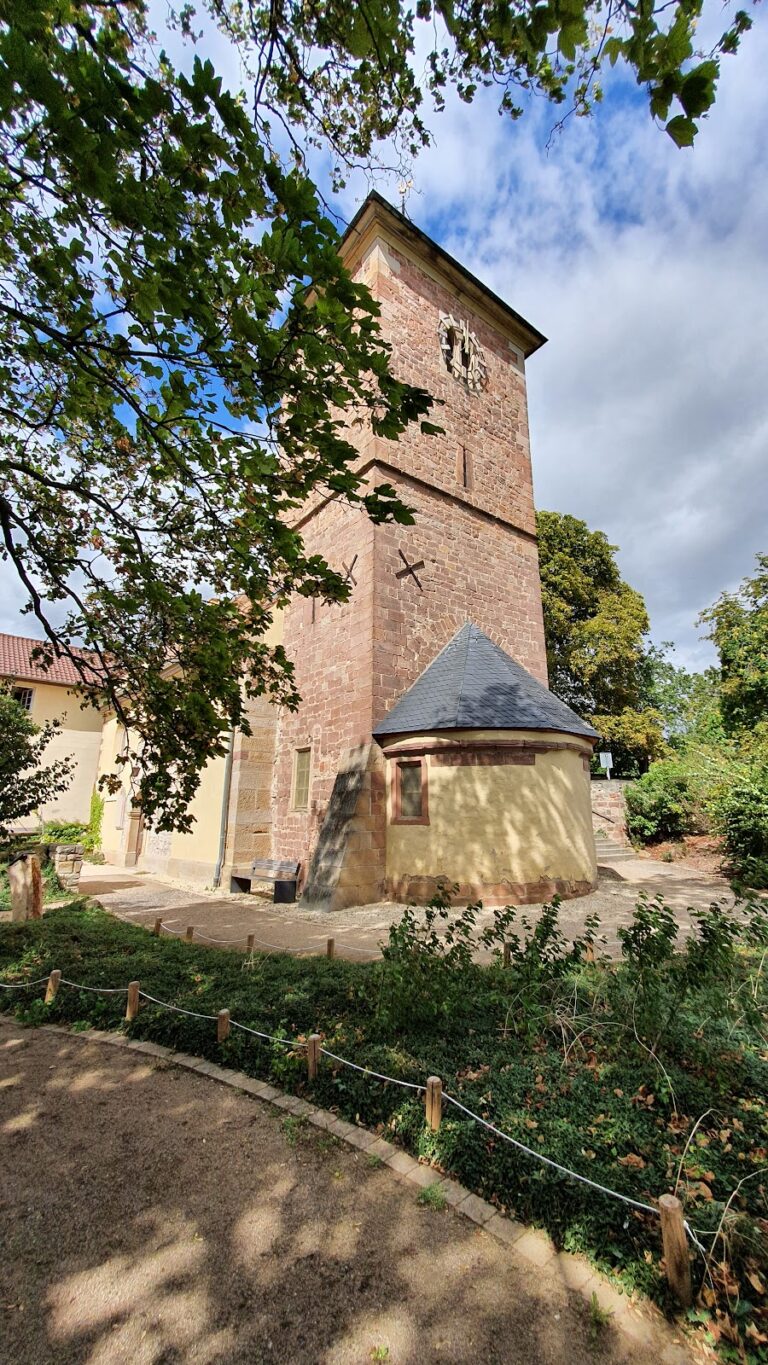
The complex retains a former church wing, a formerly secular central section, a castle courtyard, and the restored castle garden. The church wing forms the northwestern part of the complex and is marked by a roof turret, a small tower rising from the roof. The historic castle church preserves its Baroque interior in full. Its furnishings include a pulpit bearing the Hallberg coat of arms. The high-altarpiece painting was produced by Giovanni Antonio Pellegrini, an Italian Baroque painter known for large religious and decorative works. Pellegrini also decorated Mannheim Palace.
St. James Church
The present Catholic Church of St. James occupies the former secular middle section of the castle. Its interior contains some Baroque furnishings, while the former castle church functions as its side chapel. Together, these spaces preserve the complex’s change from a secular residence with a dedicated church wing into a parish center incorporating both historic and later worship areas.
Garden and Burial Crypt
Castle Garden
The former castle garden is an associated landscaped feature of Hallbergsches Schloss. It was restored in 1983 and 1984, preserving the garden as part of the complex’s surviving architectural and landscape arrangement.
Crypt Beneath the Castle Church
A crypt, meaning a burial chamber beneath a church or chapel, lies below the castle church. It contains a modern sarcophagus holding the remains of Jakob Tillmann von Hallberg and Anna Maria Josepha von Hallberg. A window from the castle courtyard allows the crypt to be viewed, and a memorial plaque commemorates the builder of the castle and his wife.
Nearby sites