Schloss St. Georgen an der Stiefing: Renaissance Castle in Austria

Site at a Glance
- Rating
- 4.9
- Popularity
- Very Low
- Country
- Austria
- Primary era
- Early Modern
- External website
- Open
- Eras represented
- Medieval, Early Modern
- Civilizations
- Habsburg, Holy Roman Empire
- Site type
- Domestic
- Remains
- Castle
On this page9 sections
History
Schloss St. Georgen an der Stiefing is a historic castle in Austria, first recorded in 1147 and shaped by major Renaissance alterations in the sixteenth century. It forms a historical unit with the parish church of St. Georgen an der Stiefing, which began as the castle church. The surrounding settlement has a much older history, reaching back to the Neolithic period around 4000 BC.
Medieval origins and episcopal ownership
The castle first enters the written record in 1147, when Rupertus of St. Georgen donated vineyards on nearby Aframberg to Admont Abbey. Count Luitold I of Plain, a member of the powerful Counts of Plain, is regarded as the founder of both the castle and the parish church. The original complex is not known in detail, including its precise form and method of construction.
When the Counts of Plain died out in 1253, their possessions passed to the Bishop of Seckau and his successors. The Bishop of Seckau led the diocese of Seckau, an important ecclesiastical institution in Styria, and could control substantial landed estates and castles. Schloss St. Georgen remained connected with this episcopal lordship until the sixteenth century.
War and Renaissance rebuilding
Military conflict repeatedly affected the castle and its surroundings. In 1480, troops of Matthias Corvinus, the fifteenth-century king of Hungary, occupied the castle. Imperial forces under Frederick III, the Holy Roman Emperor, recaptured it in 1481. Fighting during these operations devastated the castle, the church, and the settlement.
Further destruction followed in 1532, when armies under Suleiman II crossed the Styrian border and devastated St. Georgen and the surrounding area. On 10 September 1555, Bishop Peter of Seckau sold the castle and its associated estates to Andre von Glojach, a nobleman of the old Styrian Glojach family. Von Glojach then undertook extensive alterations and additions, giving the castle the Renaissance character that continues to define its appearance.
Baroque remodelling and changing ownership
The Glojach family retained the castle until 1754, when Joseph Egkh von Hungerspach and his wife, Maria Anna, purchased it. Their coat of arms was placed on the main portal and remains there. In 1755, the new owners remodelled the Knights’ Hall in the late Baroque style, a period associated with elaborate movement and ornament. Sculptures produced in the workshop of Veit Königer belong to this phase, including works dated 1769.
Ownership changed several times during the nineteenth century. Franz Xaver Mihurko, formerly an administrator at Tannhausen, assumed control in 1816, during the crisis that followed the Napoleonic Wars. Anton Count of Attems became lord of the castle in 1823, and Karl Binder von Kriegelstein acquired it in 1859. In 1876, the oldest wing was demolished after becoming structurally unsafe. This alteration created the area later known as the Basteigarten.
The Ernst family and modern use
Hans Count Fink von Finkenstein bought Schloss St. Georgen in 1917. Elena Longinotto lived there and managed it for several years. In 1925, the writer, poet, and thinker Paul Ernst acquired the castle. He was buried in 1933 on the Johannishügel in front of the building. His wife, Else Ernst, continued to live at Schloss St. Georgen for several years and was buried on the same hill in 1946. Their daughter-in-law, Barbara Ernst, later lived at and managed the castle.
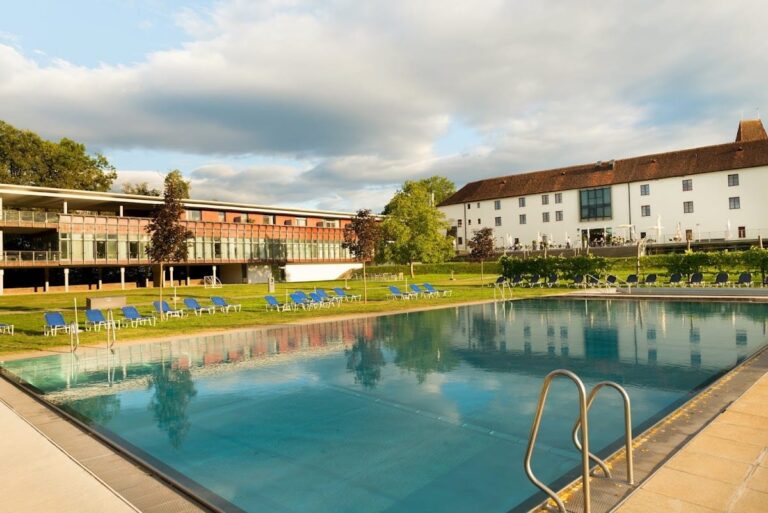
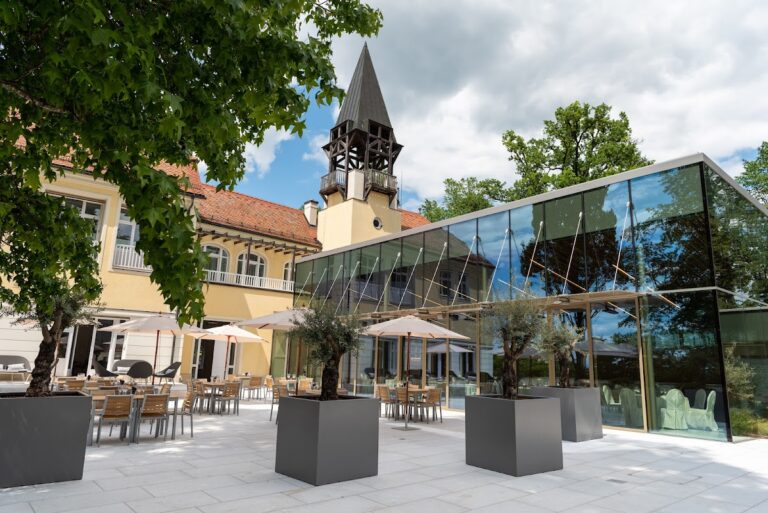
Karl Schmelzer-Ziringer bought the castle from the Ernst family heirs in 1975 and planned to establish a music school there, although the project was not realised. Franz and Christine Reinisch acquired the property in 1981 and renovated and adapted it as a residence. From 1992, part of the castle was used by a massage school founded by the couple and later managed by their descendants. From 2011, the entire castle served the institution. Schloss St. Georgen an der Stiefing has protected-monument status in Austria.
Remains
Schloss St. Georgen survives as a castle complex historically linked to the parish church, whose origins lie in the former castle church. Its physical character reflects several building phases, especially the Renaissance rebuilding carried out after the castle came into the possession of Andre von Glojach. The courtyard, surviving portal elements, decorated interiors, sculptures, and the open space created by the nineteenth-century demolition together convey the complex’s changing form.
Castle and parish church
The original building’s layout and construction remain uncertain. A surviving fragment of a portal in the crypt beneath the parish church is Romanesque, the medieval tradition associated with massive construction, rounded arches, and early stone church building. The crypt is a chamber below the church used for burial or religious purposes. The portal fragment may belong either to the foundation period or to an early stage of the wider castle and church complex.
Renaissance and late Baroque features
The castle’s characteristic Renaissance architecture belongs to the major rebuilding of the sixteenth century. A stone open staircase in the courtyard dates from this phase. The main portal carries the coat of arms of Joseph Egkh von Hungerspach and Maria Anna, who owned the castle from 1754. Inside, the Knights’ Hall was remodelled in 1755 in the late Baroque style.
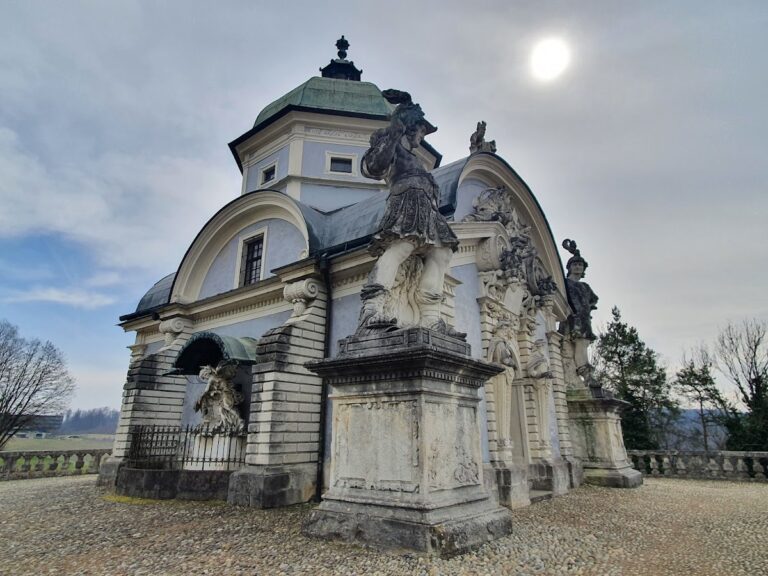
The courtyard contains a statue of the Immaculate Virgin Mary made in the workshop of Veit Königer. This title refers to the Catholic doctrine that Mary was conceived free from original sin. A statue of Saint John Nepomuk and an angel stand on the Johannishügel in front of the castle. Saint John Nepomuk was a fourteenth-century Bohemian Christian saint associated by tradition with bridges, waterways, and protection against drowning. Both sculptures on the hill date from 1769.
Basteigarten and Johannishügel
The Basteigarten occupies the space formed when the oldest castle wing was demolished in 1876 because of structural danger. In front of the castle, the Johannishügel contains the graves of Paul Ernst and Else Ernst, buried there in 1933 and 1946. These features preserve physical evidence of the property’s later history alongside its medieval, Renaissance, and Baroque fabric.