Burg Beyernaumburg: A Hilltop Castle and Neo-Gothic Manor


Site at a Glance
- Rating
- 4
- Popularity
- Very Low
- Country
- Germany
- Primary era
- Modern
- Eras represented
- Medieval, Modern
- Civilizations
- German, Holy Roman Empire
- Site type
- Domestic
- Remains
- Castle
On this page9 sections
History
Imperial Origins and Medieval Lords
Burg Beyernaumburg is a partially preserved hilltop castle in Germany, located in Beyernaumburg, now part of the city of Allstedt in Saxony-Anhalt. The site was mentioned in the ninth century as castellum Nivanburg and in 979 as civitas et castellum Niwanburch. It initially served as an imperial castle, placing it within the medieval network of fortified centres associated with imperial authority.
At the beginning of the twelfth century, Emperor Henry V, who ruled as Holy Roman Emperor from 1111 to 1125, granted the castle as a fief to the Bavarian Count Wichmann of Gleuß-Seeburg. Toward the end of the twelfth century, donations transferred the castle to the Archbishopric of Magdeburg. It later came into the possession of the Lords of Querfurt.
The Templar Conflict of 1308
Burg Beyernaumburg became involved in a regional confrontation over the suppression of the Templars, a medieval Christian military-religious order whose members combined monastic life with military service. In 1308, Archbishop Burchard III of Magdeburg ordered the arrest of Templars in the Halberstadt ecclesiastical district and in other districts of the Harz region. The Templars withdrew to Burg Beyernaumburg and fortified themselves there.
Burchard III besieged the castle and strengthened two nearby churches as defensive positions for his troops. Bishop Albrecht I of Anhalt of Halberstadt, who was regarded as a supporter of the Templars, opposed both the military conversion of the churches and the failure to hand confiscated Templar property to the Bishopric of Halberstadt. Albrecht placed the Archbishop of Magdeburg under an ecclesiastical ban, a formal church penalty that could also function as a powerful political sanction. Burchard then suspended the arrests and guaranteed the Templars safe departure.
Asseburg and Bülow Ownership
From 1430, the castle belonged to the Asseburg family. This branch ended in 1628, and ownership then passed to the Barons von Bülow, who held the estate until 1945. The castle gatehouse was built in the sixteenth century. From 1815, the complex served only as a manor estate, reflecting its changed role after its earlier military and political functions had ended.
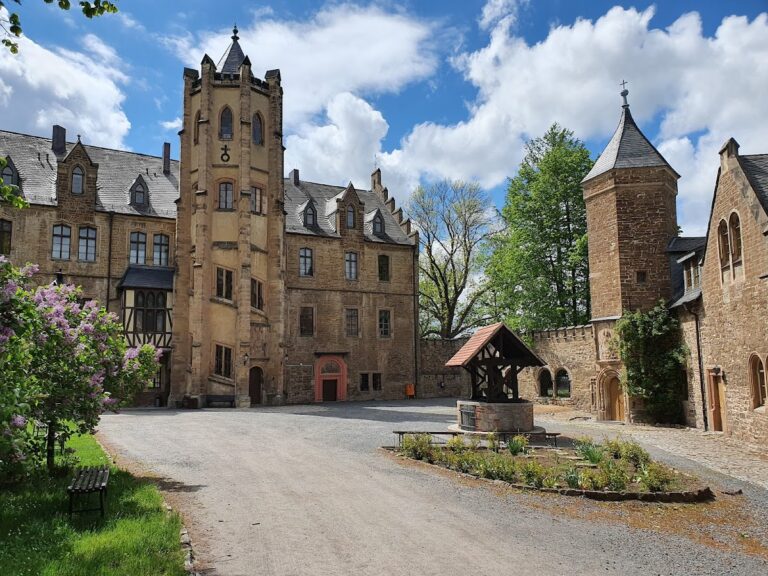
In 1865, Victor von Bülow demolished the dilapidated and outdated castle and replaced it on the same site with a castle in the Neo-Gothic style. Friedrich von Bülow created the castle park, whose layout was planned by Eduard Petzold. The later castle therefore occupies the ground of the medieval complex while representing a nineteenth-century transformation of the estate.
Land Reform and Later Use
Hans Baron von Bülow was the last owner. He was expropriated in 1945 during the land reform in the Soviet occupation zone and died in Wendlinghausen in 1979. From 1946 to 2001, the castle belonged to the municipality of Beyernaumburg and was used first as a home for older people and later as a nursing home. Since 2001, it has been privately owned. Schloss Beyernaumburg is protected as a monument in the monument register of Saxony-Anhalt under registration number 094 18550.
Remains
Fortifications and Later Estate
The partially preserved castle occupies a mountain spur about 270 metres above sea level, behind the present Schloss Beyernaumburg. The medieval complex consisted of a ring-enclosed inner castle and a western outer bailey, a defended area outside the central stronghold. A ditch separated the inner castle from the outer bailey, organizing the site into distinct defensive zones.
Outer Bailey Keep
The original castle had two keeps, the principal fortified towers of the complex. One survives in the outer bailey. It is a 30-metre-high tower on a square ground plan measuring 8 by 8 metres. Together with sections of the castle walls, the keep forms the principal surviving fabric of the medieval castle.
Neo-Gothic Castle and Park
The present castle was built in the Neo-Gothic style on the site of the demolished medieval complex. The castle park contains several graves belonging to members of the von Bülow family, linking the later manor landscape with the family that owned the estate from 1628 to 1945.
Nearby sites