Larunque Château: A Restored Seigneurial Residence in France

Site at a Glance
- Rating
- 5
- Popularity
- Very Low
- Country
- France
- Primary era
- Modern
- External website
- Open
- Eras represented
- Modern
- Civilizations
- French
- Site type
- Domestic
- Remains
- Castle
On this page8 sections
History
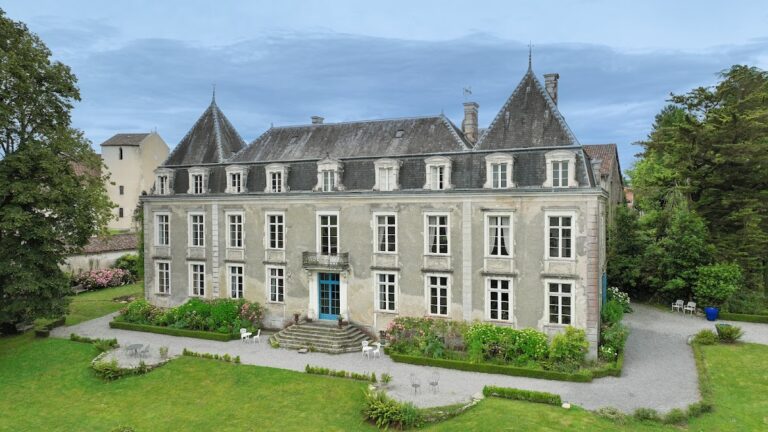
Larunque Château is a historic estate in Saint-Laurent-de-Gosse, France, built in the early 1870s by Xavier de La Croix de Ravignan as a prestigious seigneurial residence, meaning the principal home associated with a lord or landed estate. Construction was completed around 1875. The present appearance, however, largely reflects the rebuilding carried out after a major fire in 1977.
Seventeenth-century origins and nineteenth-century construction
The estate’s history reaches back to the seventeenth century, when a farm known as Larenque was attached to the neighboring Château de Lagurgue. In the early 1870s, Xavier de La Croix de Ravignan used inherited land to establish the château as a prominent family residence. The project was completed around 1875.
Family residence and changing ownership
At the beginning of the twentieth century, Xavier’s daughter, Marie-Antoinette de La Croix de Ravignan, and her husband, Raymond Merle de la Brugière de Laveaucoupet, converted the estate into a family second home. It remained in the same family until its sale in 1957.
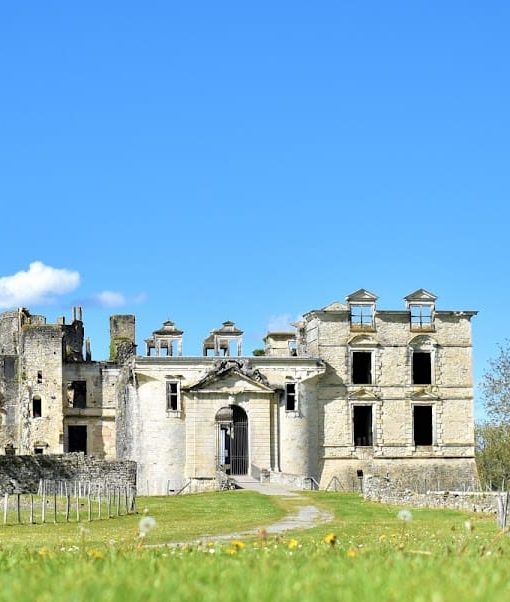
Afterward, the property passed through several hands. Its owners included a former colonel of the colonial army in Morocco, a former teacher involved in French cooperation in Africa, and a property developer from Bayonne. A fire in 1977 destroyed a large part of the building, after which the château stood abandoned for an extended period.
Restoration and contemporary use
Alain Castant, an entrepreneur and patron of the arts, bought the château in 1993 and directed an ambitious restoration between 1993 and 1995. The work reshaped the building as an arts center inspired by Italian Renaissance architecture, a fifteenth-century Italian movement characterized by classical forms, symmetry, monumental composition, and ornament.
The estate later passed successively to an English businessman and a professional jockey. After a change of ownership in 2021, it became a setting for accommodation, professional seminars, restorative retreats, and cultural events focused on low-carbon living, environmental restraint, and renewed contact with nature. Its ecological program received the EU Ecolabel in 2024, a voluntary European Union certification for services meeting defined environmental standards. Measures associated with the estate include biomass heating, which uses organic fuel such as wood to produce heat, an electric-vehicle charging station, waste reduction, and environmental education. The current owner is identified as Marion Lafouge, associated with Lafiris.
Remains
Restored château and park-facing spaces
Exterior composition
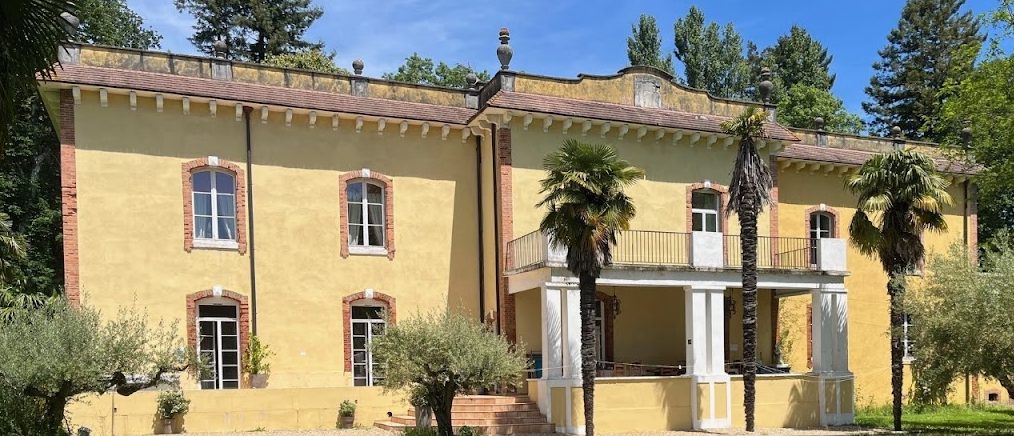
The present château is substantially the product of the restoration following the 1977 fire. Its Italian Renaissance-inspired exterior includes a roof crowned by an ornamental parapet, a raised decorative element along the edge or summit of a structure, together with statues and a monumental staircase. A large terrace extends toward the park, forming a major outdoor element of the restored composition.
Theater and interior reuse
Inside the château is an Italian-style theater with a wooden balcony. Over time, this space was converted into a bedroom or meditation room, giving a former performance area a different role within the restored building.