Schloss Fronberg: A Renaissance Castle Complex in Bavaria


Site at a Glance
- Rating
- 4.4
- Popularity
- Very Low
- Country
- Germany
- Primary era
- Early Modern
- External website
- Open
- Eras represented
- Medieval, Early Modern
- Civilizations
- Holy Roman Empire
- Site type
- Domestic
- Remains
- Castle
On this page8 sections
History
Schloss Fronberg is a Renaissance-rebuilt castle complex in Germany, located in Fronberg, a district of Schwandorf in Bavaria’s Upper Palatinate. The estate is documented in 1305, when its lords, who also held the Mappenberg bailiwick, an administrative and judicial territory governed for a higher lord, received an enfeoffment to rebuild a predecessor destroyed by fire.
Medieval and early-modern development
The castle and the village were affected by further destruction during the Landshut War of Succession, a conflict over the inheritance of the Duchy of Bavaria-Landshut. In 1594, fire destroyed almost half of Fronberg. The complex was rebuilt in the Renaissance and subsequently underwent numerous extensions and alterations, making its architectural development difficult to reconstruct in detail.
Ownership changed repeatedly. The Fronberger family held the estate until the middle of the fifteenth century, followed by the Pollinger family from 1464 into the early sixteenth century. Christoph von Plankenfels owned it in 1507, Hans Mistelbeck in 1514, and the Vestenberger family from 1521 to 1586. Christoph Heinrich von Zedtwitz acquired it in 1587. Hans Wilhelm von und zu Guttenberg held the property from 1601 to 1622, after which the barons von Spiering owned it until 1829.
Fronberg was also associated with Hanns Krafft von Festenberg. He served as the count palatine’s land judge and administrator at Burglengenfeld. From 1544 to 1552, he chaired the territorial estates and became the highest representative of the state after the insolvency of the Duchy of Palatinate-Neuburg. He died in 1564 and was buried in St. James’s parish church in Schwandorf.
The Spiering and Breidbach-Bürresheim families
Caroline von Spiering was born at Schloss Fronberg in 1815. She later became Countess von Holnstein and then Baroness von Künsberg. She lived at the castle with Wilhelm Freiherr von Künsberg, first as his lover and later as his wife. Their daughter, Marie-Wilhelmine von Künsberg-Fronberg, linked the estate to the barons von Breidbach-Bürresheim, who acquired it in 1875. Their descendants continue to reside at the castle.
Caroline von Holnstein was among the women portrayed in the Gallery of Beauties at Nymphenburg Palace. This portrait collection was commissioned by King Ludwig I of Bavaria and displayed at the palace.
The ironworks and modern conservation
An ironworks on the Naab, southwest of the castle, is mentioned in 1326. From the fifteenth century, it consisted of two water-powered iron hammers, one processing ore into bar iron and the other producing sheet metal. The castle and the works generally shared the same ownership, while the Aigner family operated the ironworks during the nineteenth century.
The von Breidbach-Bürresheim family carried out major restoration at Schloss Fronberg in 1992. Renovation in 2005 repaired most of the exterior facade and interior rooms, and the orangery, a garden building for protecting citrus and other frost-sensitive plants, was restored in 2021. In 2025, Ingrid, Hans-Christoph, and Hans-Friedrich Riederer von Paar zu Schönau received the Bavarian Monument Conservation Medal for this work.
The castle, the archaeological remains of the medieval castle and early-modern palace, and the associated ironworks are protected under separate Bavarian heritage designations. Schloss Fronberg is listed both as an archaeological monument and as a protected architectural monument.
Remains
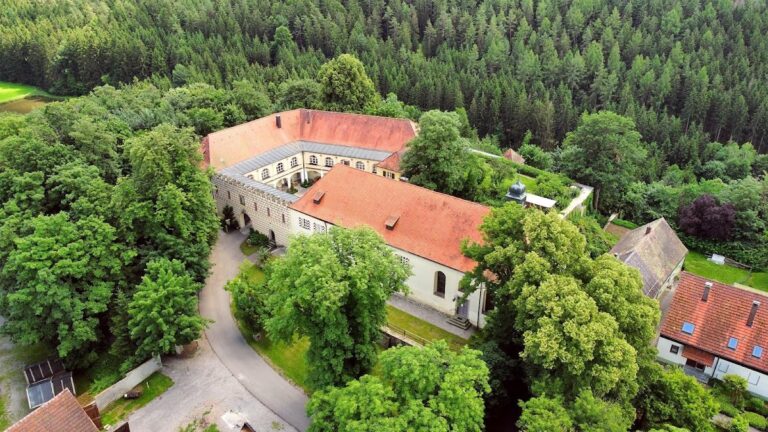
The surviving complex consists of three building wings shaped by Renaissance rebuilding and later alterations. Its courtyard retains Renaissance arcades, while part of the original moat survives toward the estate’s service and agricultural buildings. Archaeological evidence beneath the later structures relates to both the medieval castle and the early-modern palace.
Castle buildings and courtyard
The main building preserves Renaissance arcades arranged around the courtyard. These arcades are regarded as culturally and historically important elements of the complex. The inhabited castle also has a continuing cultural use, with the courtyard serving as a setting for theater, open-air cinema, concerts, and medieval festivals.
Moat and archaeological layers
A section of the original castle moat remains on the side facing the service or agricultural buildings. Beneath and within the later structures, archaeological remains preserve evidence of the medieval castle and the early-modern palace, allowing the earlier phases of the site to be studied alongside the standing Renaissance complex.
Former ironworks
The former Fronberg ironworks stood on the Naab southwest of the castle. Its surviving archaeological remains consist of subsurface evidence for a late-medieval and early-modern iron hammer complex. The works included facilities for processing bar iron and sheet metal, reflecting the two-part organization of the industrial site from the fifteenth century.
Nearby sites