Wolfring Castle: A Noble Estate in Bavaria
Site at a Glance
- Popularity
- Medium
- Country
- Germany
- Primary era
- Early Modern
- Eras represented
- Medieval, Early Modern, Modern
- Civilizations
- Duchy of Bavaria, Electoral Palatinate, Electorate of Bavaria, Holy Roman Empire, Kingdom of Bavaria
- Site type
- Domestic
- Remains
- Castle
On this page10 sections
History
Wolfring Castle is a noble residence in the village of Wolfring, now part of Fensterbach in Bavaria, Germany. The present castle was built under Melchior von Salhausen in 1570, a date preserved in an inscription in its corridor.
Early lords and medieval fiefs
A charter of Michelfeld Abbey from 1119 names Uuignandus, Vdelscalch, and Uuirnt de Uuolferingen. Later records mention Wirind de Wolfheringen and his sons in 1139, Ortlich Chazpich de Wolfringe in 1147, Conradus de wolfheringen in 1150, and Walter von Wolfring in 1165. Fridericus de Wolferinge, named around 1200, was the last recorded member of the Wolfringer family.
From 1205, Wolfring fortress belonged to Duke Ludwig of Bavaria’s possessions in the Upper Palatinate and was subsequently held from the Wittelsbachs. The Wittelsbachs were a ruling dynasty whose branches governed Bavaria and the Palatinate. A fief was land held from a superior lord under specified obligations, and a hereditary fief could pass to an heir under the terms of its grant. In 1343, Palatine Counts Ruprecht I and Ruprecht II granted property at Wolfring as a fief to Heinrich of Erkheim, a knight and official in Amberg.
On 28 January 1413, Ruprecht Kastner, Amberg’s land clerk, received Wolfring property as a hereditary fief with legal privileges. His son Caspar used the name Caspar von Wolfring in 1438. During inheritance disputes, Caspar and Albrecht Schirnting, a relative of Caspar’s wife Ursula Puchelperger, were imprisoned and required to swear a formal oath not to seek revenge for their imprisonment. After further disputes, Hans Kastner gained sole possession and sold Wolfring to Dietrich Lichtenecker in 1477. A grant from Palatine Count Philipp confirmed the fief, including the castle and residence, two associated farms, and other property. After Dietrich’s death, it passed to his son Heinrich in 1488 and then to Heinrich’s son Heinz in 1518.
Sixteenth-century transfers
Wolf von Plankenfels received Wolfring as a fief from Palatine Count Friedrich in 1545. In the early 1560s, the Plankenfels family sold the estate to Melchior von Salhausen. He appeared in the Wolfring landed-property register in 1563 but received the fief only in 1577, after agreeing to take over all the properties he had purchased outright from Plankenfels. His conduct toward the Palatine ruler was considered disobedient, and forfeiture was discussed. The estate nevertheless passed to Georg von Salhausen and soon afterward to Hans Jakob von Salhausen.
Hans Jakob sold Wolfring to Hans Fuchs, who received the fief in 1604. Jakob Fuchs had already been recorded as a pledge-holder in 1599, and the sale may not have been voluntary. In 1605, Valentin Fuchs von Dornheim, a councillor of Bamberg, acquired the estate by purchase.
War, insolvency, and the Kympel family
When Valentin died in 1630, Wolfring passed to his four sons: Valentin Christoph, Wolf Philipp, Philipp Julius, and Veit Christoph. The first three died during the Thirty Years’ War, the European conflict fought from 1618 to 1648. Veit Christoph did not report their deaths or seek a grant of the fief, and his whereabouts were unknown. He neglected the estate, which had been under insolvency proceedings since 1631. In 1650 the fief was declared forfeited to its overlord, while creditors sought a sale. An auction notice was issued on 10 May 1651.
After two attempts to sell the property, Amberg chancellor Hanns Ulrich Kympel acquired it. Veit Christoph and his sister Amalia Regina von Murach objected, but their objections failed. On 21 March 1653, Ferdinand Maria, a Wittelsbach ruler and Elector of Bavaria, granted Wolfring to Kympel as a hereditary fief. Kympel died on 17 August that year. The estate then passed to his widow and daughters and to their husbands, Hans Georg Brodeis and Adam Seiz.
Later owners and local government
In 1708, Johann Engelhard and Raimund Seiz held the share inherited from Kympel, while Baron Joachim von Lichtenau held the share inherited from Brodeis. They agreed to a conditional sale to Franz Heinrich von Podewil. The transaction became legally effective after imperial ratification on 4 August 1708. The Podewils family retained Wolfring until 1756, when Casimir von Podewils sold it to Wolfgang Albrecht, Baron von Schönstätt.
Wolfgang Albrecht died in 1760, leaving minor children Maria Eva Rosina, Maria Anna, and a younger brother. His widow, Maria Theresia von Schönstätt, Count von Kreuth, and Christian Wilhelm von Hoppe acted as guardians, while Georg Ignati Kern managed the estate. Once the siblings came of age, they agreed that the unmarried Maria Eva Rosina von Schönstätt would take over Wolfring in return for payment. She died without children in 1770, and the estate reverted to Carl Theodor and Maria Eva von Podewils, then a widow. In 1772, Maria Eva left her share to her daughter Maria Eleonora, Baroness von Podewils zu Stein, who sold it that year to Carl Theodor, Baron von Schönstätt.
Carl Theodor exercised limited local judicial authority at Wolfring until 1827. Those rights were withdrawn because he was not recognized as a landed proprietor entitled to local privileges and, despite repeated requests, could not prove that he had acquired this legal status lawfully. The political municipality of Wolfring was established in 1818 and united with Dürnsricht in 1971 to form Fensterbach. Wolfring passed to Karl von Coulon in 1923; its current owner is Count Carl von und zu Eltz.
Remains
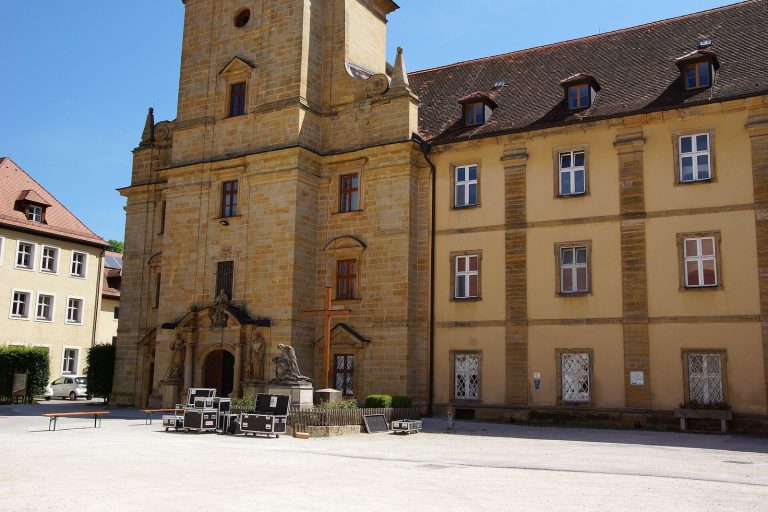
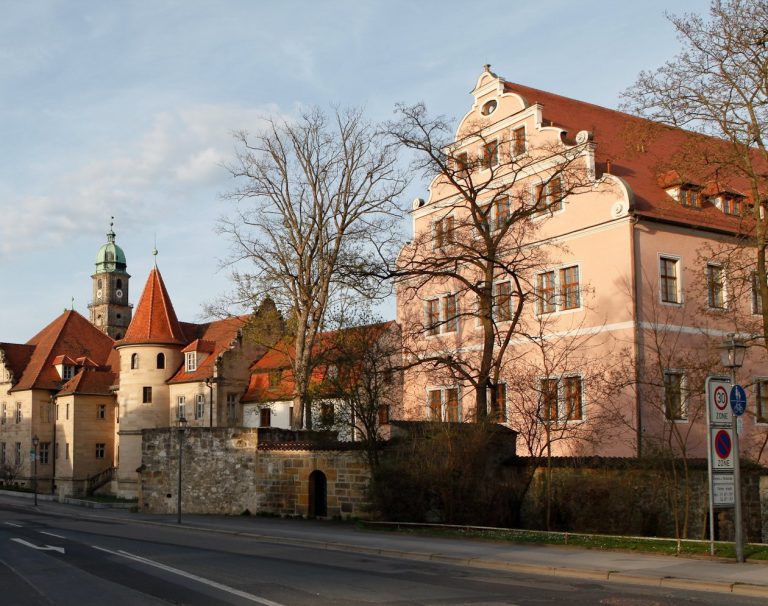
The estate complex comprises a substantial sandstone castle, associated service buildings, and an enclosure built chiefly of masonry. St Michael’s Church stands immediately beside the castle.
Castle and estate buildings
Main residence
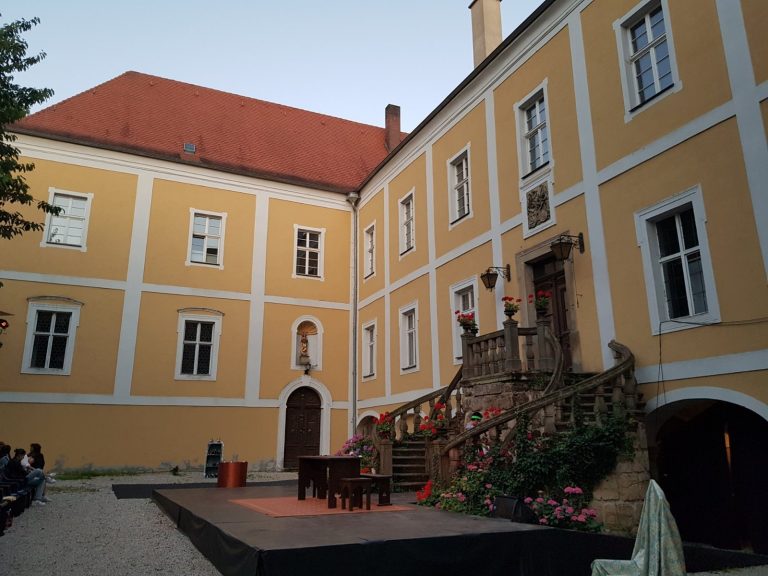
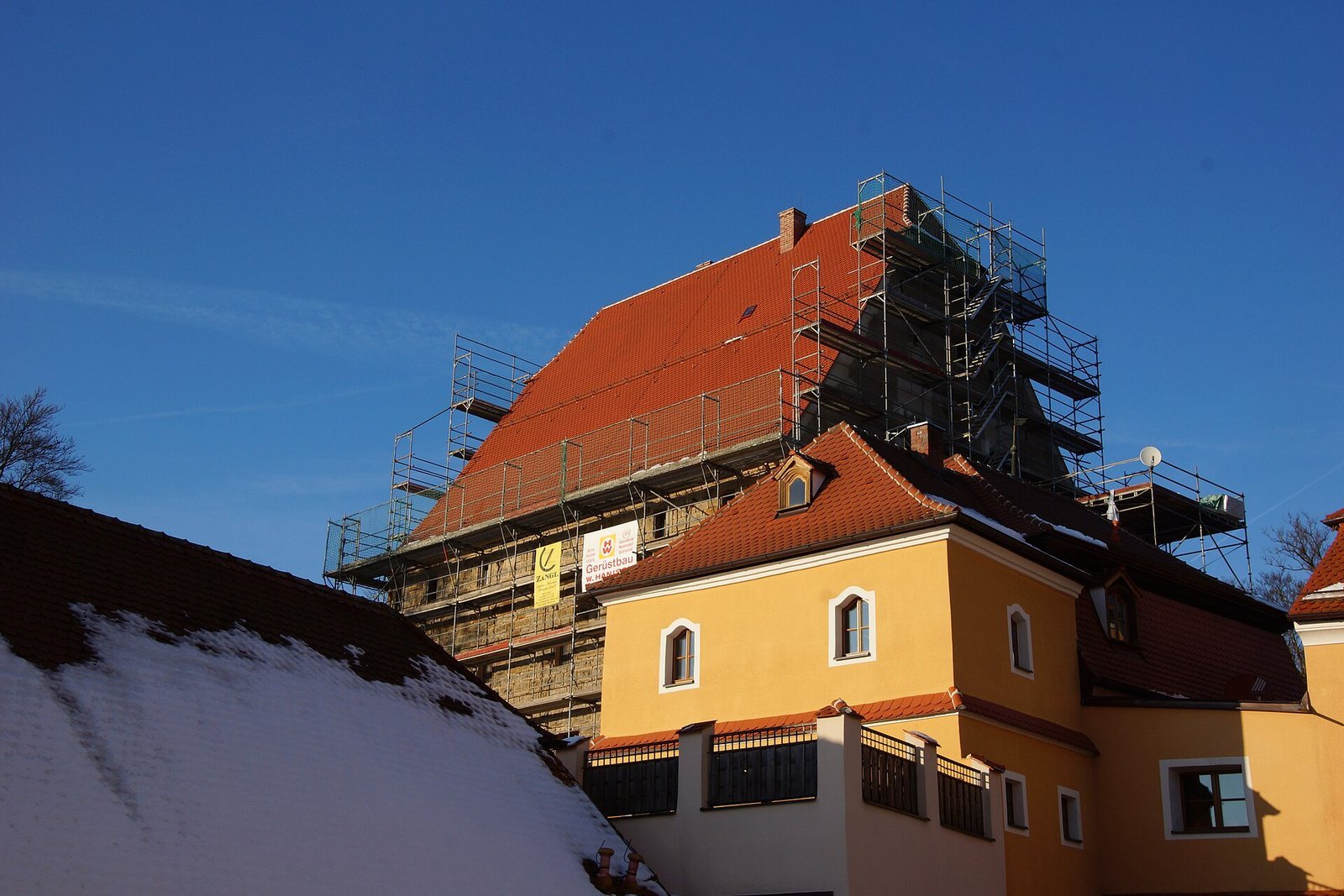
The three-storey castle is built of sandstone ashlar and has a steep half-hipped roof, with a row of small windows on the top floor. An earlier building probably occupied the site during the High Middle Ages. Later owners made only minor alterations, and the present building remains substantially in its original state.
Former service buildings
The estate includes a former forester’s house dating to 1792, a former horse stable built in 1793, and a service wing with staff accommodation dating to 1845.
Enclosure and neighboring church
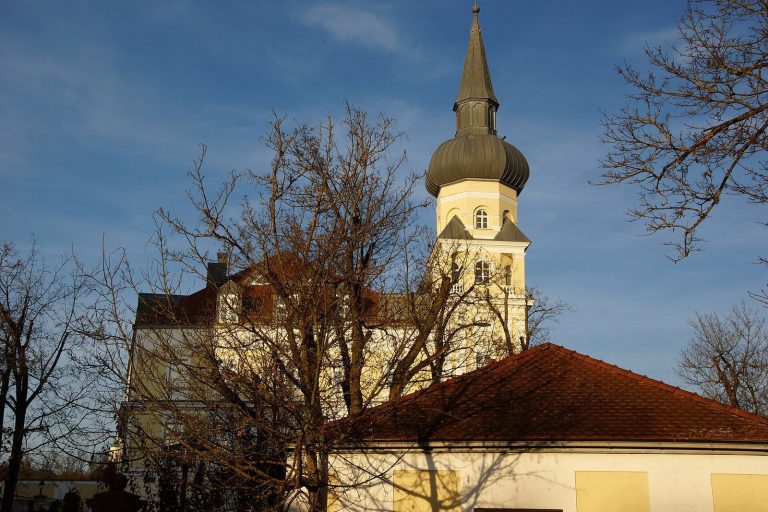
The enclosure is made chiefly of plastered ashlar masonry and includes gate piers, an arched gateway, and a northern gatehouse dating from the 18th and 19th centuries. St Michael’s Church, built at the beginning of the 16th century, stands immediately beside the castle.