Zeidlerschloss: A Nuremberg Patrician Manor House in Feucht


Site at a Glance
- Rating
- 4.7
- Popularity
- Very Low
- Country
- Germany
- Primary era
- Early Modern
- Eras represented
- Early Modern
- Civilizations
- Holy Roman Empire
- Site type
- Domestic
- Remains
- Castle
On this page10 sections
History
Zeidlerschloss is a historic manor house in Feucht, Germany, whose present building stock largely derives from rebuilding around 1560 in the Nuremberg Weiherhaus tradition, a manor house or fortified residence built in or beside a pond. Also called the Castle at Kartäuserweiher, it is one of three surviving castles of the Nuremberg patriciate in Feucht, alongside Pfinzingschloss and Tucherschloss. The Nuremberg patriciate was the city’s hereditary elite of wealthy merchant and governing families, many of whom owned rural estates around Nuremberg.
Peßler and Harsdorffer Ownership
In 1427, the Nuremberg citizen and wealthy merchant Burckard Peßler acquired imperial fiefs, including the Kartäuserweiher, from the indebted Hutt family. An imperial fief was property held from the Holy Roman Emperor or the Empire in return for recognized legal obligations. Peßler soon began constructing a manor house. The following year, the council of the imperial city of Nuremberg required him to promise that, if he sold the property, it would pass only to Nuremberg citizens or to the council itself. An imperial city governed itself directly under the Empire rather than being subject to a territorial prince.
In the late fifteenth century, the Peßler family leased the right of residence to Konrad Konhofer, parish priest of St. Lorenz, and to the Nuremberg citizen Schuler. An inheritance settlement in 1480 transferred the manor and the family’s other Feucht properties to Steffan Peßler. In 1503, he sold the manor house, its ancillary buildings and bathhouse, two Zeidler estates, a mill converted into a brass-hammer works, and manorial rights over thirteen properties to Katharina Harsdorffer, wife of Fabian Harsdorffer. A Zeidler estate was associated with forest beekeeping and the production of honey and wax. A brass-hammer works processed brass or related non-ferrous metals by hammering.
The town and manor were burned in 1504 during the War of the Landshut Succession, a conflict over the inheritance of the Duchy of Landshut. Katharina Harsdorffer died in 1508 and Fabian Harsdorffer in 1519. The inheritance then passed to Gabriel Nützel and Katharina Nützel, Katharina Harsdorffer’s daughter from her first marriage to Nikolaus Groß. The couple is believed to have rebuilt the manor around 1519.
Destruction and Rebuilding
In 1535, Nikolaus Nützel’s heirs sold the property to Christoph Mordeisen, who married Brigitte Nützel in 1539. Mordeisen sold all the properties and rights in 1543 to the brothers Hieronymus and Ludwig Schnöd. During the Second Margrave War, a sixteenth-century conflict, fire destroyed the manor on 16 May 1552. The Schnöd brothers had already sold it to the Nuremberg council in 1550, so the imperial city carried the cost of the damage.
In 1556, the council granted the burned ruins, their associated properties, and their rights to its legal adviser Dr. Christoph Gugel on the condition that he restore the manor. Much of the present building stock derives from this rebuilding. After Gugel died in 1577, his daughter Maria Salome Tucher acquired the manor following an inheritance dispute. Her son-in-law and nephew, Philipp Jakob Tucher, inherited it in 1594 and became involved in disputes with the council, the margravial office of Burgthann, and several neighbors over a proposed expansion of the hammer and mill works.
Later Ownership and Estate Reduction
Before 1616, Tucher sold the manor to Philipp Jakob Grötsch, the margravial administrator and manager of the provost’s office at Solnhofen, who had married Jakobina Welser. In 1616, Grötsch granted the imperial city a right of first refusal in favor of Nuremberg citizens and allowed the city to use the property during wartime. Christoph Adam Holbeck acquired the manor in 1626 and soon sold it to Georg Christoph Örtel and his wife Maria, née Haller. In 1649, the Nuremberg legal adviser Dr. Justin Hardesheim bought it from Örtel’s daughters. The patrician Hans Wilhelm Schlüsselfelder succeeded him in 1660, and Schlüsselfelder’s heirs sold the property in 1680 to the Nuremberg citizen Johann Andreas Waldmann.
Waldmann was followed by Georg Hannibal Braun and, from 1695, by Christof Gottlieb Löffelholz. The castle changed hands eight more times before Andreas Philipp König, a Nuremberg citizen and Hessian court councillor, sold it in 1747 to the legal official Johann Konrad Schneider. Schneider retained the manor until his death. In 1779, the property passed to Heinrich Kühnlein and again became the subject of repeated speculative sales. It reached Georg Christoph von Oelhafen in 1804.
Between 1806 and 1807, the estate was completely broken up after parts of its land had already been sold. Only the manor house and one historical Morgen of garden land remained. A Morgen was a German historical land measure whose size varied by locality and cannot be treated as a fixed modern acre. The Kartäuserweiher was drained and filled in during the same period.
Modern History
Johann Georg Heerdegen acquired the reduced property in 1809. It soon returned to the Oelhafen family and passed in 1818 to Christoph Wilhelm von Volckamer. The master mason Simon Wild bought the manor house in 1842. Under his son, a neighboring stable and farmyard were acquired in 1860, and the property became an agricultural operation. Paulus Gutmann of Schwabach purchased it as an agricultural holding in 1887. It subsequently passed through Johann Humann to Georg and Maria Hausner, whose family retained the manor house until the market town of Feucht acquired it in 1976.
Zeidlerschloss has belonged to the market town since 1976. Extensive renovation in 2009 and 2010 included an extension required for fire protection. Since April 1996, the castle garden has contained a Klapotetz, a clattering windmill characteristic of Feucht’s partner municipality of Leutschach in southern Styria.
Remains
The surviving site is centered on a solid sandstone manor house that originally stood in the water of the Kartäuserweiher and was reached by drawbridge. In front of the pond, the estate had a forecourt with inner and outer service yards, while ancillary buildings, a bathhouse, a mill, and a hammer works supported the manor’s domestic and economic functions. Drainage and infilling of the pond in 1806–1807 altered this setting, leaving the manor house and a reduced area of garden land as the core of the property.
Buildings and Estate Setting
Manor House
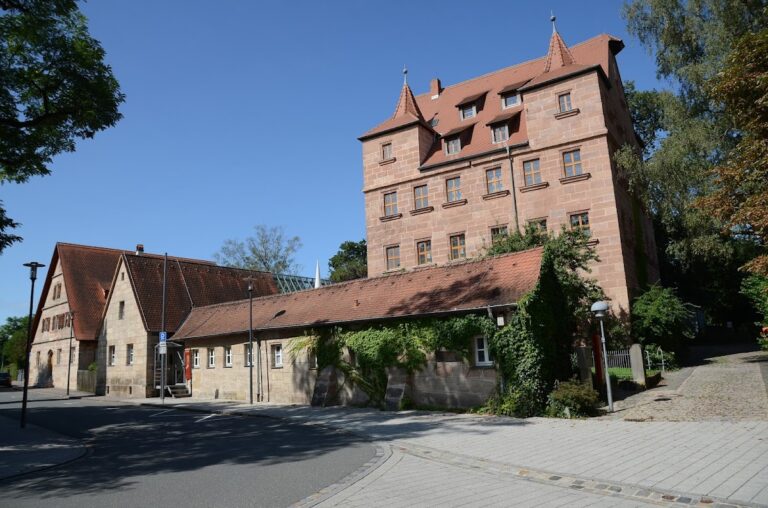
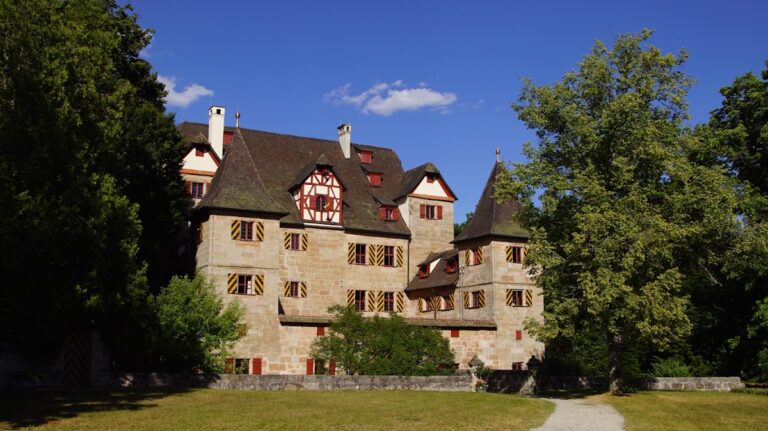
The manor house built around 1560 was a typical Nuremberg Weiherhaus, a fortified residence whose surrounding water contributed to its defensive character. It was constructed from sandstone blocks and stood in the pond, with a drawbridge providing access. A description from 1709 records three stories. The ground floor contained a storage cellar, a vaulted room, and a small writing room. Living rooms and chambers, each with a kitchen, occupied the two upper floors. The building’s present form derives substantially from the restoration carried out for Dr. Christoph Gugel after the fire of 1552, with later renovation including the fire-protection extension of 2009–2010.
Service Yards and Estate Works
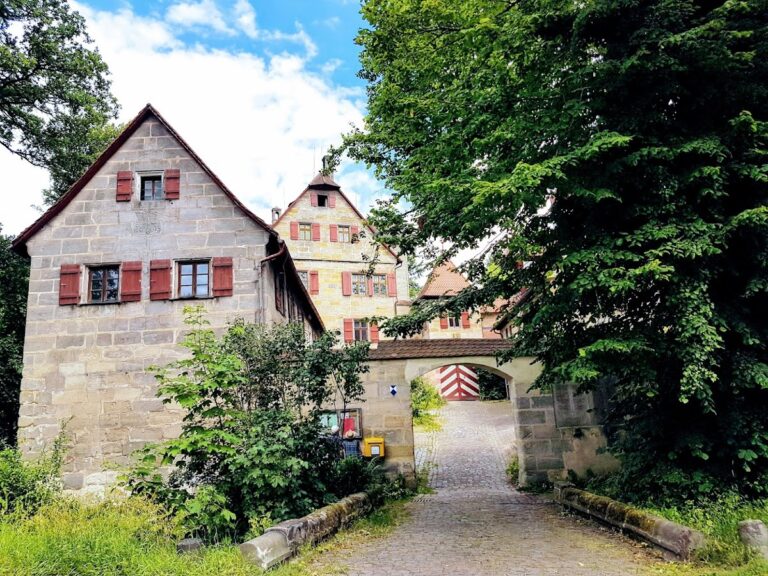
The forecourt in front of the Kartäuserweiher contained an inner service yard and an outer service yard, together with two Voithäuser. A Voithaus was a service or administrative building belonging to a manor or estate. The historical property also included ancillary buildings, a bathhouse, a mill, and a hammer works. By 1503, the mill had been converted into a brass-hammer works. A neighboring stable and farmyard joined the manor house in 1860, when the property was organized as an agricultural operation.
Castle Garden
The reduced estate includes the castle garden, where a Klapotetz has stood since April 1996. This is a clattering windmill type associated with Leutschach in southern Styria, Feucht’s partner municipality. The garden forms part of the surviving property after the historical estate was divided and the Kartäuserweiher was drained and filled in during 1806–1807.
Nearby sites