Palazzo Isimbardi: Historic Palace and Seat of Milan’s Metropolitan City


Site at a Glance
- Rating
- 4.7
- Popularity
- Low
- Country
- Italy
- Primary era
- Early Modern
- Eras represented
- Medieval, Early Modern, Modern
- Civilizations
- Duchy of Milan, Habsburg, Italian, Spanish
- Site type
- Civic
- Remains
- Palace
On this page8 sections
History
Palazzo Isimbardi is a historic palace in Milan, Italy, whose building history developed from the fifteenth to the nineteenth centuries and includes an eighteenth-century Lombard baroque façade. Also known as Palazzo della Provincia, it now serves as the seat of the Metropolitan City of Milan, continuing the building’s long association with civic and aristocratic institutions.
Origins and the Pallavicino and Taverna Families
The palace’s earliest core is traditionally associated with Cicco Simonetta, a leading political adviser to Francesco Sforza, the fifteenth-century founder of Milan’s Sforza ruling dynasty. This proposed origin has not been confirmed by documentary evidence. The first known document to mention the building dates from the late fifteenth century, when it was transferred to a descendant of Gerolamo Pallavicino.
Palazzo Isimbardi remained in the hands of the Pallavicino family until the middle of the sixteenth century, when it was sold to the Taverna family. The Tavernas used it as a suburban residence and undertook extensive remodelling during the first decades of their ownership. Their considerable wealth allowed them to reshape the palace and establish the architectural basis for later alterations.
The Osio Episode
In 1607, the Milanese nobleman Gian Paolo Osio sought refuge in the palace while being pursued. He had expected protection from the Taverna family, but they instead killed him treacherously in the basement. Osio is also remembered as the lover of the nun popularly known as the Nun of Monza and as the perpetrator of several crimes. A local tradition holds that his ghost continues to wander through the basement.
Lambertenghi and Isimbardi Ownership
After the Taverna family died out in the male line, the palace passed through several brief periods of ownership. The Lambertenghi family acquired it in 1731 and retained it for about fifty years. During that time, they carried out heavy remodelling before selling the building to the Isimbardi family, whose name it still bears.
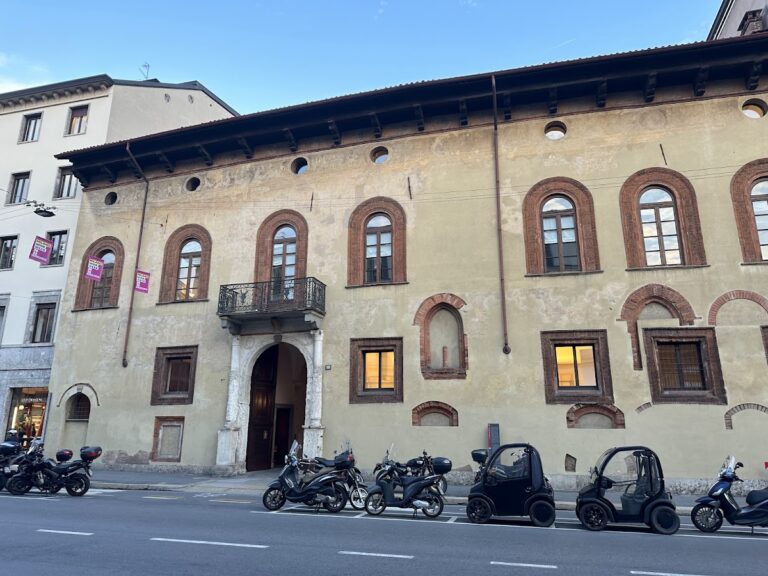
The Isimbardis commissioned additional restoration, chiefly the reconstruction of the façade facing the garden. These successive interventions left the palace with a combination of architectural phases rather than a single unified design. The street frontage in particular reflects the eighteenth-century transformation of the building.
Public Headquarters
Luigi Isimbardi died without heirs in 1908, after which the palace was sold to the industrialist Franco Tosi. The Province of Milan purchased it in 1935 and made it its headquarters. When the province was later abolished, Palazzo Isimbardi became the seat of the Metropolitan City of Milan.
Restoration and alteration work in 1939 included an extension overlooking Via Vivaio. The same intervention led to the partial rediscovery of Renaissance fresco decoration in the vaults of the portico, bringing earlier artistic features back into the interpretation of the palace.
Remains
Façades and Courtyard
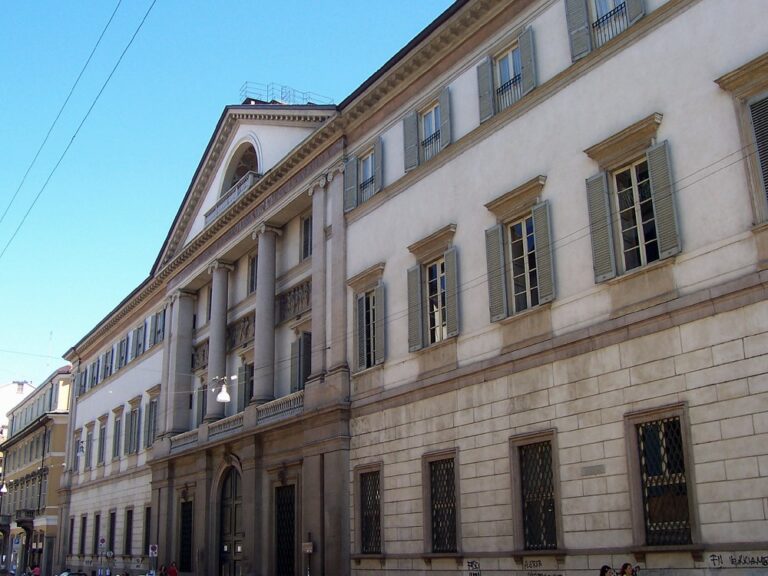
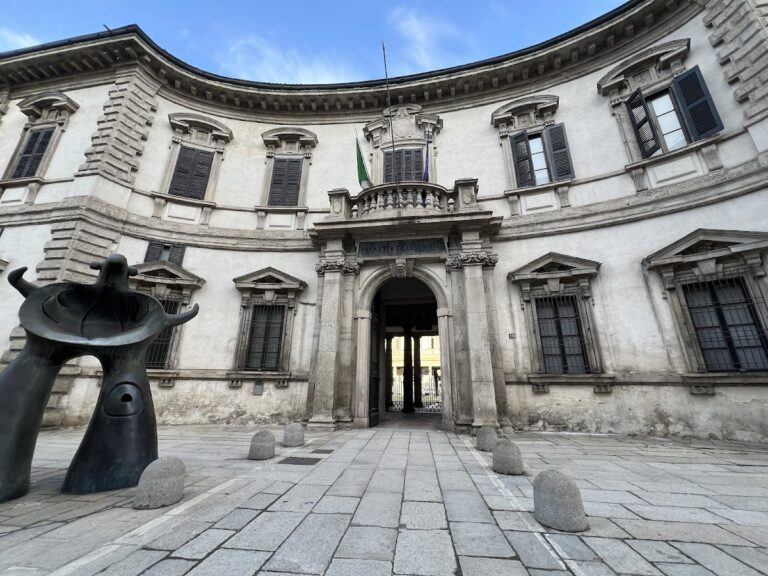
The palace presents an eighteenth-century street façade regarded as an important example of Lombard baroque. Its two decorated storeys are articulated by friezes and stucco surrounds. A stone portal supports a balcony with richly ornamented balusters, giving the entrance a strongly formal character.
Facing the garden, the façade adopts a neoclassical design. The ground floor is rusticated, with masonry treated to create a heavy, block-like appearance, while the central section rises to a monumental tympanum, the framed upper part of a classical façade. The 1939 extension designed by Giovanni Muzio projects toward Via Vivaio and forms part of the building’s later physical development.
Inside, the courtyard is arranged as a square portico with four sides. Granite columns of the Doric order, a classical form known for relatively plain columns and capitals, support round arches. The vaults originally carried Renaissance fresco decoration, and part of this painted work re-emerged during the restoration and alterations of 1939.
Painted Rooms and Sculpture
The Sala degli affreschi contains works by Morazzone, the customary name of the Italian painter Pier Francesco Mazzucchelli, who was especially known for religious and fresco painting. The Sala Giunta, a room used by an executive council or governing board, contains Giambattista Tiepolo’s fresco The Apotheosis of Angelo della Vecchia under the Sign of the Virtues. Tiepolo was an eighteenth-century Venetian painter and frescoist.
Another room contains Francesco Hayez’s Episode of the Visconti. Hayez was a major nineteenth-century Italian painter associated with Romanticism. The palace’s interior also includes sculptures by Ivo Soli, who lived from 1898 to 1976, adding works from a later period to rooms shaped by the building’s earlier aristocratic history.
Nearby sites