Château Suduiraut: A Sauternes Premier Cru Classé Wine Estate in France


Site at a Glance
- Rating
- 4.8
- Popularity
- Low
- Country
- France
- Primary era
- Early Modern
- External website
- Open
- Eras represented
- Early Modern
- Civilizations
- French
- Site type
- Domestic
- Remains
- Castle
On this page8 sections
History
Château Suduiraut is a French château and wine estate in Preignac, France, within the Sauternes appellation and the Bordeaux wine region. Its residence was rebuilt between approximately 1665 and 1675 after the earlier manor was destroyed, and the estate later became a Sauternes Premier Cru Classé, a high-ranking category in Bordeaux wine classification. The property extends across almost 200 hectares, including 92 hectares of vineyards, near Château d’Yquem.
From the Allard estate to the Suduiraut family
The property belonged to the d’Allard family until the sixteenth century and was then known as the Domaine d’Allard. Around 1580, Nicole d’Allard married Léonard de Suduiraut. He became a councillor of the Parlement of Bordeaux in 1581, and the property passed into the Suduiraut family.
During the Fronde, a series of civil disturbances and rebellions in France from 1648 to 1653, conflict involving Bernard de Nogaret de La Valette d’Épernon led to the former manor being plundered and burned in 1648 or 1649. Blaise de Suduiraut, the grandson of Léonard de Suduiraut, rebuilt the residence between about 1665 and 1675.
The Duroy and Guillot periods
After Blaise de Suduiraut died, the estate passed through his daughter Marie-Anne to her nephew Joseph du Roy, whose name also appears as Duroy or Duroi. Joseph renamed it Ancien Cru du Roy. After Joseph and his son Jean died, the property passed to Louis-Guillaume du Roy. His widow later left it to the Bordeaux merchant Nicolas-Edme Guillot, who adopted the name Guillot de Suduiraut.
Nicolas-Edme Guillot greatly expanded the estate and bought the neighboring Castelnau property in 1831. This acquisition is recalled by the name of the second wine, Castelnau de Suduiraut. The estate was inherited by Guillot’s sons and was classified as a Premier Cru Classé in the Bordeaux Wine Official Classification of 1855. In that classification, estates producing sweet wines in Sauternes and Barsac were ranked separately from the red-wine estates of the Médoc and Graves.
Industrial ownership and vineyard crises
In 1875, the property was sold to the industrialist Henri-Ferdinand Rabourdin. About four years later, he left it to his daughter Lucie, whose husband was Charles Émile Antoine Petit de Forest. The couple managed the estate during the nineteenth-century phylloxera crisis and outbreaks of powdery mildew. Phylloxera, an insect pest that devastated European vineyards, was controlled in part through grafting European vines onto resistant rootstocks. Charles Émile Antoine introduced this method as an early response to the threat. After his death in 1899, Lucie continued to run Château Suduiraut until 1929.
Their daughter Isabelle Petit de Forest and her husband Alfred de Girodon-Pralong then took over the property. Wine quality declined, while sweet wines faced growing competition from dry wines. An unsuccessful attempt to produce dry wine preceded the sale of the estate in 1940 to the textile industrialist Léopold-François Fonquernie.
Restoration and modern ownership
Léopold-François Fonquernie and his cellar master, Pierre Pascaud, invested extensively in the vineyards and cellars and restored the estate’s reputation. After Fonquernie died, his daughters continued to manage the property with Pascaud. He assumed responsibility for daily operations in 1978.
The Fonquernie family sold Château Suduiraut in 1992 to AXA Millésimes, a wine-investment company associated with the AXA insurance group. The château’s period furniture was sold separately at auction. The property was occupied during the Second World War, and its central courtyard and gardens were placed under the protection of the French historic-monuments authorities during that period. A fire affected the château’s left wing in June 2018.
Château Suduiraut is produced as a sweet white wine when the required conditions are met. The Grand Vin was not bottled in 1991, 1992, or 1993 because the results did not meet the estate’s standards. The estate also produces Castelnau de Suduiraut, S de Suduiraut, and Les Lions de Suduiraut. Production of the latter two wines was introduced in 2005 and 2009 respectively, while only Château Suduiraut itself holds Premier Cru Classé status. The property is included in the General Inventory of Cultural Heritage, where it was recorded in 1985.
Remains
Château, courtyard, and gardens
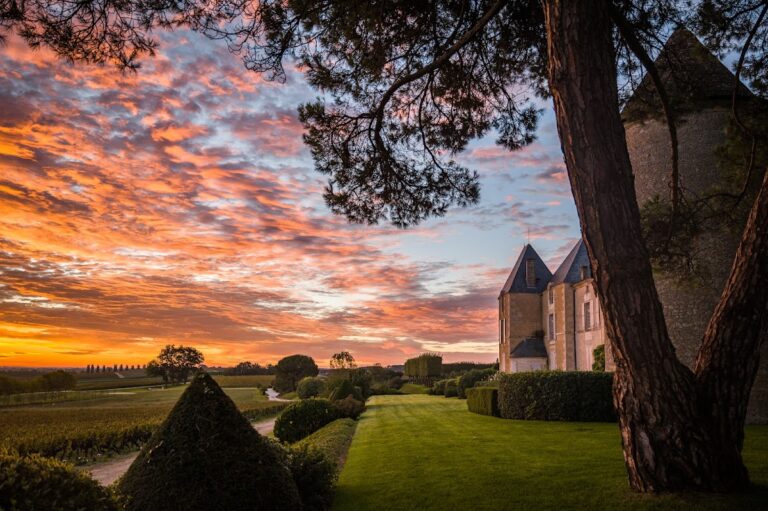
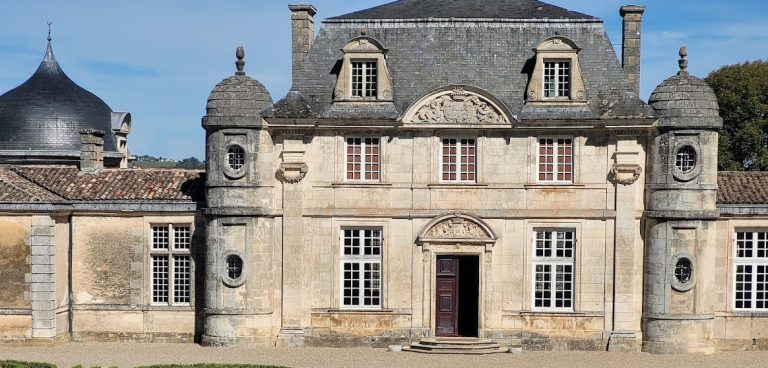
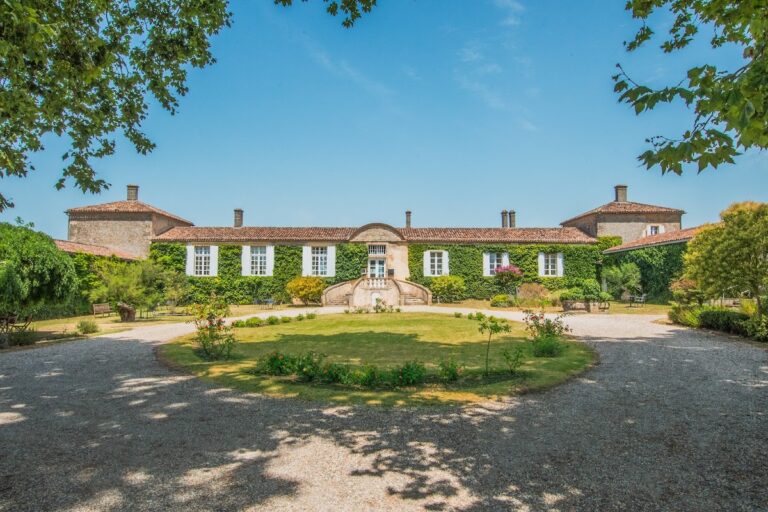
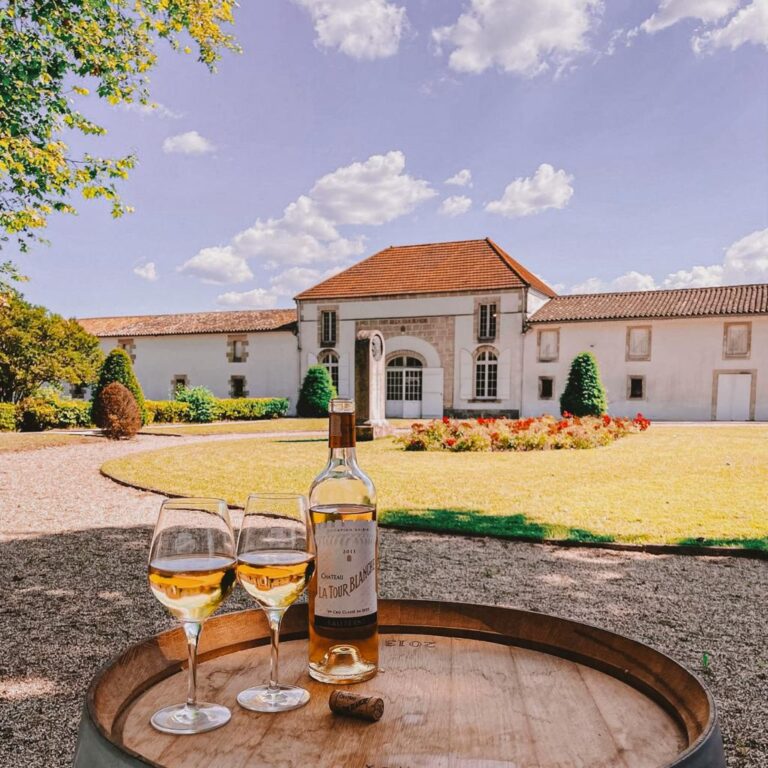
The oldest surviving part of Château Suduiraut forms an irregular quadrilateral around an entrance courtyard. Two round towers and two square pavilions flank the entrance. A long avenue crosses the vineyard, follows a pond formerly used for bathing horses, and reaches the château gates.
The garden-facing facade is simply rendered, with an additional tower at each end. Its openings toward the park have plain surrounds. During the eighteenth century, Joseph du Roy modernized this facade by adding a central pavilion with the wrought or ornamented balcony associated with the château. He also marked the residence with a cartouche combining the arms of the Suduiraut and Duroy families, using ermine motifs for the former and boar’s heads for the latter. These arms also appear on Château Suduiraut wine labels. A nineteenth-century remodeling was probably carried out by one of Nicolas-Edme Guillot’s sons.
The gardens designed by André Le Nôtre form part of a park of approximately 10 hectares within the estate. Le Nôtre was the principal landscape designer of the gardens of Louis XIV, including those at Versailles, and his work is associated with formal French garden planning and axial design. A new cellar commissioned from the engineer Charles Émile Antoine Petit de Forest, who was associated with Gustave Eiffel, was later replaced.
Vineyard and wine production
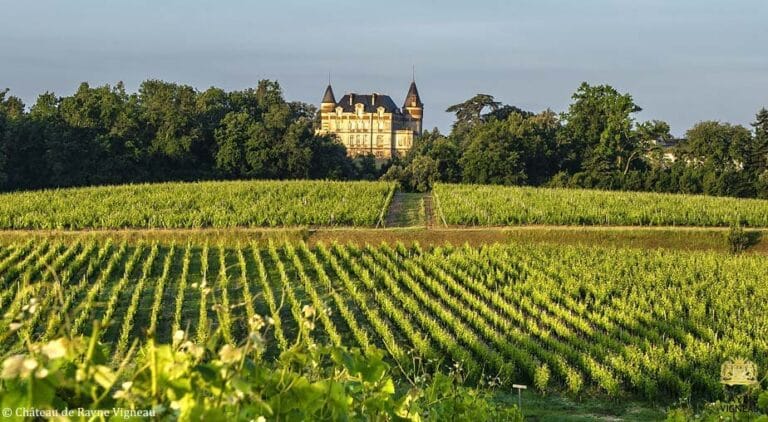
The estate contains approximately 92 hectares of planted vineyard within a domain of almost 200 hectares. The vines average about 25 years of age and are planted at approximately 7,000 vines per hectare. Sandy-clay gravel soils cover most of the vineyard, which is planted with approximately 90 percent Sémillon and 10 percent Sauvignon Blanc. The Grand Vin uses the same proportions.
The vineyard’s autumn microclimate combines warm, sunny afternoons with misty mornings. These conditions encourage Botrytis cinerea, a fungus that produces noble rot and concentrates sugars and acids in ripe grapes. Pickers harvest by hand in several passes, selecting berries affected by noble rot. Grapes for the dry white wine S de Suduiraut come from the first three passes, while the Crème de Tête cuvée uses individually selected berries. This specially selected wine had been produced twice at the period described.
After fermentation to approximately 13 to 14 percent alcohol, the developing wine is transferred to stainless-steel tanks and cooled to 7 degrees Celsius over four to five days. It is then sulphured and matured for 18 to 24 months in barriques, small oak barrels traditionally holding about 225 litres. The Grand Vin produces almost 100,000 bottles in some years, within a broader estate production range of approximately 30,000 to 100,000 bottles annually. S de Suduiraut accounts for about 10 percent of total production.
In 2008, Château Suduiraut joined 16 other Bordeaux estates in a project to propagate their own Sémillon clones in response to shortages of planting material. The vineyard, cellars, château, courtyard, and gardens together preserve the physical setting in which the estate’s successive owners developed its architecture and wine production.
Nearby sites