Schloss Schwarzenfeld: A Historic Castle in Germany


Site at a Glance
- Rating
- 4.2
- Popularity
- Low
- Country
- Germany
- Primary era
- Modern
- External website
- Open
- Eras represented
- Medieval, Early Modern, Modern
- Civilizations
- German, Holy Roman Empire
- Site type
- Domestic
- Remains
- Castle
On this page11 sections
History
Schloss Schwarzenfeld is a historic castle in Schwarzenfeld, Germany, developed by local and noble owners from a medieval fortified residence into a nineteenth-century historicist country house. Schwarzenfeld itself first appears in written records in 1015, when Emperor Henry II donated it to the Diocese of Bamberg, which he had founded in 1007 from territory belonging to the dioceses of Würzburg and Eichstätt.
Medieval beginnings and destruction
Conrad Pullenhofer built and occupied the castle in 1372. In 1389, the Upper Franconian noble family of Plankenfelser acquired it and enlarged the comparatively modest building. During the fifteenth century, the family added four towers. These towers were probably destroyed during the Thirty Years’ War, the European conflict fought from 1618 to 1648 amid religious, dynastic, and political struggles. The castle and the village were devastated, and the towers were not rebuilt.
The Teuffel von Pirkensee family acquired Schwarzenfeld in the 1580s. From 1654, the imperial colonel Peter Pischer and his family held the estate, before the noble von Schneidau family became its lords in 1686. A fire in 1707 destroyed the castle and surrounding buildings. The subsequent rebuilding included the Plankenfelser Schlössl, a new structure raised on the foundations of the older castle.
From noble estate to country residence
By 1717, Schwarzenfeld belonged to the von Wildenau family. In the late eighteenth century, Maria Sara von Wildenau sold it to Max Joseph, Count von Holnstein of Bavaria, who converted the property into a representative country residence. After his death in 1824, the estate passed to his son Karl Theodor von Holnstein. Karl Theodor died in 1857, leaving it to his only son, Maximilian Karl Theodor von Holnstein.
Maximilian von Holnstein lived at the castle from 1857 and held important positions in the Kingdom of Bavaria. He was a member of the Reichsrat, the kingdom’s upper legislative chamber, and a personal confidant of King Ludwig II, the Bavarian monarch from 1864 to 1886. From 1866, Holnstein served as the king’s chief master of the horse. He married Maximiliane von Gumppenberg-Pöttmes in 1867.
Holnstein was regarded as pro-Prussian and took part in preparing the Imperial Letter, through which Ludwig II consented to the establishment of the German Empire in 1871. Between 1890 and 1892, Holnstein commissioned the engineer Julius Hofmann to rebuild and enlarge the castle, its outbuildings, and two towers in the historicist style. Historicism was a nineteenth-century architectural approach that revived and recombined forms from earlier periods. Up to 160 workers were employed, while surrounding buildings were demolished to open the view toward the castle.
After the rebuilding, Holnstein used Schloss Schwarzenfeld as his retirement residence. He became blind in 1893 and died at the castle on 1 February 1895. The property passed to his son Ludwig Karl, Count von Holnstein of Bavaria, and was later occupied by Ludwig Karl’s widow Maximiliane and their descendants. Maximiliane left in 1907, after which the castle was largely unused apart from short-term leases. Financial difficulties led to its leaving the Holnstein family’s ownership in the mid-1930s.
Postwar uses and rebuilding
After the Second World War, the castle accommodated displaced people and refugees for several years. It also served temporarily as school premises and as an old people’s home. Later uses included a dance hall, a sewing workshop, and a riding hall. The market town of Schwarzenfeld acquired the property at auction in 1954, intending to preserve it as a local landmark without altering its exterior. Proposed conversions for the rural police or the Bavarian Red Cross did not succeed, and repeated forced auctions brought further changes of ownership.
In 1979, the castle was converted into a discotheque. During the night of 24–25 June 1982, it burned out completely and remained a building ruin for many years, requiring repeated measures to stabilize its fabric. In 1995, Christine and Hans Dobler of Nabburg purchased the ruins. They completely gutted and renovated the castle, replacing the economic wing through a similar reconstruction, and converted the complex into a conference hotel that opened in 1996. Schloss Schwarzenfeld now functions as a conference center and luxury hotel.
Schloss Schwarzenfeld is protected as an architectural monument and as an archaeological monument because medieval and early-modern evidence survives in the area, including traces of predecessor buildings and earlier construction phases. It is also regarded as the landmark of Schwarzenfeld. A separate Hofmark castle associated with the former Schwarzenfeld hammer works once stood in the town. A Hofmark was a landed jurisdiction generally exercised by a local lord, and that now-vanished castle should not be confused with Schloss Schwarzenfeld.
Remains
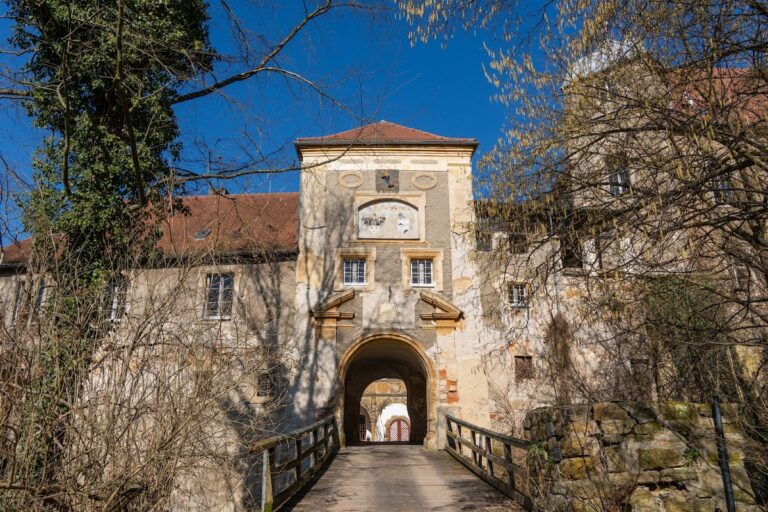
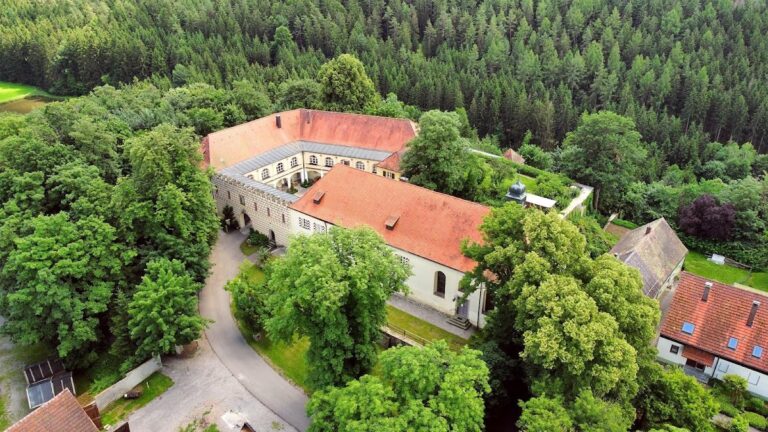
The castle complex stands in Schwarzenfeld in the Schwandorf district of Upper Palatinate, Bavaria, on the Naab, a tributary of the Danube. Its surviving arrangement comprises the main castle building, outbuildings, and two towers incorporated or enlarged during Julius Hofmann’s rebuilding of 1890–1892. Earlier phases remain in the archaeological evidence around the former castle, while the present complex reflects medieval foundations, post-fire reconstruction, nineteenth-century enlargement, and the rebuilding that followed the 1982 fire.
Castle buildings and early fabric
Plankenfelser Schlössl
The Plankenfelser Schlössl was erected after the fire of 1707 on the foundations of the older castle. Its stepped gables followed the architectural style of the period. At the beginning of the nineteenth century, those gables were removed and replaced by a hipped roof, giving the main building its later form. Two small towers with onion domes were also added during this phase.
Historicist complex
Hofmann’s rebuilding between 1890 and 1892 established the castle’s final historicist appearance. The work enlarged the main building with additional structures and two towers, creating the complex that included the castle, its outbuildings, and the enlarged tower elements. Some surrounding buildings were demolished during the project, opening the view toward the castle.
Fire damage and archaeological evidence
Post-1982 reconstruction
The fire of June 1982 left the castle completely burned out. The later renovation involved the complete removal and renewal of the interior. The economic wing was replaced through a similar reconstruction, allowing the damaged complex to be converted into its present conference-hotel use.
Earlier construction phases
Archaeological remains in the area of the former castle preserve evidence from medieval and early-modern phases. They include traces of predecessor buildings and earlier construction phases, linking the present complex to the castle established by Conrad Pullenhofer and enlarged by the Plankenfelser family.
Nearby sites