Gochsheim Castle: A Renaissance Residence in Kraichtal, Germany


Site at a Glance
- Rating
- 4.4
- Popularity
- Low
- Country
- Germany
- Primary era
- Early Modern
- External website
- Open
- Eras represented
- Medieval, Early Modern, Modern
- Civilizations
- Holy Roman Empire
- Site type
- Domestic
- Remains
- Castle
On this page8 sections
History
Gochsheim Castle is a Renaissance castle in Kraichtal, Germany, developed on the site of a medieval stronghold and completed in 1580. The complex was one of the principal residences of the Counts of Eberstein, a comital dynasty whose estates included Gochsheim.
Medieval origins
Gochsheim grew around the medieval castle, which was held by the Counts of Eberstein under changing overlords. In 1278, the settlement was described as an oppidum, a medieval Latin term for a town or urban community. The castle therefore stood at the center of a settlement that had already acquired recognized urban status.
The Eberstein Renaissance castle
From 1520, the Counts of Eberstein commissioned a new castle. The Renaissance complex, incorporating architectural forms associated with the cultural period that followed the Middle Ages, consisted of a smaller Front Castle and a larger Rear Castle. It had been completed by 1580.
After Casimir of Eberstein died in 1660 without male heirs, the inheritance passed through his daughter, Albertina Sophie Ester. Her marriage to Friedrich-August of Württemberg-Neuenstadt on 9 February 1679 transferred the property to Württemberg, a ruling dynasty and territorial state. The couple had the castle renovated and used it as a residence from 1682.
War damage and ducal ownership
French forces damaged the castle during the devastation of Gochsheim in 1689, in the War of the Palatine Succession, a conflict between France and a coalition of European powers. Friedrich-August withdrew to Neuenstadt during the campaign. After the war, the castle was reconstructed and again served as a ducal residence.
Friedrich-August died in 1716. Following Albertina Sophie Ester’s death in 1728, Gochsheim returned to the main Württemberg ducal line. A town fire caused further damage in 1739.
Demolition, municipal ownership, and museum use
In 1828 and 1829, the larger Rear Castle was demolished. The surviving Front Castle passed to the town and was temporarily used as a school. After a new school had been built, the remaining castle was remodeled into its present form in 1905.
The partially preserved complex has been owned by the municipality since the nineteenth century. It now houses the Museum of the City of Kraichtal and the Kraichgau Library in Gochsheim. The museum holds around 100 works by the Karlsruhe artist Karl Hubbuch, who died in 1979. Its upper floor contains Heinrich Sommer’s collection of about 1,300 irons, described as the world’s largest exhibition of irons, together with works by the theologian, folklorist, and artist Carl Krieger and reed-pen drawings by Margarethe Krieger. Cooper’s and blacksmith’s workshops are also part of the museum.
Remains
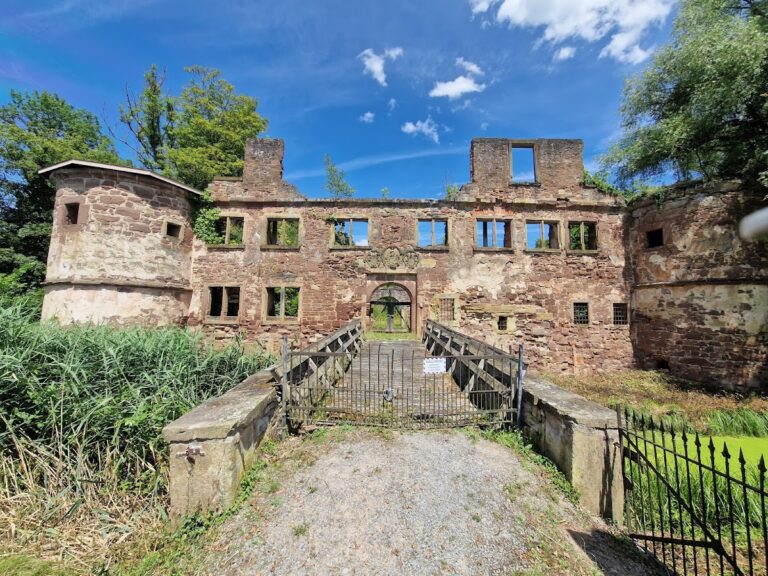
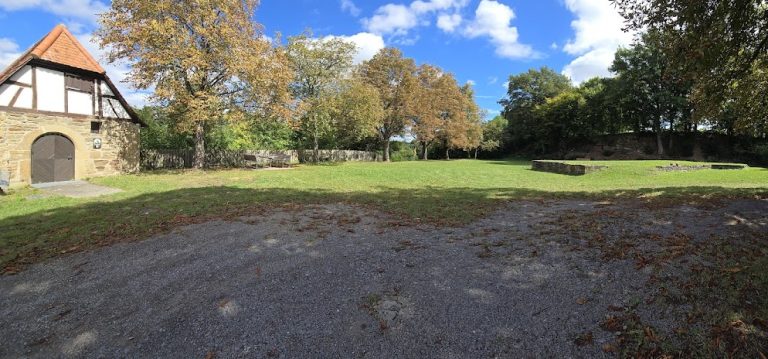
Gochsheim Castle stands on a hill west of and above the Kraichbach. The Renaissance complex was arranged as a smaller Front Castle and a larger Rear Castle, with a manorial wine press behind the palace grounds on the site now occupied by the school. The Rear Castle was demolished in the nineteenth century, leaving the Front Castle as the principal surviving part of the complex.
Front Castle
The surviving Front Castle retains several sixteenth-century elements from the Renaissance rebuilding. These include the stair tower, the main portal, and a stucco ceiling in the tower room. An alliance coat of arms above the portal combines the heraldic arms of Württemberg and Eberstein. It also bears the initials of Friedrich-August, Duke of Württemberg, and Albertina Sophie Ester, Duchess of Württemberg and Countess of Eberstein.
Courtyard service building
A building in the castle courtyard served as a service structure containing horse stables and a carriage shed. Its south side has visible rusticated masonry, and this fabric is probably the only surviving remnant of the medieval castle. The building forms part of the preserved architectural group alongside the Front Castle.
Nearby sites