Wasserschloss Menzingen: A Renaissance Water Castle in Germany


Site at a Glance
- Rating
- 4.2
- Popularity
- Very Low
- Country
- Germany
- Primary era
- Early Modern
- Eras represented
- Medieval, Early Modern
- Civilizations
- Holy Roman Empire
- Site type
- Military
- Remains
- Castle
On this page9 sections
History
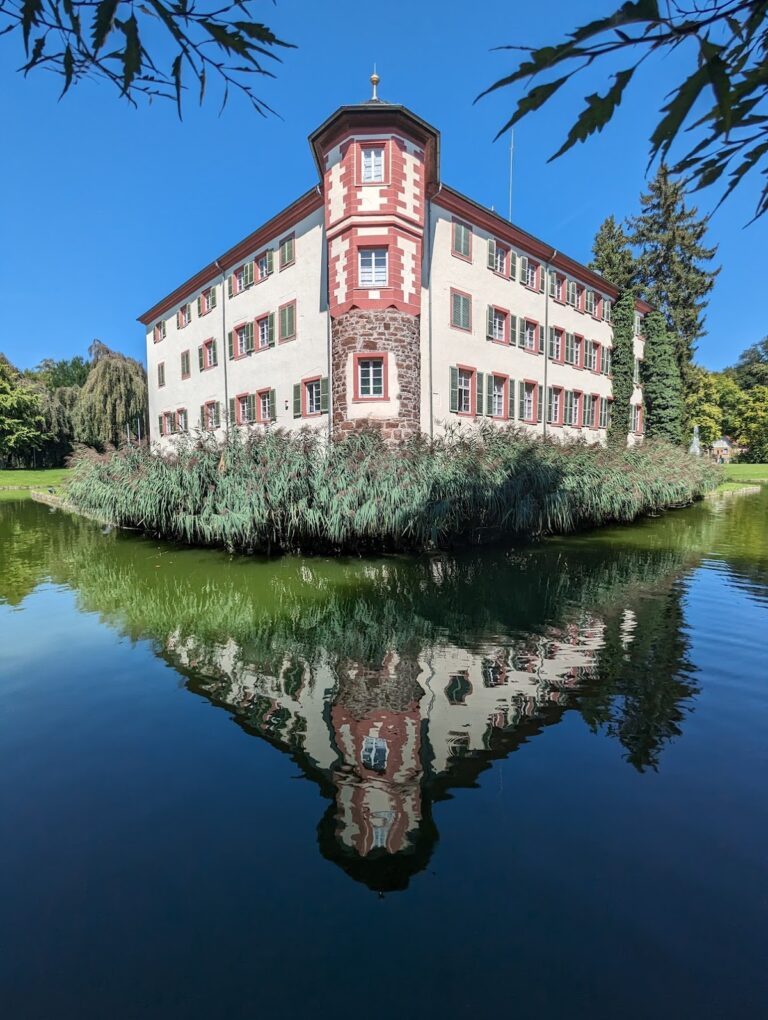
Wasserschloss Menzingen is a Renaissance-period water castle in Germany, located in Menzingen, now a district of Kraichtal in Karlsruhe District, Baden-Württemberg. The present complex was built between 1529 and 1539, while the site itself already existed in the Middle Ages. Its rebuilt form belongs to the Renaissance, a European period that revived classical forms and favored ordered plans, symmetry, and ornament.
Medieval origins
Two castles were recorded at Menzingen in 1359. They are generally understood as predecessors of Wasserschloss Menzingen and the nearby Schwanenburg. In this interpretation, the water castle developed from the former low-lying castle, a fortified residence built on relatively level ground rather than on a prominent hill. The early construction and appearance of these buildings are not known, although surviving structural features of the ruin provide clues. The Lords of Mentzingen held the complex from the High Middle Ages.
The earlier low-lying castle was destroyed by insurgent peasants during the German Peasants’ War, a series of rural uprisings across the German lands in 1524 and 1525. This destruction preceded the construction of the present castle.
Renaissance rebuilding
Peter von Mentzingen, a member of the Mentzingen nobility, commissioned a new castle between 1529 and 1539. The result was a three-storey complex arranged in three wings. Sections of masonry and architectural elements from the earlier castle were incorporated into the southern and southwestern parts of the new building.
Later alterations and wartime destruction
The Lords of Mentzingen moved their principal residence to Gondelsheim in the seventeenth century. During the early eighteenth century, the brothers Maximilian and Benjamin von Mentzingen carried out further work, including the installation of a heraldic stone above the main portal in 1707. The castle stood uninhabited from 1723 to 1790. Afterward, it was enlarged by an additional storey, its wooden drawbridge was replaced by a permanent stone bridge, and the building was occupied again.
During the Second World War, the castle sheltered relocated clock and coin collections from Heidelberg’s Kurpfälzisches Museum. A fighter-bomber attack destroyed the complex on 2 April 1945, during the final weeks of the war. Excavations in 1947 searched for the buried coin collection. Apart from this work, the ruin remained largely untouched for decades, becoming overgrown with trees and undergrowth while the adjoining agricultural farmyard continued to be used.
Conservation of the ruin
The stone bridge was repaired in 1991, allowing further conservation work to proceed. With the owner’s support, an initiative of the Kraichtal Local History and Museum Association cleared the ruin through years of voluntary rubble removal and forestry work. Later interventions, supported by the state heritage authority, the Baden-Württemberg Monument Foundation, and Dominicus Freiherr von Mentzingen, consolidated the masonry and stabilized the severely endangered northeast tower. Flooding had undermined the tower’s base. The first phase of this work was completed in spring 2002.
Remains
Castle layout and surviving masonry
The ruin stands at the northern edge of Menzingen. The principal building was a three-storey, three-wing Renaissance complex constructed between 1529 and 1539. After the destruction of 1945, rubble heaps as high as four metres covered much of the site, with only sections of the foundation walls projecting above them. Masonry and architectural elements belonging to the older castle survive particularly in the southern and southwestern areas, linking the Renaissance structure to the earlier stages of the complex.
Main portal and bridge
The main portal carries a richly carved heraldic stone dated 1707. Its central panel bears the arms of the Barons of Mentzingen, with a raven on the shield and a swan as the crest. The arms of Maximilian von Mentzingen’s wife, Margaretha Elisabeth Schaffelitzki von Muckadell, appear on the left, while those of Benjamin von Mentzingen’s wife, Sophia Charlotte Klenke von Renckhausen, appear on the right. The panel therefore records both the Mentzingen family and the marriages of the two brothers. The former wooden drawbridge was replaced by a fixed stone bridge after 1790. The bridge was partly destroyed in 1945 and repaired in 1991.
Tower and adjoining farmyard
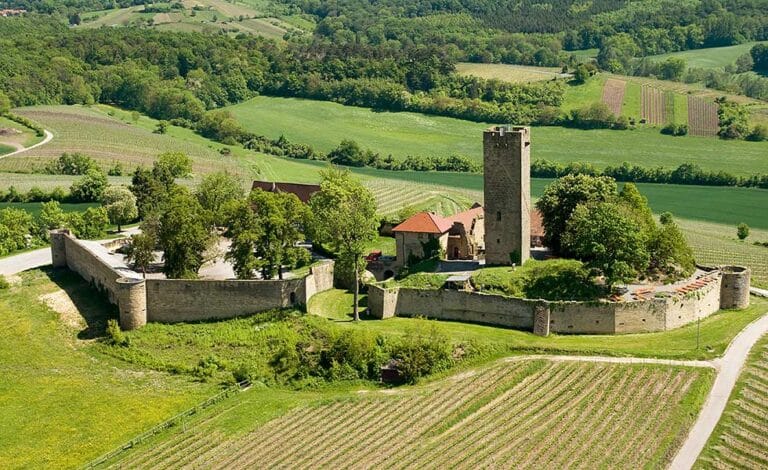
The northeast tower survives in a stabilized form after conservation addressed severe instability caused by flooding and consolidated the remaining masonry. The adjoining farmyard contains a large historic stable building, one of the surviving structures associated with the castle complex.
Nearby sites