Schloss Wildenfels: A Fortified Castle and Cultural Residence in Germany


Site at a Glance
- Rating
- 4.5
- Popularity
- Low
- Country
- Germany
- Primary era
- Early Modern
- External website
- Open
- Eras represented
- Medieval, Early Modern
- Civilizations
- Holy Roman Empire
- Site type
- Military
- Remains
- Castle
On this page11 sections
History
Schloss Wildenfels is a fortified castle complex in Wildenfels, Germany, begun by the Lords of Wildenfels before 1200. It became the seat of their lordship, which they held as a fief from the imperial County of Hartenstein.
Medieval Lordship
The site appears in medieval records through references to Jutta de Wildenvels in 1226 and to urbani de Wildenfels in a charter of 1233. The castle and its surrounding territory formed the political center of the Lordship of Wildenfels.
In 1440, the lordship separated from the County of Hartenstein. It then remained until 1706 a small but autonomous imperial after-fief, meaning a territory received through an earlier feudal relationship but ultimately held from the Holy Roman Empire. Its lands included the town of Wildenfels, two villages, and parts of six other villages.
Solms-Wildenfels Residence
The original Wildenfels noble line ended with the death of Anarg Friedrich von Wildenfels in 1602. The lordship, its possessions, and its rights passed to the Counts of Solms, and the castle remained with the Counts of Solms-Wildenfels until 1945.
During the rule of Friedrich Magnus I and his wife Caroline Sophie von Leiningen-Hartenburg, the small residence was remodeled along with its castle park and interiors. The couple invited poets, intellectuals, and painters to Wildenfels, giving the residence a cultural role within the region.
Friedrich Magnus I’s commitment to humanism, an intellectual movement centered on classical learning and human capacities, also shaped the household’s outlook. In 1776 he founded the Freemason lodge Zum goldenen Apfel. Freemasonry is a fraternal movement organized through lodges and expressed through symbolic ceremonies and moral teachings. His sons continued the family’s cultural interests.
State Ownership and Conservation
In 1945, Schloss Wildenfels was expropriated and transferred to state ownership. Parts of the complex were subsequently adapted for rented housing. The castle area received protection as an archaeological monument and castle site on 18 January 1971, safeguarding a place that includes surface and buried remains of past human activity.
Fundamental repairs have been undertaken since 1990. The nonprofit Friends of Schloss Wildenfels association, founded in 1998, supports the restoration of the historic interiors and furnishings. Work on the eighteenth-century wall coverings, particularly those in the Blue Salon and Chinese Cabinet, has proceeded gradually.
Remains
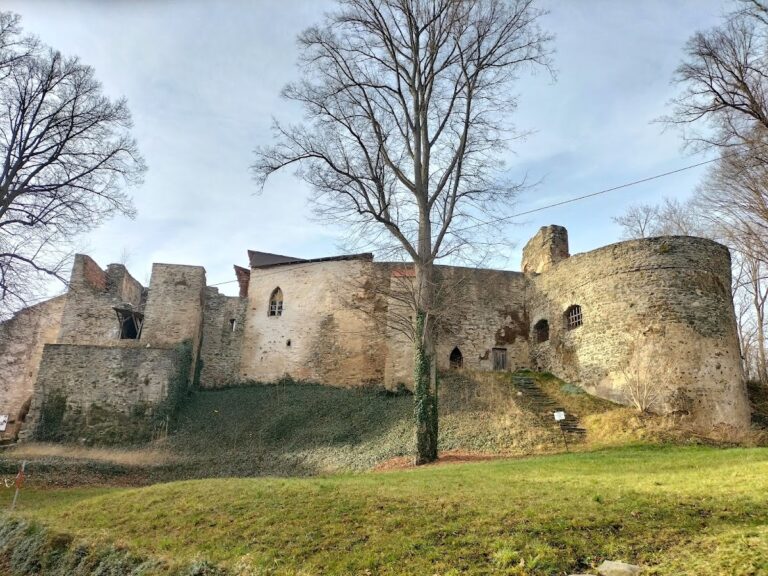
Schloss Wildenfels stands in the center of Wildenfels on a west-facing hill spur between the Zschocken-Wildenfels-Schönauer Bach and a tributary. The oldest part occupies the western end of the spur. Later buildings, erected largely during the Renaissance, make up most of the present castle complex, which includes two courtyards and a castle park.
Castle Layout
Western Residential Building
The oldest building was originally the palas, the principal residential and representative building of a medieval castle. It was later converted into a granary, preserving the building’s place within the changing history of the complex.
Renaissance Complex
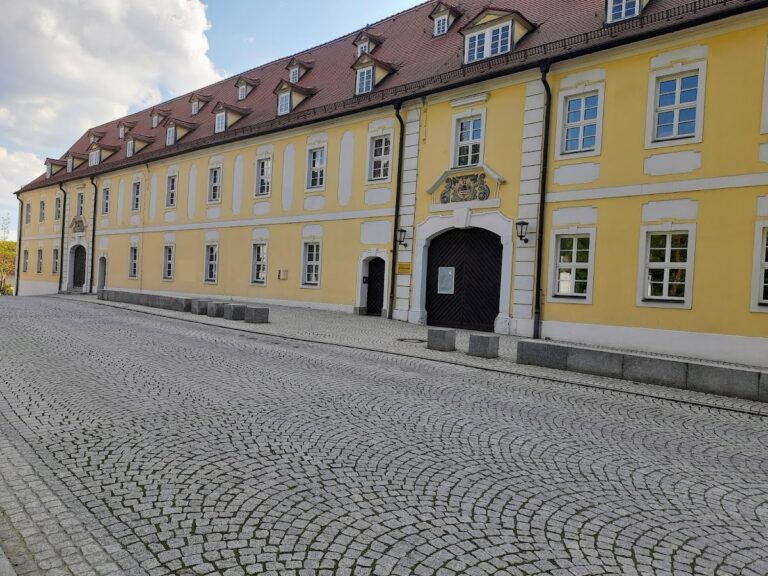
The later castle buildings include a chapel, a principal residential building, service buildings, and other ancillary parts. Economic, residential, and administrative buildings stand in front of the main castle complex, while the front and rear courtyards organize the built area in relation to the castle park.
Interiors and Continuing Uses
Historic Wall Coverings
The former comital living quarters contain eighteenth-century paper and silk wallpapers. Particularly notable silk wall coverings survive in the Blue Salon and the Chinese Cabinet. Once widespread, such coverings are now extremely rare, and their gradual restoration forms an important part of the conservation of the interiors.
Contemporary Functions
The historic complex continues to accommodate housing as well as public-event spaces and rentable salons. Parts of Schloss Wildenfels also house a branch of the Clara Wieck District Music School and the Wildenfels municipal library.
Nearby sites